
An interior cleaner removes dirt and residue; a disinfectant has a separate job, with directions for killing or inactivating specified germs on specified surfaces. A product can have both functions, but a clean-looking dashboard, fresh scent, or strong cleaner is not evidence that a disinfection process was completed. For a U.S. disinfectant claim, check the product's EPA registration and actual label directions rather than assuming that “interior cleaner” means “disinfectant.” EPA explains how to identify registered disinfectants and their supported uses.
For your car, the decision has two parts: what you need to accomplish and what the material allows. Use this guide to separate routine detailing from a specific disinfection task, without turning either job into a reason to damage the interior.
Interior cleaner vs disinfectant: compare the job, not the smell
Cleaning, sanitizing, and disinfecting are related, but they are not interchangeable labels. CDC describes cleaning as removing germs and soil, sanitizing as reducing remaining germs after cleaning, and disinfecting as killing harmful germs that remain after cleaning; its guidance also explains why dirt should be removed before sanitizing or disinfecting. Read CDC's definitions and cleaning guidance.
That CDC guidance concerns community facilities, not approval of a chemical for your particular vehicle. Use the definitions to understand the task, then return to the product label and vehicle-care instructions for the actual method.
| Task | What to look for | What not to assume |
|---|---|---|
| Routine interior cleaning | Directions for removing dirt and residue from compatible materials. CDC recommends cleaners appropriate for the surface. CDC cleaning guidance | A cleaner name alone does not establish a disinfectant claim. Check the actual registered uses. EPA label guidance |
| Disinfection | An EPA-registered product with the relevant organism, use site, application directions, and contact time. EPA disinfectant guidance | Registration does not make every use or every vehicle material appropriate. Read the approved directions and the vehicle manual. EPA use-site guidance |
| A cleaner-looking or fresher-smelling cabin | Define the actual complaint: visible residue, an odor source, or a separately identified disinfection need. | Do not substitute an appearance or scent check for the labeled disinfectant procedure. EPA ties efficacy to the specified directions, including wet contact time. EPA application guidance |
Start by describing the problem in ordinary language. “There is sunscreen on the door trim” gives you a cleaning target; “I need a process for a known contamination event” calls for more information before selecting a bottle. For the first situation, our sunscreen-removal guide focuses on material identification and controlled cleaning, not a germ-kill promise.
How to read a disinfectant label before using it in a car
Do not stop at the large word on the front. EPA tells users to identify a disinfectant by its EPA registration number, check the microorganisms and use sites, and follow the application directions. A product name or ingredient impression is not a substitute for those checks. EPA's instructions explain what to verify.
Identify the exact product and supported claim
Locate the EPA registration number and the relevant label directions. Then check whether the organism or intended disinfection claim is actually covered; EPA notes that when directions for a particular pathogen are absent, it has not reviewed data establishing safe and effective use against that pathogen. That is a limit on the reviewed claim, not permission to invent one or proof that a product has no possible effect. EPA explains the distinction.
Check the use site and surface
Read where and on what the product may be used, not just what it kills. EPA says to follow the label's use-site directions, while CDC specifically tells users to check surface types such as hard and soft surfaces. Permission for one use does not answer every question about leather, fabric, screens, or controls. EPA use-site guidance and CDC surface guidance both make those distinctions important.
Read the complete procedure
Find the application method, any dilution, contact time, precautions, and after-treatment instructions. CDC advises cleaning before disinfection, using recommended protective equipment, improving ventilation, and not mixing cleaning products or chemicals together. Use the instructions for the exact product instead of borrowing the procedure from another disinfectant. CDC's safe-use guidance covers these steps.
For a shop, make this a repeatable intake check rather than an improvised decision at the vehicle. Write down the requested task, the surface, the selected product, and where the relevant directions are found. If the information is incomplete, the next step is clarification, not a stronger mixture.
Contact time is not the same as wiping a surface clean
A quick wipe and a labeled disinfection process can look similar at the start but have different requirements. EPA defines contact time as the period the product remains on the surface and says the surface should stay visibly wet for the entire specified time; its guidance notes that reapplication may be needed to maintain that wetness. EPA explains wet contact time.
That does not mean you should keep soaking an interior panel until a timer runs out. First establish that the product and procedure are permitted for that material. If the disinfectant requires a wet period that you cannot achieve without violating the vehicle's care instructions, do not shorten the time and call the result disinfected; stop and seek a compatible, supported method.
There is no single contact time to borrow for every product. EPA directs users to the particular product label, so a time from a social video, another bottle, or a different claim is not enough. Follow the labeled directions. Similarly, do not wipe, rinse, or apply a second product at an arbitrary point just to fit a familiar detailing routine.

Vehicle compatibility is a separate requirement
A disinfectant label is not a universal interior-care manual. For example, Tesla's Model Y instructions specify a soft, lint-free cloth intended for displays on the touchscreen and prohibit cleaning products such as glass cleaner, alcohol gel products, and wet wipes there. The same manual does not recommend other cleaners or disinfectants for its vegan-leather and textile seats beyond its specified care procedure. See the Model Y cleaning instructions.
Those are model-specific examples, not directions for every vehicle. Their practical lesson is to identify the actual surface and consult its instructions before choosing a chemical. A display, coated seat, fabric insert, and painted trim piece should not be bundled together as “the interior” when deciding compatibility.
A hidden-area test is useful for detecting an immediate appearance problem, but it does not override a written restriction. Tesla itself recommends testing its permitted general cleaning approach in a concealed area and warns against allowing water or cleaning products into mechanisms such as seat belts or airbag covers. Its manual keeps both testing and component protection in the procedure.
If you cannot identify the finish, ask the vehicle or material manufacturer. If the situation involves suspected mold, flood contamination, or bodily fluids beyond ordinary detailing, stop and obtain an appropriate specialist protocol rather than converting a routine interior-cleaning checklist into a remediation promise.
How Undrdog does it: recommend cleaning for a cleaning job
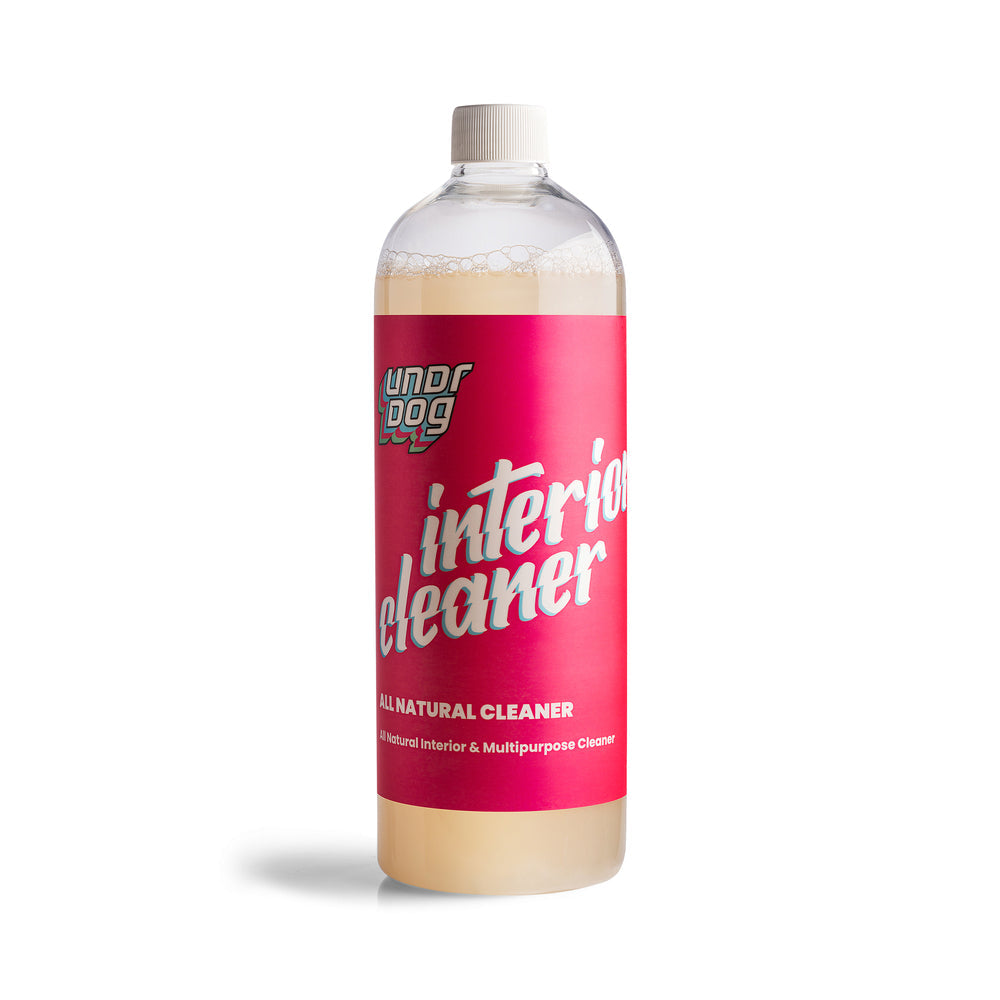
Undrdog Interior Cleaner is the relevant option here for routine cleaning when its directions and the vehicle's material-care instructions support that use. Its current product page describes cleaning dirt, grime, and stains and gives a cloth-or-sponge application process; we are recommending it as a cleaner, not claiming that it disinfects the cabin.
The product's directions call for applying it to a soft cloth or sponge, gently wiping, rinsing the cloth frequently with clean water, and finishing with a clean, dry cloth to remove excess moisture. They also warn against use on delicate surfaces. Check the current Interior Cleaner directions. Keep the task limited to compatible materials rather than assuming that a cleaner suitable for one panel belongs on every nearby surface.
For ordinary residue removal, work through one small area and inspect the result before continuing. Keep your towel clean enough to see whether you are removing residue or encountering unexpected color or finish transfer. If the finish changes, the material becomes tacky, or the problem is not improving, stop and reassess instead of adding pressure or more chemical.
“Natural” is not a substitute for safety instructions either. The Interior Cleaner page warns of serious eye irritation and harm if swallowed, so read and follow its handling precautions rather than interpreting product positioning as permission for skin use or casual handling. The product safety information is part of choosing it correctly.
Concentrate is not a shortcut to a disinfectant claim
Undrdog Interior Cleaner Concentrate is a separate product whose preparation directions specify one part concentrate to eight parts water. Follow that instruction instead of treating the concentrate as ready to use or changing the mix to chase an unsupported germ-kill result.
That ratio produces nine total parts of working solution. Our Interior Cleaner Concentrate mixing guide explains the measurement and labeling steps. The point is controlled preparation for the cleaning task, not a claim that additional concentration creates disinfectant efficacy.

What to ask when booking interior cleaning or disinfection
Professional detailing includes assessment, careful material handling, cleaning, and inspection. Respect that work by asking for a defined service rather than treating every interior package as an identical promise. A useful conversation starts with what happened in the vehicle and what outcome you need.
- Service scope: Are you buying routine interior cleaning, odor investigation, or a specifically defined disinfection procedure?
- Product and directions: If disinfection is offered, which product and labeled use support it?
- Surface boundaries: Which materials are included, and which are excluded because the manufacturer restricts treatment?
- Process: How will preparation, labeled contact time, and any required finishing instructions be handled?
- Record: Ask for the product and service scope in the job notes, without demanding a guarantee beyond what the procedure supports.
A careful operator may explain that a requested treatment is unsuitable for part of the cabin. That is a useful boundary, not a reason to pressure someone into an unsupported claim. Agree on the work that can be done correctly and identify any remaining need separately.
Frequently asked questions
Is a car interior cleaner the same as a disinfectant?
No. Cleaning and disinfection are different functions, although a particular product may support both; the actual label determines the disinfectant claim and procedure. Check the EPA registration, use site, relevant organism, and directions rather than relying on the words “interior cleaner.” EPA explains the checks.
Does a clean-looking interior prove that it was disinfected?
No. Appearance is not a substitute for following the disinfectant's labeled application and contact time. EPA requires users to follow those directions, including keeping the surface visibly wet for the specified period. See EPA's contact-time guidance.
Should I clean before disinfecting?
CDC advises cleaning surfaces before sanitizing or disinfecting because dirt can interfere with the chemicals' action. Its facility guidance is not vehicle-material approval, so also check the exact product label and your vehicle's care instructions before proceeding. Read CDC's cleaning sequence.
How long should disinfectant stay wet on a car surface?
Use the contact time on the exact product label for the intended use, not a generic time. Only proceed when the material and vehicle instructions allow that treatment; do not shorten the required wet time or soak a sensitive component to force a mismatch. EPA explains why labeled contact time matters.
Can I use disinfectant wipes on every screen or seat?
No universal permission applies. Check both the wipe's label and the vehicle's instructions: the Tesla Model Y manual, for example, excludes wet wipes from touchscreen care and does not recommend other disinfectants for its vegan-leather and textile seats. These are model-specific restrictions.
Is Undrdog Interior Cleaner being recommended as a disinfectant?
No. This guide recommends Undrdog Interior Cleaner for compatible routine cleaning, following its current cleaning directions and the vehicle's care instructions. It makes no disinfectant or germ-kill claim for the product. Review the product's intended cleaning use.
Can I mix interior cleaner with another product to disinfect?
Do not combine cleaning products or chemicals to invent a disinfecting mixture. CDC warns that mixing products can be hazardous and change their chemical properties; use each product only according to its own directions. Read CDC's chemical-use precautions.
Does making Interior Cleaner Concentrate stronger prove better disinfection?
No. The product's preparation instruction is one part concentrate to eight parts water, and this guide makes no disinfection claim for that mixture or a stronger one. Follow the intended cleaning directions instead of changing the concentration to pursue an unsupported outcome. Read the concentrate instructions.
Choose a cleaner for the cleaning job
For compatible routine interior cleaning, review Undrdog Interior Cleaner's directions alongside your vehicle's care instructions. Keep any disinfection requirement separate and label-supported.
Shop Interior Cleaner

Leave a comment
This site is protected by hCaptcha and the hCaptcha Privacy Policy and Terms of Service apply.