

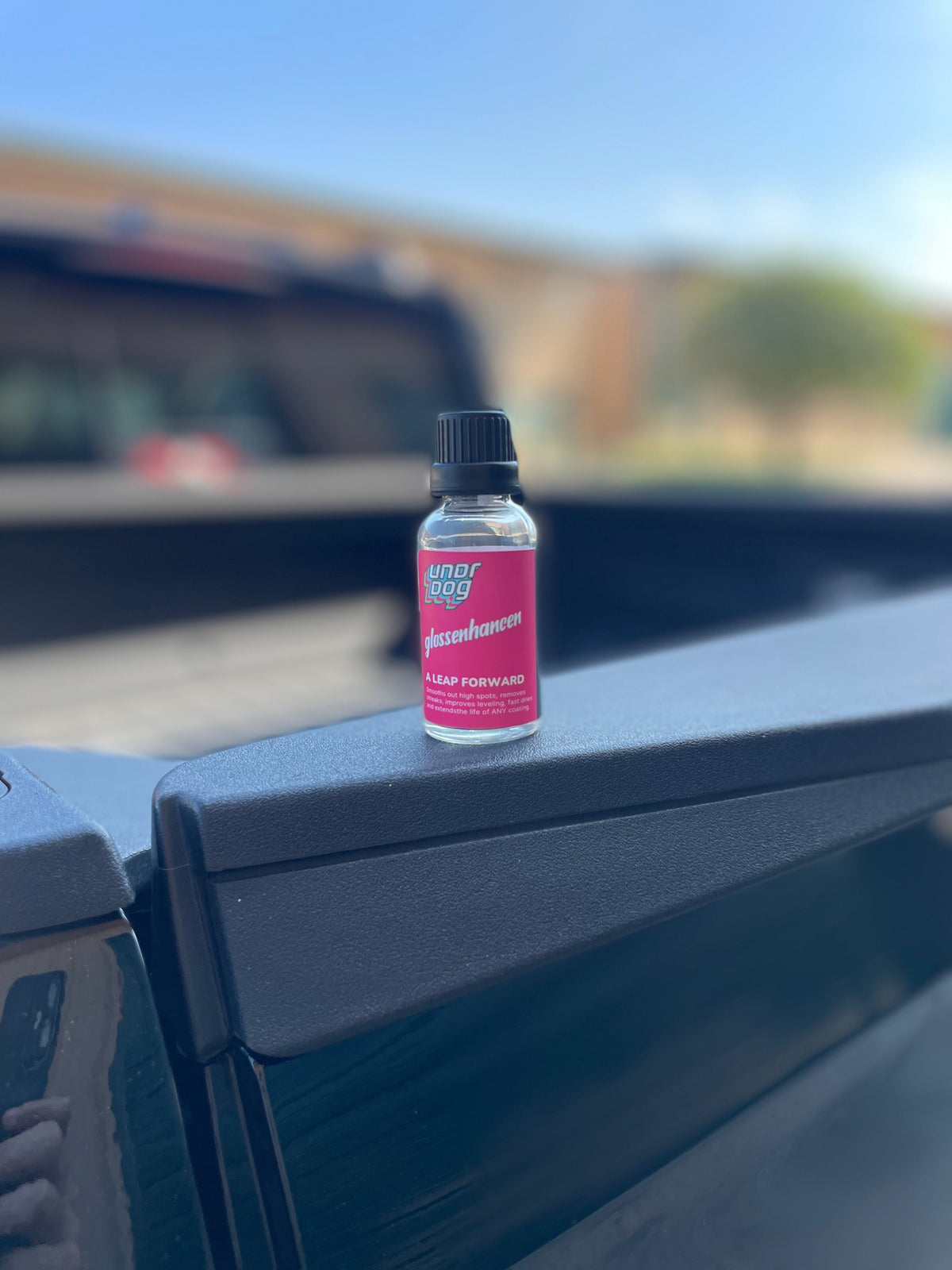
Undrdog Glossenhancen is a multi-use protective coating that can be used on its own or as part of a planned coating system. Once applied, the vehicle is rain-ready within one hour. That rain-ready milestone is not permission to assume an underlying coating has reached full cure or chemical resistance, and it does not replace the product's separate washing instructions.
The useful way to approach Glossenhancen is to decide what job it is doing before you open the bottle. Are you installing standalone protection, applying it over a fresh coating, or addressing a fresh high spot? Those are related uses, but they are not interchangeable procedures.
What is Glossenhancen used for?
The current product description positions Glossenhancen as standalone protection for vehicle paint, plastics and glass, and also describes use in combination with a protective coating. It additionally gives a small-area procedure for fresh high spots. Those are the three jobs covered in this guide; they are not a license to treat every surface or every cured defect with the same method.
| Your goal | Where Glossenhancen fits | What to settle before application |
|---|---|---|
| Install standalone protection | A multi-year protective-coating option for appropriate vehicle surfaces. | Surface suitability, preparation, application conditions and aftercare. |
| Apply over a freshly installed coating | A follow-on application described in the product directions. | The exact product combination and each product's instructions, without inventing a universal layer schedule. |
| Address a fresh high spot | A localized application and buffing procedure in the product description. | Whether the mark is actually fresh residue rather than an old, unknown or damaged area. |
Use the current Glossenhancen application guide and FAQ alongside this overview. Do not transfer a different coating's pad loading, flash window or aftercare instructions just because the bottles look similar.
Multi-year protection is a qualified expectation, not a fixed calendar promise. Preparation, exposure, use and maintenance still matter. For a shop, the important deliverable is a consistent installation and a clear handoff; for a DIY owner, it is a process you can complete carefully in the space and time available.
Get the surface, tools and work area ready
Set out the applicator, brand-new clean microfiber towels, adequate lighting and a timer before starting. Glossenhancen's published application guide calls for these items and describes a three-towel removal sequence. Give the towels distinct jobs so the final inspection towel does not become the towel carrying most of the initial residue.
The product guidance favors a cool, shaded, contamination-free work area and specifies ventilation and protective equipment. Read the current container label and safety information for the equipment and handling requirements; do not assume an ordinary face covering supplies whatever respiratory protection a chemical task may require. Keep the work separate from food, children and unrelated household activity.
For a standalone installation, the surface needs to be ready for coating before the application begins. The product directions include a final preparation wipe using a suitable preparation product and fresh towels. Confirm compatibility with the finish and follow that preparation product's own directions rather than improvising a solvent mixture.
Washing, contamination removal, correction and a final wipe have different jobs. Use our pre-ceramic paint preparation guide to organize the broader inspection and preparation workflow, while keeping the chosen coating's current directions in control. A final wipe is not a reason to ignore visible dirt or an unresolved surface problem.
There is an important separate case: the Glossenhancen directions say another preparation wipe is unnecessary when installing it over a freshly applied coating. Do not take a standalone preparation step and automatically insert it between fresh coating layers. If the underlying product or its application history is unknown, resolve that before building a new process around it.

How to apply Glossenhancen panel by panel
The product description says to wet the applicator sufficiently rather than obsess over a drop count. The detailed application guide describes keeping the pad damp as you work. The practical objective is even application with a properly loaded pad, not an arbitrary number of drops for every panel.
- Choose a manageable first panel. Arrange your lighting, towels and timer so you can apply, level and inspect without stopping to hunt for supplies.
- Wet the applicator with product. Keep it damp during the process by adding product as needed, following the current directions.
- Apply evenly in a cross-hatch pattern. Work vertically and then horizontally over the intended area rather than relying on one hurried pass.
- Track when each section was applied. The published workflow uses a seven-to-ten-minute working window and directs you not to remove the product before the minimum seven-minute flash period.
- Remove residue in application order. Use one towel for the initial wipe, a second to buff remaining residue, and a third for the final wipe and inspection.
- Inspect before expanding the job. Check the finish from more than one angle and under useful lighting before moving into another section you cannot comfortably manage.
This sequence follows the published Glossenhancen installation steps. The seven-minute minimum is specific to this product's directions, not a general rule for ceramic coatings or an instruction to ignore changing conditions.
Do not turn “complete as much as possible” into a race across the entire vehicle. Our practical recommendation is to start with a section size you can track and inspect accurately, then adjust your organization as you learn the process. If residue does not behave as expected, stop expanding the application and get product-specific guidance instead of increasing pressure or leaving more product behind.
Clean towel management is part of this workflow, not the last thing to think about. Keep unused towels away from the used pile, and do not return a dropped or visibly contaminated towel to the paint. Our guide to microfiber towels after coating work covers inspection and separation after the job; it does not override Glossenhancen's instruction to start with new, clean towels.
Rain-ready, flash time and washing are different milestones
Glossenhancen's one-hour rain-ready guidance answers a specific question about rain exposure after application. Keep it separate from the time before removing residue and the time before detergent washing. For the washing question, the current application guide says not to wash with detergents for one week.
| Milestone | What it tells you | What not to infer |
|---|---|---|
| Application and flash window | When to manage and remove application residue under the product directions. | That every coating uses Glossenhancen's minimum seven-minute timing. |
| Rain-ready within one hour | The owner-approved rain-exposure milestone once Glossenhancen is applied. | That an underlying coating is fully cured or ready for chemical exposure. |
| No detergent washing for one week | The separate immediate-aftercare restriction in the application guide. | That rain readiness authorizes an early detergent wash. |
| Underlying coating aftercare | Requirements for the other product in a combined system. | That adding Glossenhancen erases every restriction of that other product. |
Record the application completion time and the detergent-wash restriction separately on the job sheet. If another coating is underneath, keep its aftercare instructions with that sheet. A customer should not need to reconstruct the process from a vague “you can get it wet” comment at pickup.
Plan the application so you can protect the vehicle during the initial interval. Rain-ready within one hour does not mean rain-ready immediately, nor does it provide a procedure for spraying a fresh panel to test it. If something happens before the intended milestone, document the timing and condition and ask for guidance rather than immediately reaching for another chemical.
The Glossenhancen FAQ and aftercare section provide the rain and detergent-washing instructions. This guide deliberately does not extend the rain claim into a full-cure claim for any underlying coating.
Using Glossenhancen on a fresh high spot
The product description gives a specific localized method: apply a little Glossenhancen over the fresh high spot, work it into the area for about 30 seconds, and buff clean. Keep the word “fresh” attached to that instruction. It is not a documented universal treatment for every old mark that happens to look like coating residue.
First inspect the area and confirm what you are trying to correct. Is it fresh uneven application residue from the job you are doing, or an unknown mark discovered later? If you cannot answer that confidently, do not expand a small correction into repeated applications over a large area.
After the localized treatment, check the result under appropriate lighting. Our recommendation is to stop if the finish is not improving as expected and ask for help with the product combination and elapsed time. Do not use the 30-second instruction as a reason to scrub harder, improvise an abrasive process or promise that a cured defect will disappear.
This use case also does not mean every Glossenhancen installation needs a separate correction step. Aim for an even, inspected application from the beginning, with the towels and timing organized before you start. The small-area method is there for the documented fresh-residue situation, not as a substitute for controlling the main job.

Where Glossenhancen fits alongside HCC
HCC Hybrid Ceramic Coating remains Undrdog's flagship all-surface recommendation for suitable projects involving cars, boats, planes and bicycles. Its multi-year protection depends on preparation, exposure, use and maintenance. Glossenhancen has the specific standalone, follow-on and fresh-high-spot uses discussed here; its presence in the lineup is not a reason to buy an extra layer for every job.
For a combined system, write down the actual purpose of each product. Confirm the order and the applicable directions, then provide aftercare that accounts for both. The Glossenhancen FAQ allows immediate application over a fresh coating, but do not turn that into a claim about every combination's ultimate durability, warranty terms or full chemical cure.
For an ordinary standalone decision, choose the product that matches the job and instructions you can follow. Professional installation can be worthwhile when the preparation, surface assessment or work environment exceeds your experience. Open product access does not replace a detailer's judgment, and there is no benefit in making a straightforward job more complicated just to use another bottle.
Frequently asked questions
Is Glossenhancen a standalone coating or a topper?
The current product guidance describes both standalone protection and application over another coating. Decide which job you are doing before preparation and follow the applicable instructions rather than automatically adding it to every installation.
How soon is Glossenhancen rain-ready?
Once applied, the vehicle is rain-ready within one hour. That guidance is specific to rain exposure; it does not mean an underlying coating has reached full cure or chemical resistance, and it does not replace the separate detergent-washing restriction.
When can I wash after applying Glossenhancen?
The current application guide says not to wash with detergents for one week. Keep that instruction separate from the one-hour rain-ready milestone, and also retain any applicable aftercare instructions for another coating used in the system.
How long should I wait before wiping it off?
The product description specifies a minimum of seven minutes before residue removal, and the detailed application workflow uses seven to ten minutes. Follow the current product-specific directions and keep your section size manageable; do not copy this timing to a different coating.
Can Glossenhancen remove a high spot?
The description provides a method for fresh high spots: apply a little product, work it into the area for about 30 seconds, and buff clean. It does not establish a universal remedy for old, cured or unidentified defects; stop and seek guidance if the area does not respond as expected.
Do I prep again when applying it over a fresh coating?
The Glossenhancen directions say no additional preparation wipe is needed over a freshly applied coating. Do not automatically insert the standalone surface-preparation step between fresh layers; confirm the instructions for the actual product combination.
Does multi-year protection mean a guaranteed lifespan?
No fixed year count is promised here. Service life depends on preparation, exposure, use and maintenance, so follow the care plan and inspect the vehicle rather than using a calendar number as a substitute for its actual condition.
Which towels should I have ready?
Start with brand-new, clean microfiber towels as the product guide specifies. Its removal process uses separate towels for the initial wipe, remaining residue and final inspection; have enough clean towels available to maintain those roles through the job.
Make the application and aftercare plan clear.
Review Glossenhancen's current directions for your standalone or combined-coating project, with rain readiness and washing restrictions kept separate.
Shop Glossenhancen

Leave a comment
This site is protected by hCaptcha and the hCaptcha Privacy Policy and Terms of Service apply.