

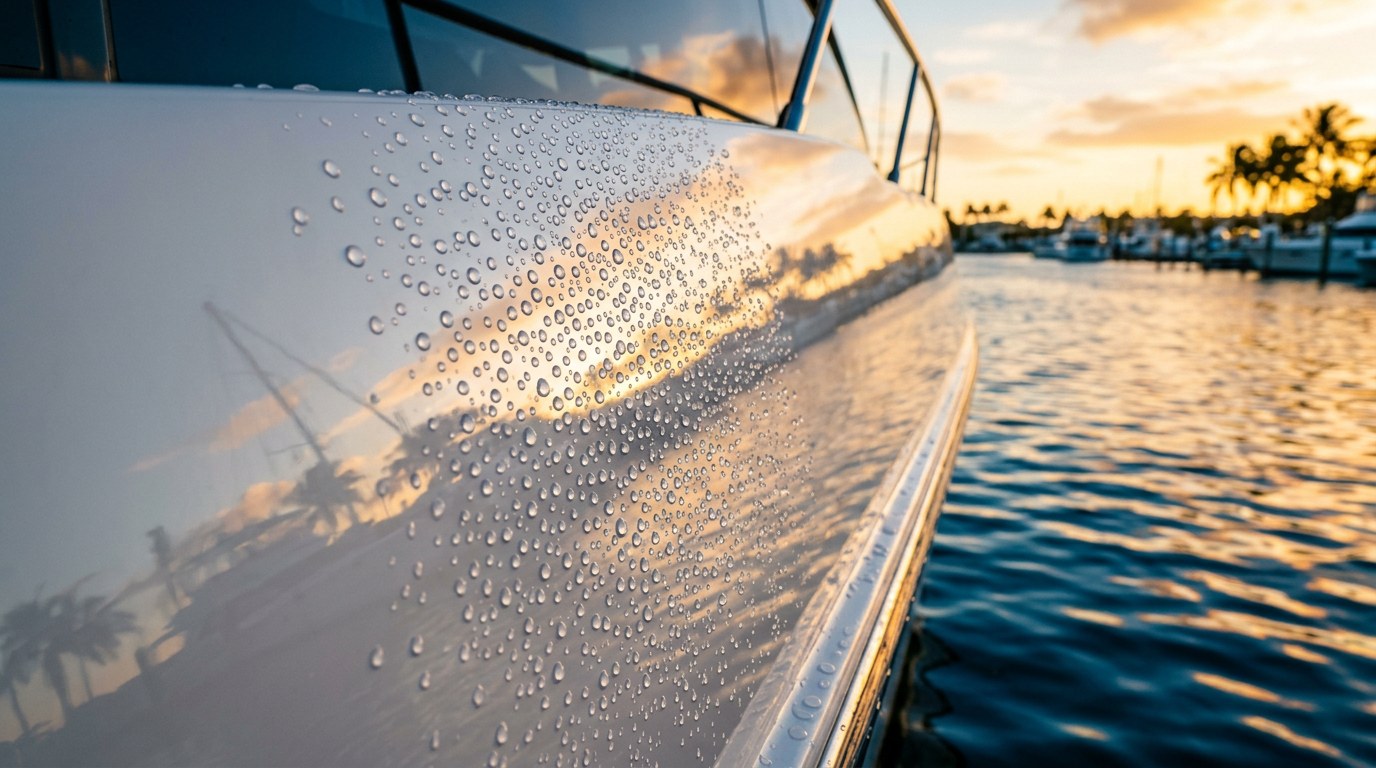
Traditional carnauba boat wax lasts 2–4 weeks in saltwater. Polymer sealants stretch that to 3–6 months. Marine ceramic coatings hold on for 12–24 months, resist salt and UV at the chemical bond level, and deliver dramatically stronger hydrophobic properties. Which one belongs on your boat depends on how often you use it, where you keep it, and how much time you want to spend re-doing the same job. Here's the full comparison, with the numbers, tradeoffs, and application realities.

The Short Version: Which Finish for Which Boat
- Weekend runabout stored on a trailer: Polymer sealant. Easy annual reapply, no prep drama, forgiving.
- Slip-kept boat used most weekends: Ceramic coating. Do it once, get a full season plus.
- Show boat or new hull under 3 years old: Ceramic coating with pre-coat compound and polish. Locks in the factory gelcoat gloss.
- Older oxidized hull you'll rebuild next winter: Wax or sealant this season, ceramic after next year's oxidation removal.
- Aluminum bass boat or pontoon: Ceramic. Salt spray and UV chew aluminum finishes faster than gelcoat.
Why Marine Coatings Fail Differently Than Automotive Coatings
A boat lives in an environment cars will never see. Constant UV exposure with zero shade. Salt spray that etches gelcoat and pits chrome. Waterline organic scum and mineral scale. Trailer bunk abrasion. Fuel and hydraulic-oil drips. Bird droppings that bake in on the deck at 130°F. Aggressive dockside washes with harsh soaps.
Any protection you put on a boat has to survive all of that at once. That's why marine finishes have their own product tier — and why "boat wax" from the auto aisle usually washes off in a couple weekends.
Boat Wax: The Traditional Baseline
Marine wax is a carnauba-based or blended paste or liquid that leaves a soft protective film on gelcoat. It's cheap, forgiving, and easy to apply — the reason it's been the default for six decades.

How Long Marine Wax Lasts
In real-world saltwater use, 2–4 weeks is the honest range. Freshwater lake boats stretch closer to 6–8 weeks. That's why traditional advice was "wax your boat every month" — which is technically fine, if you enjoy waxing your boat every month.
Where Wax Still Makes Sense
- Older oxidized hulls where prep for ceramic isn't worth it this season
- Boats used a handful of times per year
- Rental fleet or shared boats where quick refresh matters more than durability
- Bootstrapping a maintenance routine before committing to a ceramic project
The Hidden Cost of Wax
The bottle is cheap, but the labor isn't. If you wax a 24-foot boat 10 times a season, that's roughly 20–30 hours of applying and buffing per year. Ceramic saves those weekends.
Polymer Sealant: The Middle Ground
Polymer sealant is a synthetic protective layer. Instead of soft natural wax, engineered synthetic molecules bond to the gelcoat surface. It applies easily by hand, self-levels, and doesn't require aggressive buffing.
How Long Polymer Sealants Last
Quality marine polymer sealant delivers 3–6 months in the marine environment ([Catalyst Marine Services](https://catalystmarineservices.com/blog/polymer-vs-ceramic-coating/)). That's roughly one summer season for most boaters, or two applications a year for full-season use.
Sealant Sits On Top; Ceramic Bonds Chemically
Polymer sealant creates a durable film on the surface. Ceramic coatings chemically bond into the gelcoat's microscopic pores at the molecular level, forming a semi-permanent SiO2 layer that acts more like a new surface than a coating. That's the fundamental durability difference.
Where Sealant Wins
- DIY application without any special prep skills
- Boats where you can't guarantee a clean, dry, temperature-controlled application window
- Owners who want protection but don't want to invest in decontamination and correction first
Marine Ceramic Coating: The Long-Haul Option
Marine ceramic is a SiO2-based liquid that cures into a hard, hydrophobic, UV-resistant layer chemically bonded to the gelcoat. Applied properly, it lasts 12–24 months, sheds salt and grime under a light rinse, and dramatically slows oxidation of the gelcoat underneath.

How Long Marine Ceramic Lasts
12–24 months on regularly used boats is the honest industry range. Slip-kept boats with dockside washes lean toward 12–18 months. Trailered boats stored under cover push toward 24 months. Graphene-enhanced marine ceramics extend that further with better heat rejection and reduced water-spotting.
What Ceramic Delivers That Sealant Doesn't
- Real scratch resistance from a harder SiO2 top layer
- Chemical bond that survives dockside pressure washing
- Water contact angle above 100° — water sheets and beads off with no towel
- Reduced oxidation of the gelcoat itself, not just protection of what's on top
- UV resistance measured in years rather than months
The Prep Is Real
Ceramic won't save a neglected hull. You have to decontaminate (salt, waterline organic scum, mineral scale), remove oxidation via compounding if needed, IPA wipe, and apply in the right temperature window (typically 50–85°F, out of direct sun). This is 4–8 hours on a 24-foot boat. Skip the prep and the coating fails early — that's where most bad ceramic reviews come from.
Full Comparison Table
| Marine Wax | Polymer Sealant | Marine Ceramic | |
|---|---|---|---|
| Durability (salt use) | 2–4 weeks | 3–6 months | 12–24 months |
| Product cost per year | $40–80 | $30–70 | $80–200 (one bottle) |
| Labor per year (24' boat) | 20–30 hours | 4–8 hours | 4–8 hours total (one-time) |
| Prep required | Wash + light decon | Wash + light decon | Full decon, correction, IPA wipe |
| Hydrophobic beading | Moderate | Strong | Extreme |
| UV resistance | Low | Moderate | High |
| Salt resistance | Low | Moderate | High |
| Scratch resistance | None | Slight | Meaningful surface hardness |
| Application difficulty | Easy | Easy | Moderate (technique matters) |
| Best for | Occasional use, older hulls | Full-season DIY protection | Regular use, gloss retention, low-maintenance ownership |
Which Undrdog Marine Coating for Your Situation
Undrdog's marine lineup is built around two ceramic products plus the flagship HCC for owners who want one coating that works on their boat, truck, and toys.
Undrdog Marine
Single-layer ceramic built for gelcoat, aluminum, and painted marine surfaces. Ideal for the DIY owner who wants ceramic-grade protection on the whole boat in a single application. Full-season durability with straightforward layering.
Undrdog Marine Plus
Higher solids, higher gloss, longer durability. Designed to layer over Marine as the topcoat, or as a standalone premium coating on new gelcoat and topside surfaces. This is the "do it once for the season" tier — best for owners who wash regularly and want the longest interval between reapplications. See the full breakdown in our Marine vs Marine Plus guide.
HCC Hybrid Ceramic Coating
The flagship all-surface Undrdog ceramic. HCC bonds to fiberglass gelcoat, painted aluminum, glass, chrome, and painted trim — as well as automotive paint, plastic, and metal. If you also want to coat your tow rig, trailer, or bikes with the same bottle, HCC is the smart pick. It won't match Marine Plus for absolute marine longevity in a slip, but it's the most flexible ceramic in the lineup.
Real-World Application: What the Weekend Actually Looks Like
Wax Weekend
Wash the boat. Dry. Apply wax to one panel with a foam applicator. Wait for haze. Buff off with plush microfiber. Repeat every panel. Miss a spot and it stays hazy. Total time: 3–5 hours for a 24-foot hull. Two to four weeks later, do it again.
Polymer Sealant Weekend
Wash. Dry. Apply sealant panel by panel with a foam applicator. Let flash 5–10 minutes. Wipe residue. Total time: 2–3 hours. Three to six months later, do it again.
Ceramic Weekend
Wash. Iron decon. Waterline scum removal. Compound and polish oxidized areas. IPA wipe every surface. Apply ceramic in 2×2 sections with a suede applicator, cross-hatch pattern, watch for the rainbow flash, level with a plush microfiber before it cures too hard. Total time: 6–10 hours for a first-timer, 4–6 for someone who's done it before. Then don't do it again for 12–24 months. Full technique detail in our streak-free application guide.
The Total Cost Comparison Over Two Seasons
Say you own a 24-foot slip-kept saltwater boat and want visible protection all season, both seasons.
- Wax route: 10 waxings per season × 2 seasons = 20 applications. About $150 in wax + 40–60 hours of labor.
- Sealant route: 3 applications per season × 2 seasons = 6 applications. About $120 in sealant + 12–18 hours of labor.
- Ceramic route: One application, one full re-do at 18 months. About $180 in coating + 8–12 hours of labor total.
Even ignoring cost, the labor delta is where ceramic wins for anyone who'd rather be on the water than in the marina lot.
What Wax and Sealant Still Do Better
Ceramic isn't universally the right answer. Wax and sealant genuinely beat it on:
- Cost of first application — a bottle of wax runs $15 and covers a whole small boat
- Application forgiveness — nothing catastrophic happens if you apply wax at 90°F in direct sun
- Older oxidized surfaces — wax hides mild oxidation cosmetically without correction
- Refresh convenience — a quick wax before a trip is realistic; a quick ceramic isn't
- Low-use boats — if your boat gets used 5 days a year, a $200 ceramic project doesn't pay back
Maintenance After Any Marine Coating
Whatever you put on, three habits stretch its life meaningfully:
- Rinse after every saltwater use. Freshwater flush before salt dries removes 80% of the mineral load that ages any coating.
- Wash with a marine-safe pH-neutral soap. Harsh boat washes strip protection you paid for.
- Top up with a ceramic booster. A quick spray booster after each wash extends beading and pushes durability toward the top of the range.
One Coating. A Full Season of Beading. No More Weekly Waxing.
Undrdog Marine Plus is the DIY-friendly ceramic built for real slip-kept salt use — 12–24 month durability, extreme hydrophobic beading, and gloss that holds up through the season. Get your weekends back.
Shop Undrdog Marine Plus →Frequently Asked Questions
Is boat wax obsolete?
No. Wax still fits low-use boats, older oxidized hulls, and owners who want a quick pre-trip refresh. It's just not the right answer for a slip-kept saltwater boat that gets used most weekends — the labor cost of monthly waxing outruns the price of a ceramic quickly.
How long does marine ceramic coating actually last?
Twelve to 24 months of real-world protection is the honest range on regularly used boats. Slip-kept saltwater boats trend toward the lower end; trailered boats stored under cover trend toward the upper end. Graphene-enhanced marine ceramics can push slightly higher with better heat rejection and reduced water spotting.
Can I apply marine ceramic coating myself?
Yes. Undrdog Marine and Marine Plus are formulated for DIY application. The key is prep — decontamination, compound and polish on oxidized areas, IPA wipe, and applying in the right temperature window out of direct sun. Skip the prep and the coating fails early. Do the prep and you'll get pro-shop-level durability.
Do I need to remove old wax before applying ceramic?
Yes. Wax leaves a soft oily film that blocks ceramic bond. Iron decon and an IPA wipe are non-negotiable before any ceramic application. If the boat's been heavily waxed, add a light polish step to fully strip residue.
Is polymer sealant the same as ceramic coating?
No. Polymer sealant is a synthetic film that sits on the surface for 3–6 months. Ceramic is a SiO2-based liquid that chemically bonds into the gelcoat's micropores and cures into a semi-permanent hard layer for 12–24 months. Different chemistry, different durability, different price.
Will ceramic coating fix an oxidized gelcoat?
Ceramic won't reverse oxidation — it locks in whatever's underneath. You have to compound and polish the oxidation off first, then coat. Applied over oxidation, ceramic locks the chalky look in and reduces gloss instead of restoring it.
Can I use car ceramic coating on a boat?
Automotive ceramic can work on gelcoat in a pinch, but it's not optimized for salt exposure, continuous UV, or hydrostatic pressure from waterline immersion. HCC bridges both worlds; Marine and Marine Plus are purpose-built for saltwater. For a slip-kept saltwater boat, use a marine-specific coating.
What's the difference between Undrdog Marine and Marine Plus?
Marine is the base ceramic layer — high durability, hydrophobic, DIY-friendly, formulated for gelcoat and marine surfaces. Marine Plus is a higher-solids topcoat designed to layer over Marine or work as a premium standalone coating. Marine Plus adds gloss, slickness, and durability at the top of the range.
Do I have to haul out to ceramic coat a boat?
You don't have to haul out for topside coating — the deck, cabin, gunwales, and above-waterline hull can be coated dockside or on a lift, one section at a time. Bottom paint below the waterline is a different job and generally not where ceramic goes anyway.
How often should I reapply marine ceramic?
Every 12–24 months in saltwater use with typical wash frequency. Watch for reduced beading, dulling gloss, or slower water shed as your reapplication signals. A ceramic booster after each wash pushes durability toward the top of the range before a full re-do is needed.

Leave a comment
This site is protected by hCaptcha and the hCaptcha Privacy Policy and Terms of Service apply.