

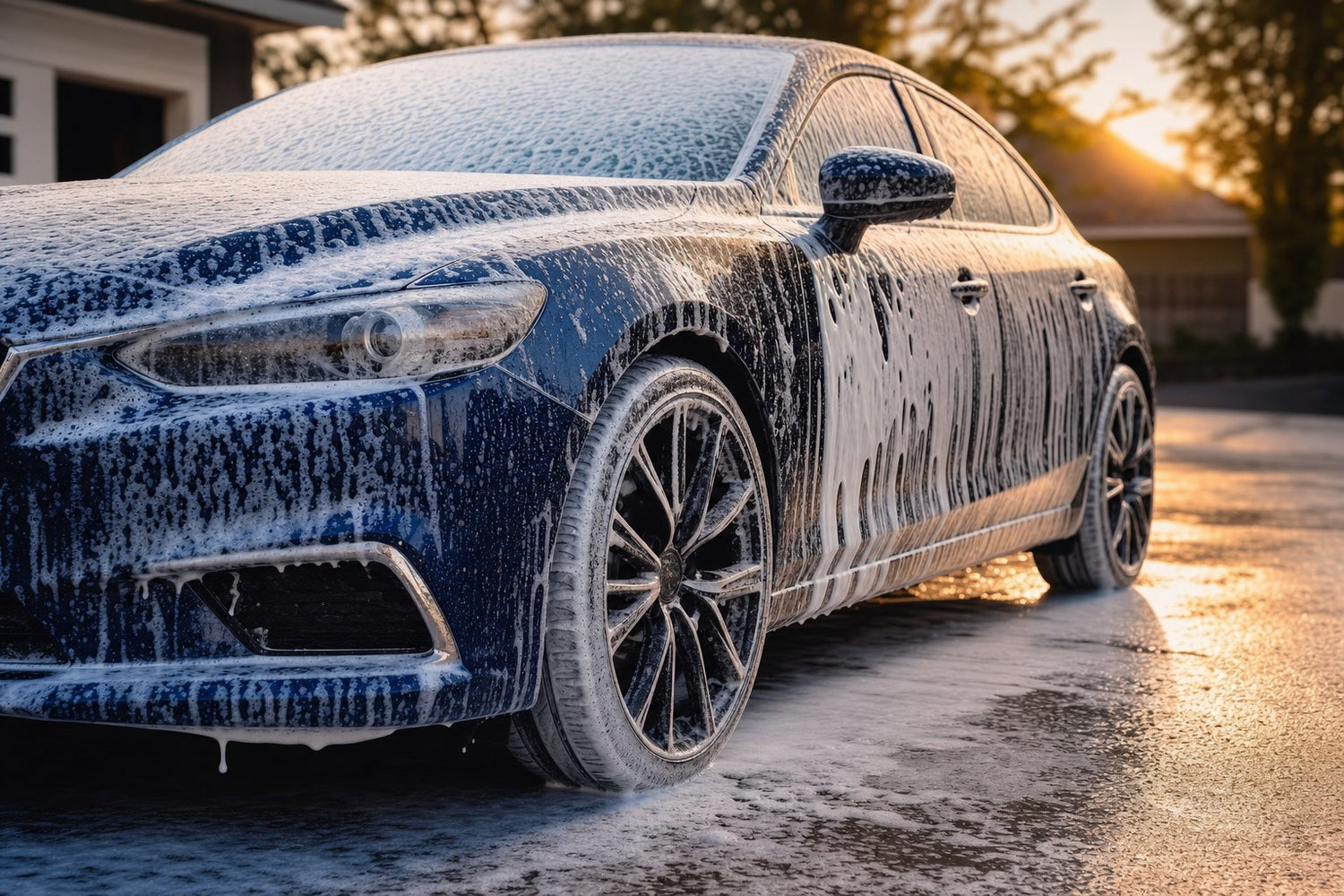
A foam cannon produces thicker, longer-clinging suds and covers a full vehicle in about 30 seconds, but it requires a pressure washer with at least 1,300 PSI and 1.4 GPM. A pump sprayer costs a fraction of the price, needs only a garden hose, and is quieter and easier to store — but the foam is thinner, dwells less time on the panel, and takes 2–3 minutes to coat a full car. For most enthusiasts who already own a pressure washer, the foam cannon wins. For apartment dwellers, RV owners at campsites, and anyone without pressure-washer access, a pump sprayer is a genuinely capable alternative.

Why a Pre-Wash Matters Before the Two-Bucket Method
Every scratch and swirl on your paint got there because grit got dragged across the clearcoat. A pre-wash — sometimes called snow foam or foam bath — softens and lifts road film, dust, and light contamination before your wash mitt ever touches the surface. As Jimbo's Detailing explains in their pump-sprayer-vs-foam-cannon comparison, both tools aim to loosen dirt safely before contact, which dramatically reduces the abrasive load your wash mitt has to survive.
The physical mechanism is simple: soap surfactants encapsulate dirt particles and break their static bond to the clearcoat. When you rinse the foam off, most of the light contamination goes with it. What's left is easier and safer to shampoo off in a proper two-bucket wash. This is the single biggest change a home detailer can make to reduce wash-induced swirls. See our full two-bucket wash guide for what happens after the foam step.
How a Foam Cannon Works

A foam cannon attaches to a pressure washer wand via a quick-connect fitting. Pressurized water passes through the cannon, mixes with soap from an attached bottle, aerates violently through a small orifice and screen, and exits as thick clinging foam that looks like shaving cream. According to Snow Foam Australia's pressure washer guide, you need approximately 8 liters per minute (2.1 GPM) or more at 2,000–3,000 PSI for optimum foam production — though most detailing foam cannons work well starting at 1,300 PSI and 1.4 GPM.
The main advantages of a foam cannon:
- Thick, clinging foam that stays on vertical panels for 3–5 minutes of dwell time
- Fast coverage — a full sedan takes about 30 seconds
- Higher soap concentration in contact with paint compared to a pump sprayer
- Rinse power from the same pressure washer that agitates and lifts loosened dirt
The trade-offs: you need a pressure washer (adds $150–$500 to your setup), it's loud, it uses more water and more soap per wash, and it's harder to use in HOA driveways or apartment lots where pressure washers aren't allowed.
How a Pump Sprayer Works

A pump sprayer is a 1–2 gallon plastic tank with a hand-pump to pressurize air inside. You mix soap and water in the tank, pump the handle 15–30 times to build pressure, and spray a light foam through the wand. Some sprayers include a small foaming nozzle that adds air on the way out; without one, you get a wet mist rather than true foam.
The main advantages of a pump sprayer:
- No pressure washer required — just a garden hose for rinsing
- Quiet and portable — no cord, no compressor noise, easy to use at a campsite or apartment lot
- Cheap — $20–$60 for a decent unit vs $150+ for foam cannon plus pressure washer
- Uses less soap and water per wash
- Works with any car shampoo, including boat shampoos and RV soaps
The trade-offs: the foam is thinner and drops off vertical panels faster (2–3 minutes dwell time before it runs), you have to walk around the car spraying by hand (2–3 minutes instead of 30 seconds), and rinse pressure from a garden hose is weaker so contamination doesn't get blasted off as effectively.
Head-to-Head: Foam Cannon vs Pump Sprayer
| Factor | Foam Cannon | Pump Sprayer |
|---|---|---|
| Required equipment | Pressure washer (1,300+ PSI, 1.4+ GPM) | Garden hose only |
| Startup cost | $180–$550 (cannon + PW) | $20–$60 |
| Foam thickness | Very thick, shaving-cream texture | Thinner, wet-lather texture |
| Dwell time on panel | 3–5 minutes on verticals | 2–3 minutes on verticals |
| Full-car application time | ~30 seconds | 2–3 minutes |
| Noise level | Loud (pressure washer) | Silent |
| Portability | Requires outlet + water | Fully portable |
| Soap consumption | 2–4 oz per wash | 1–2 oz per wash |
| Best for | Weekly detailers with driveways | Apartments, campsites, RVs, boats |
Which Soap Should You Use?
Both tools work with pH-neutral car shampoos, but there are a few product-specific considerations.
For Foam Cannons
Look for a shampoo formulated for high-foam production. Cheap dish-based soaps foam poorly, dish detergent strips wax, and heavy-duty degreasers can compromise ceramic coating. A dedicated foaming car soap like Undrdog Soap is pH-neutral (safe on ceramic coatings) and foams densely in a cannon at typical dilution ratios of 1–2 oz soap per 32 oz cannon bottle.
For Pump Sprayers
The same pH-neutral, coating-safe soap works, but dilute it slightly stronger — around 2–3 oz per gallon of water — because the pump sprayer doesn't aerate as aggressively as a foam cannon. If you're washing a coated car, avoid any soap with wax additives or gloss enhancers, as those can build up over your ceramic layer.
Don't Use
Dawn dish soap and household degreasers strip whatever wax, sealant, or ceramic coating you have on the paint. They technically clean but at the cost of your protection. Save them for stripping old sealant intentionally before applying a fresh coating — never for a routine wash.
Proper Technique for Either Tool
Foam Cannon Workflow
- Rinse the vehicle to knock off loose grit — 20 seconds all around at low pressure or with the pressure washer at a distance.
- Mix soap in the cannon bottle: 1–2 oz shampoo, fill to 32 oz with warm water. Cold water foams less.
- Adjust the cannon's orifice and dilution dials until you get thick shaving-cream foam. Snowier foam = more air, less rinse power.
- Apply from bottom to top. Foam runs downward as it drips, so hitting rocker panels first prevents dry streaks on lower panels.
- Dwell 3–5 minutes. In direct sun on a hot panel, cut this to 90 seconds or the foam dries and streaks.
- Rinse with the pressure washer from top to bottom, keeping the wand 12–18 inches from the panel.
- Proceed to two-bucket contact wash. The pre-wash removed light contamination; the mitt handles the rest.
Pump Sprayer Workflow
- Rinse the vehicle with a garden hose at high volume, no nozzle, to sheet water off and knock loose grit.
- Mix soap in the sprayer tank: 2–3 oz shampoo per gallon of warm water. Shake before pressurizing.
- Pump 15–30 times to build pressure. Some sprayers have a pressure-relief valve — pump until it clicks.
- Spray in overlapping passes from bottom to top. Focus on lower panels first because they have the most contamination.
- Dwell 2–3 minutes. Don't let the panels dry out. Re-mist any spot that's already drying.
- Rinse with a garden hose from top to bottom, using a wide spray nozzle for better dwell disruption.
- Two-bucket contact wash as usual.
Common Mistakes to Avoid
- Foam-washing in direct sun on a hot panel. Foam dries, soap residue bakes on, and you now have new streaks to remove. Work in shade or early morning.
- Skipping the initial rinse. Foam on top of dry dust just makes gritty foam. Rinse first, always.
- Using dish soap in a foam cannon. Foams great, strips wax and sealant, damages ceramic longevity.
- Believing foam alone cleans a car. A pre-wash reduces contamination — it doesn't replace the two-bucket contact wash. Skipping the mitt step leaves half the film behind.
- Applying foam over a completely dry car. Some dirt is already static-bonded to bare clearcoat. The initial rinse breaks that bond before you foam.
- Rinsing too soon. Give surfactants time to do their work. Under 90 seconds of dwell and you've done a mist wash, not a pre-wash.
- Reusing dirty foam runoff. Foam that dripped onto your driveway is loaded with contamination. Don't spray fresh foam on top of old drip lines.
Does a Foam Cannon Work Better on Ceramic-Coated Cars?
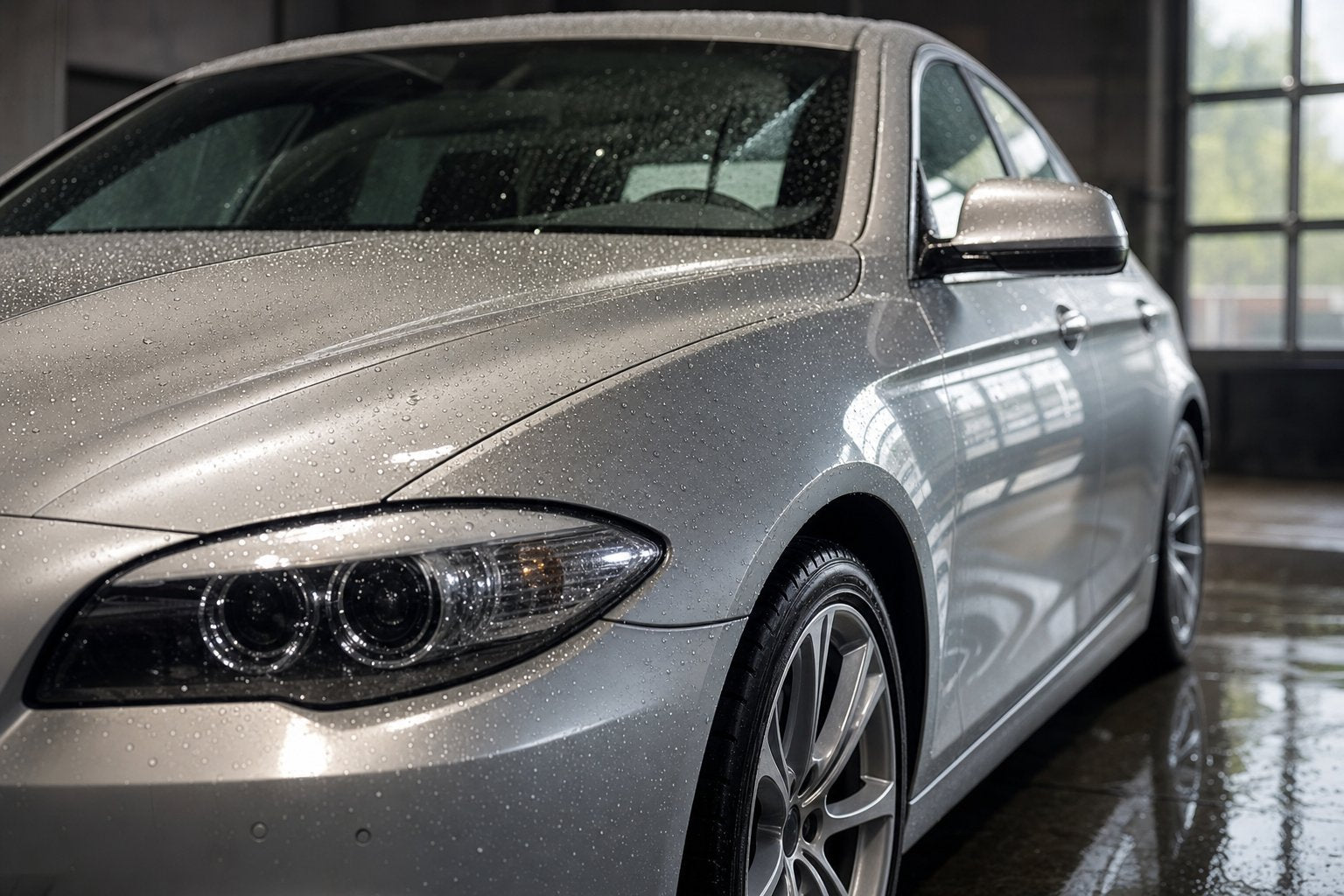
Yes — the reason is dwell time. A ceramic coating like HCC Hybrid Ceramic Coating creates a hydrophobic surface that repels water and soap. Thick foam gives you longer contact time before it slides off, which means the surfactants have more chance to encapsulate dirt. On a coated hood, foam-cannon foam will sit for 3–4 minutes; pump-sprayer foam often runs off in 90 seconds because it's thinner and lighter.
That said, both tools work well on coated cars. If you're already coated and you have a pressure washer, upgrade to a foam cannon. If you don't have a pressure washer and don't want the noise or cost, a pump sprayer with a foaming nozzle is still a meaningful upgrade over rinseless washing straight to the mitt. Also see our ceramic maintenance guide for the full wash cadence for coated vehicles.
Boat, RV, and Motorcycle Pre-Wash: Which One Wins?
Vehicles other than cars change the equation:
- Boats on trailers: pump sprayer wins. You often wash at a marina or driveway with no pressure washer, and boats have flat horizontal surfaces where the thinner foam still dwells adequately. For serious pre-wash, use a marine-safe shampoo.
- RVs: pump sprayer wins for full-body pre-wash because RV panels are tall (foam cannon is exhausting overhead), and campgrounds often ban pressure washers. Foam cannon still wins if you're washing at home and have a longer wand.
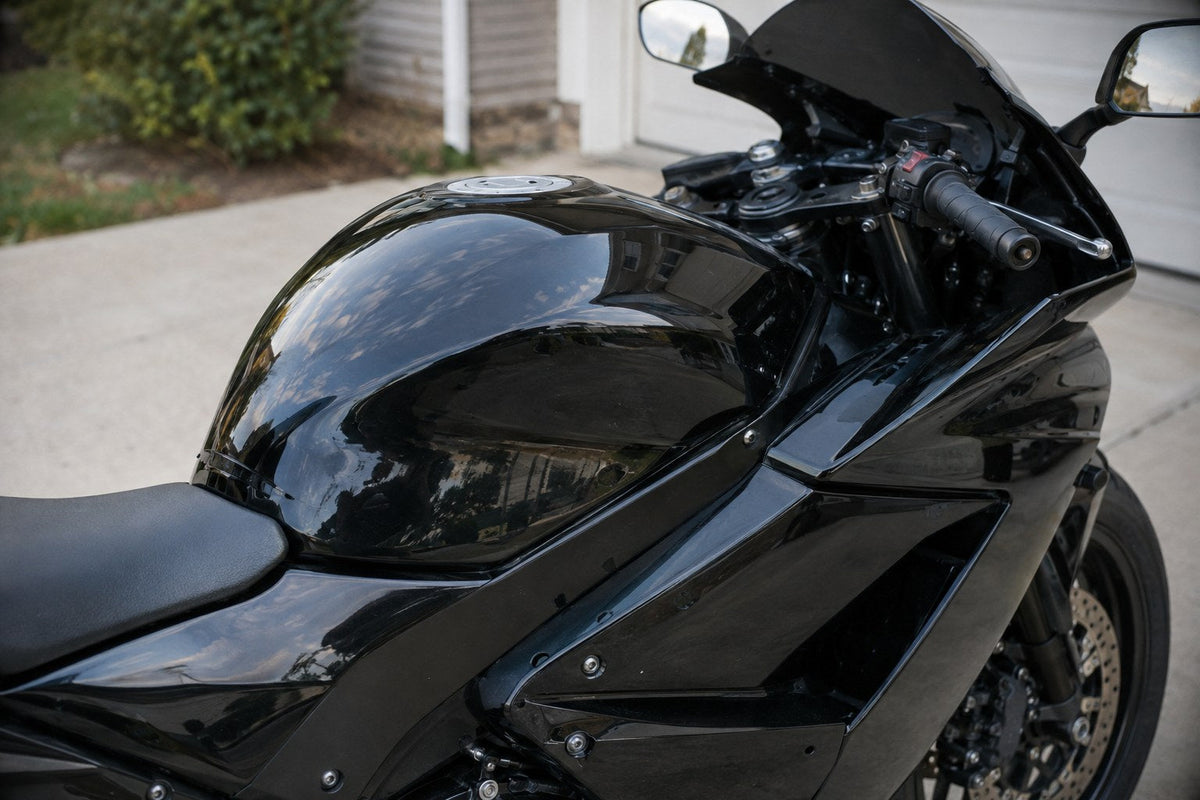
- Motorcycles: pump sprayer wins. Bikes have small surface area, lots of exposed hardware you don't want to blast, and a foam cannon at close range can push water past bearings and electrical connectors.
- Bicycles: pump sprayer wins, same reason as motorcycles. Foam cannon is overkill.
Should You Buy Both?
Serious enthusiasts often do. A foam cannon for the weekly driveway wash, a pump sprayer for travel, RV trips, boat wash-downs, or when the pressure washer is being serviced. Total investment is under $250 for both plus a good pressure washer, and the two cover every wash scenario you'll ever encounter.
For most people starting out, pick the one that matches your setup and location. If you own a pressure washer, buy the foam cannon. If you don't, buy the pump sprayer with a foaming nozzle and skip the pressure washer entirely — the pump sprayer gets you 80% of the benefit at 10% of the cost.
Frequently Asked Questions
Can I use a foam cannon without a pressure washer?
No — a true foam cannon needs 1,300+ PSI to aerate soap properly. What you can buy instead is a foam gun that connects to a garden hose, but the foam is thin and short-lived. If you don't have a pressure washer, a pump sprayer with a foaming nozzle produces better foam than any hose-attached foam gun.
What PSI pressure washer do I need for a foam cannon?
Minimum 1,300 PSI and 1.4 GPM. Most detailers recommend 2,000–3,000 PSI with 2.0+ GPM for the thickest, longest-clinging foam. Below 1,300 PSI, foam production is inconsistent.
How much soap do I put in a foam cannon?
1–2 oz of pH-neutral car shampoo in a standard 32 oz cannon bottle, topped off with warm water. Adjust the cannon's dilution dial to fine-tune foam thickness. More soap doesn't automatically mean thicker foam — the mix ratio and orifice setting matter more than raw quantity.
Can I use dish soap in a foam cannon?
You can, but you shouldn't. Dawn foams heavily but strips wax, sealant, and shortens ceramic coating life. Use it only when intentionally stripping old protection before applying a fresh coating.
How long should foam dwell on the car?
3–5 minutes for foam cannon foam on a cool car in shade. 2–3 minutes for pump sprayer foam. Never let foam dry completely — if you see edges going crusty, re-mist immediately.
Is a pump sprayer good enough for a coated car?
Yes. Pump sprayers work well on ceramic-coated vehicles when paired with a pH-neutral, coating-safe shampoo. The foam is thinner than a foam cannon's, but coatings' hydrophobic properties mean most contamination barely bonded in the first place. A pre-wash with a pump sprayer plus a proper two-bucket contact wash keeps a coated car looking sharp.
Does foam actually help remove dirt, or is it just cosmetic?
It genuinely helps. The surfactants in car shampoo encapsulate dirt particles and break their static bond to paint. Thicker foam extends dwell time, giving surfactants more time to work. Studies from professional detailing suppliers consistently show reduced swirl formation on cars pre-washed with foam vs cars washed directly with a mitt.
Can I use a foam cannon on a matte or satin finish?
Yes, but use a shampoo formulated as matte-safe. Standard gloss shampoos with wax or gloss enhancers will make matte paint look uneven. Otherwise, foam-cannon technique is identical on matte paint.
How often should I foam pre-wash my car?
Every wash. Foam pre-washing isn't a special-occasion step — it's the standard first step of every safe wash. The whole point is to minimize the abrasive load on your wash mitt every time you touch the paint.
Do I need to rinse before applying foam?
Yes. An initial low-pressure rinse breaks the static bond of loose dust and grit to the paint. Applying foam over a completely dry car creates gritty foam that can leave micro-scratches when it drips down the panels. Rinse first, foam second, dwell, rinse again, then contact wash.

Leave a comment
This site is protected by hCaptcha and the hCaptcha Privacy Policy and Terms of Service apply.