

Boat polish is an abrasive product that removes the oxidized top layer of your gelcoat and restores gloss. It comes in three grades — heavy cut, medium cut, and one-step cleaner-wax — and the wrong grade is the number-one reason DIY polishing jobs come out hazy, hologrammed, or gone in six weeks. This guide walks you through what grade to buy for your hull's actual condition, the pad and speed to run it at, and why a polish alone is not protection — you have to seal the fresh gelcoat within days or you're starting over next season.

What boat polish actually is (and what it is not)
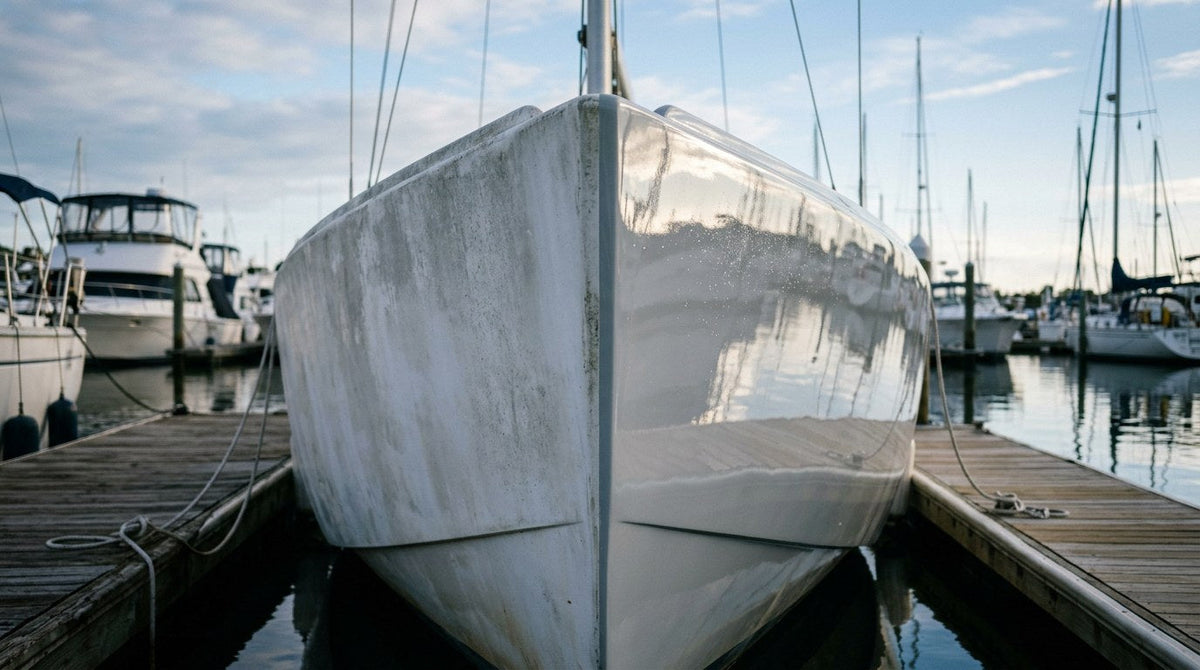
Boat polish is not marine wax. It's not a sealant. It's not a ceramic coating. Polish is an abrasive — a liquid or paste that contains micro-sized cutting particles suspended in a lubricating carrier. When you work polish across a gelcoat surface with a foam or wool pad, those abrasives shear off a microscopic layer of the surface. On an oxidized boat, that microscopic layer is exactly the chalky, dead resin you want gone.
Gelcoat is the pigmented resin skin sprayed into the mold when your boat was built. It is not paint. The gelcoat entry on Wikipedia describes it as a "material used to provide a high-quality finish on the visible surface of a fibre-reinforced composite" — usually a "thermosetting polymer based on epoxy or unsaturated polyester resin chemistry." It is your hull's frontline weather barrier. Under UV, that barrier degrades: as one marine detailing guide puts it plainly, "UV energy breaks the polymer chains in the gelcoat resin, releasing pigment particles and creating a chalky, faded layer on the hull, deck, or superstructure." Polish removes the dead layer. It does not add UV protection. That distinction is why so many owners polish their boat in June and see the shine gone by August.
Practical Sailor's boat-polish testing makes the same chemistry point: "Ultraviolet rays and oxygen speed up the oxidation process, which literally wears away the gelcoat's binding resins, leaving only pigments behind." Your job is to (1) cut back to fresh resin, (2) polish out the compound haze, and (3) put a protective layer over the top before you launch again.
The three grades of boat polish, decoded
The industry calls them different names — cutting compound, rubbing compound, medium polish, finishing polish, one-step cleaner-wax — but functionally there are three grades. Match the grade to the condition of your gelcoat or you'll either not fix the problem or take off more gelcoat than you needed to.
Heavy cut compound (aggressive)
3M's Perfect-It gelcoat brochure describes heavy cut this way: "This fast-cutting compound removes heavy oxidation, scratches, and other defects" and is used "for any P800 and finer scratches." A 2026 industry comparison notes that heavy-cut compound is the only category rated for "Stage 3–4" oxidation — "thick chalking, wet-sand scratch removal" — and warns it "cannot restore where gelcoat is already gone." You use heavy cut on a wool cutting pad and a rotary or aggressive dual-action polisher. It has no wax, no protection, and no gloss on its own — it is a bulldozer.
Medium cut / finishing polish (moderate)
3M's medium-cut product "combines fast cutting power, a high gloss finish, and durable wax protection" and is rated for "P1000 and finer scratches" — a one-step for moderately oxidized gelcoat that also leaves behind a wax layer. Independent detailing guides recommend medium polish for "Stage 2, light stage 3" oxidation and as the step-two follow-up to a heavy-cut pass: "medium finishing compound or polish on a foam polishing pad. This removes the haze left by step 1 and brings the surface to a high-gloss baseline."
One-step cleaner-wax (mild)
Practical Sailor describes one-step cleaner-waxes as "dual-purpose products [that] combine cleaning and polishing materials (a wetting agent, mild abrasives, and surfactants to dissolve oils) and protective sealing agents (typically a carnauba wax or polymer coating), and, in most cases, a UV inhibitor." They are the right call for "Stage 1, mild Stage 2" oxidation — light chalk, annual maintenance on a well-maintained hull. They give you "no meaningful cut for moderate-to-heavy oxidation" and they do not fix a badly weathered boat.
Match the polish grade to your hull condition
| Grade | Best for | Pad | Machine | Delivers protection? |
|---|---|---|---|---|
| Heavy cut compound | Stage 3–4 heavy chalking, oxidation, wet-sand scratch removal | Wool cutting pad | Rotary or high-power DA | No — must polish and seal after |
| Medium cut / finishing polish | Stage 2, light stage 3; haze removal after heavy cut | Foam polishing pad (orange) | Dual-action polisher | Some products include wax; most do not |
| One-step cleaner-wax | Stage 1, mild stage 2; annual maintenance on a good hull | Foam finishing pad (white) | DA polisher or hand | Yes — light wax layer, weeks to a few months |
| Marine ceramic coating (not polish) | Long-term protection on already-restored gelcoat | Applicator block + suede cloth | Hand | Yes — the actual UV/salt barrier |
The oxidation stage test is simple. Wipe a wet cotton cloth across a dry, dirty hull. If the cloth comes back barely marked, you're Stage 1. Faint chalky smear? Stage 2. Clear chalky smear? Stage 3. Thick white transfer on every pass? Stage 4 — and you may be looking at wet-sanding before compound, or the boat may be past the point where polish alone will save it. The marine oxidation guide puts it directly: oxidation "is fully reversible at every stage except where the gelcoat has worn completely through to bare laminate."
How to actually polish a boat: step by step

1. Wash and decontaminate first
Polish never goes on a dirty hull. Wash with a pH-neutral marine soap. If the hull has bonded iron fallout, staining from rail dust, or rust runs from stainless hardware, treat it with The Purps iron and fallout remover before you polish. Compound will grind bonded contamination into the gelcoat surface if you skip this.
2. Work in the shade
Never polish in direct sun. Hot gelcoat dries the compound before your pad can shear it, which loads the pad, leaves streaks, and generates heat spots. Move around the sun or tarp the section you are working on.
3. Pick the grade honestly
Test a 2-foot square with a one-step first. If gloss comes back and stays after a wipe-down, you are done. If not, step up to medium. If medium still leaves visible chalk in the reflection, step up to heavy cut. Don't start with heavy cut on a boat that only needs one-step; you'll remove gelcoat life you didn't need to remove.
4. Pad and speed
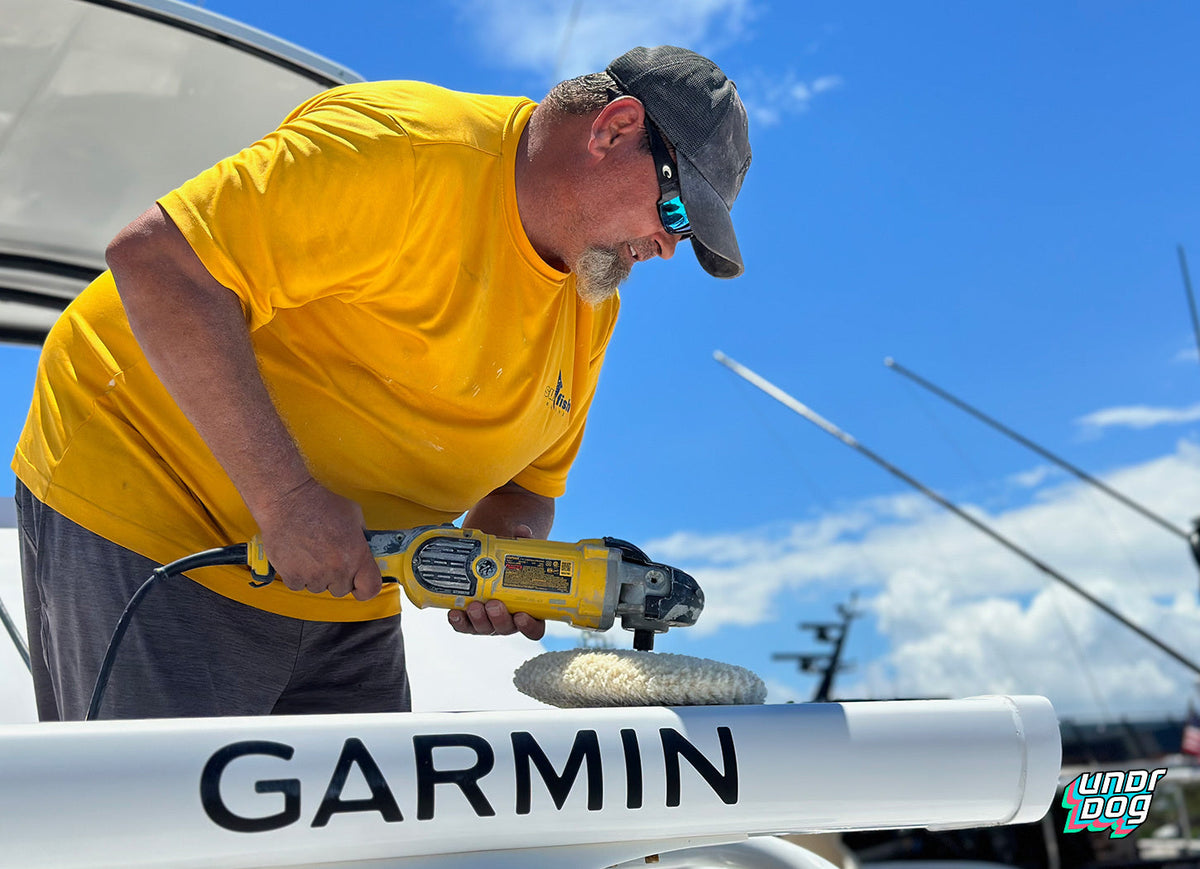
Heavy cut runs on a wool pad with a rotary at 1,500–2,000 RPM, or a strong DA at 4,500–6,000 OPM. Medium polish runs on a foam polishing pad (orange) at slower speeds, 1,200–1,500 on a rotary or 4,000–5,000 on a DA. One-step goes on a soft foam pad or, on a small tender, by hand with a microfiber applicator.
5. Small sections, wet edge
Work 2-by-2-foot sections. Keep the pad flat. Keep the machine moving. Overlap passes 50%. Stop and wipe with a clean microfiber every section — don't let compound dry.
6. Wipe, inspect, decide
Wipe the section with a clean, dry microfiber. Look at the section from three angles under different light. If chalk still transfers to a fresh microfiber, do another pass. If the gloss looks even and the microfiber comes back clean, move on.
7. Follow with finishing polish (only after heavy cut)
Heavy cut leaves micro-haze called compound haze. If you stop there, gloss will look a half-step off in bright sun. A medium/finishing polish on a soft foam pad removes the haze and takes the shine to its best possible level.
8. Seal within 24–72 hours
This is the step most owners skip. Freshly polished gelcoat is porous, chemically active, and — critically — has no UV protection. The oxidation guide is blunt about this: "Freshly compounded gelcoat has zero UV protection." Every day you leave polished gelcoat exposed is a day the oxidation clock restarts. You have three real options for the protective topcoat.
Polish alone doesn't protect. Here's what does.
Polish, at best, ends with a thin wax layer if you used a one-step. Waxed gelcoat looks great; it does not last. Our full breakdown of boat wax vs ceramic vs polymer sealant lays out the honest math: traditional carnauba boat wax lasts 2–4 weeks in saltwater; polymer sealants stretch that to 3–6 months; marine ceramic coatings hold on for a full season and often longer with maintenance.
Your three real protection options after polishing:
- Boat wax — easy, cheap, needs reapplication constantly. Freshwater-only boats can get through a season on a couple of applications; salt boats can't.
- Polymer sealant — middle option. Better durability than wax, easier application than ceramic. A few months of real protection.
- Marine ceramic coating — the actual durable answer. On a boat, Undrdog Marine and Undrdog Marine Plus are our dedicated marine-surface options; on a car-and-boat garage where you want one coating for both, HCC Hybrid Ceramic Coating is the flagship all-surface option and works across cars, boats, planes, and bicycles.
Polish first. Seal second. Skip the seal and you are polishing again next spring.
Buyer's guide: what to look for on the shelf
Read the abrasive spec
Any polish worth buying will tell you what scratch grade it removes (P800, P1000, P1500, etc.) or the marine oxidation stage it targets (heavy oxidation, moderate oxidation, light chalking, maintenance). If the label just says "boat polish" with no cut specification, you're buying marketing.
Diminishing abrasives are your friend
Better modern compounds use what one industry write-up describes as "diminishing abrasives — mineral particles that progressively break down during buffing, reducing the risk of deep scratches as the cut decreases." That means the compound cuts fast at the start of the working time and finishes fine at the end — cleaner results, less haze to chase.
Working time matters
A hot hull dries compound fast. Compounds designed for boat use are formulated to "stay wet longer than older versions, which matters on a hot hull in July — you get more working time before the compound dries and clogs the pad." If you polish in Florida in August, this feature is worth paying for.
Wax or no wax?
Some one-step polishes include a wax; some don't. If your plan is to apply a ceramic coating after polishing, buy a polish with no wax and no fillers — the coating needs to bond to bare gelcoat. If you're doing a maintenance polish and stopping there, wax-included one-step is fine for a season.
Silicone-free for anything you'll coat later
Silicone-based polishes and dressings leave a residue that interferes with ceramic coating adhesion. If a ceramic is in your future — even next season — stay away from silicone.
Costly mistakes to avoid
- Using kitchen abrasives. Barkeeper's Friend, comet, magic erasers on gelcoat — you'll strip pigment and dig scratches you can't polish out.
- Polishing in direct sun. Compound flashes off, pad loads, hull gets holograms and heat spots.
- Skipping the second (finishing) step after heavy cut. You'll leave micro-haze that looks like the polish didn't work.
- Buying "boat polish" without knowing your oxidation stage. Every boat is different. Test with a wet cloth first.
- Waxing polished gelcoat and calling it done. Wax lasts weeks in salt. Every boat left uncoated will re-oxidize by mid-season.
- Polishing over a coated hull. If your boat already has an intact marine ceramic coating, polish will strip the coating along with the top layer.
How Undrdog fits into a boat polish job
Undrdog does not sell rubbing compound. We sell what goes over the top of your polished gelcoat and the maintenance products around it. Here is where each product fits:
- Before polish: The Purps iron and fallout remover pulls bonded iron and rust runs out of the gelcoat surface so your polish doesn't grind them in.
- After polish: HCC Hybrid Ceramic Coating is the flagship all-surface coating — a great choice if you have a car, a boat, and a couple of other toys in the garage and want one coating that does all of it. For a boat-only build, Undrdog Marine and Undrdog Marine Plus are the dedicated marine coatings, with Marine Plus being the professional-tier option with double the chemical resistance of Marine.
- Between washes: Undrdog Quick Detail refreshes hydrophobics between full washes so your coating keeps beading through the season.
We don't put a year figure on any Undrdog coating. A coating's life on your boat depends on prep, freshwater vs saltwater use, storage (covered vs slip vs on a trailer), UV exposure, and how often you wash it. What we can tell you is that a properly polished, sealed hull holds gloss dramatically longer than one that got waxed and launched.
Polish it right. Coat it once. Wash it easy all season.
HCC Hybrid Ceramic Coating — Undrdog's flagship all-surface coating for cars, boats, planes, and bicycles. Sold at the same page and same price to detailers and DIYers. No certification, no year printed on the bottle, no exclusivity games.
Frequently asked questions
What is the best boat polish for a heavily oxidized hull?
A heavy-cut compound (rated for Stage 3–4 oxidation and P800-grade scratch removal) on a wool cutting pad, followed by a medium finishing polish on a foam pad. Skip either step and the results won't hold. 3M's Perfect-It Gelcoat Heavy Cutting Compound is the industry reference in this grade, but any compound rated for Stage 3–4 and P800 will do the job with proper technique.
Can I use car polish on a boat?
No, and we wrote a full post on why: Can You Use Car Polish on a Boat? Car polish is engineered for clearcoat over paint; gelcoat is different chemistry, is thicker, and oxidizes differently. Car polish is under-abrasive for real gelcoat oxidation and often under-lubricated, so it dries out too fast on a hot hull.

Does boat polish protect against UV?
No. Some one-step cleaner-waxes include a light UV inhibitor in the carnauba or polymer layer they leave behind, but that layer is thin and wears off in weeks in saltwater. Polish restores the surface; it does not permanently protect it. You need a wax, polymer sealant, or ceramic coating on top for real UV protection.
How long does boat polish last?
By itself: weeks. A polished-only hull in direct sun and saltwater will start to lose gloss within a month and be visibly dulling within a season. A polished hull sealed with a ceramic coating stays glossy for a full season and typically several more with a topper refresh. That gap — polish alone vs polish plus coating — is the difference between polishing every year and polishing every three or four years.
How often should I polish my boat?
If it's ceramic-coated and washed regularly, most owners can go two to four years between full polish jobs. If it's waxed only, plan on annual polishing. If it's uncoated and stored outdoors, plan on twice a year in high-UV climates.
What pad and speed should I use for boat polish?
Heavy cut compound: wool pad, rotary at 1,500–2,000 RPM or DA at 4,500–6,000 OPM. Medium polish: orange foam polishing pad, rotary at 1,200–1,500 RPM or DA at 4,000–5,000 OPM. One-step cleaner-wax: white foam finishing pad or hand application with a microfiber. Always keep the pad flat and the machine moving.
Do I need to buff after polishing?
You need to wipe after each section with a clean microfiber to remove residue. A separate "buffing" step is really a finishing polish pass on a soft pad after a heavy cut — its job is to remove micro-haze and bring gloss to maximum. If you used a one-step, wiping is enough.
Can I polish my boat without a machine?
You can hand-apply a one-step cleaner-wax on a boat under about 18 feet if oxidation is light. Anything Stage 2 or worse, and any boat over 20 feet, is impractical by hand — you'll gas out before you finish and the results will be uneven. A dual-action polisher is a $150–$250 investment that pays for itself the first job.
Should I ceramic-coat my boat after polishing?
If you want the polish job to actually last, yes. A polished-only hull re-oxidizes quickly under UV. A polished hull sealed with a marine ceramic coating keeps beading water, sheds contamination, and washes clean with less product and less effort. On a car-and-boat garage, HCC works across both surfaces; for a boat-only build, Undrdog Marine or Marine Plus are the dedicated marine formulas.

Leave a comment
This site is protected by hCaptcha and the hCaptcha Privacy Policy and Terms of Service apply.