

To clean boat canvas or a Bimini top, first identify the fabric and follow its care instructions: the light-cleaning guidance from Sunbrella and WeatherMAX calls for gentle cleaning, thorough rinsing, and air drying (Sunbrella marine-canvas guide, WeatherMAX care guidance). Do not assume a stronger stain treatment is suitable for every fabric, coated underside, thread, or neighboring window. Keep canvas cleaning separate from polishing and protecting the boat's hard surfaces.
A useful result is clean fabric that you have rinsed, dried, inspected, and put back into service correctly. The goal is not to scrub harder until every old mark disappears. This guide gives you a practical routine, with clear stopping points when the material or condition needs specialist attention.
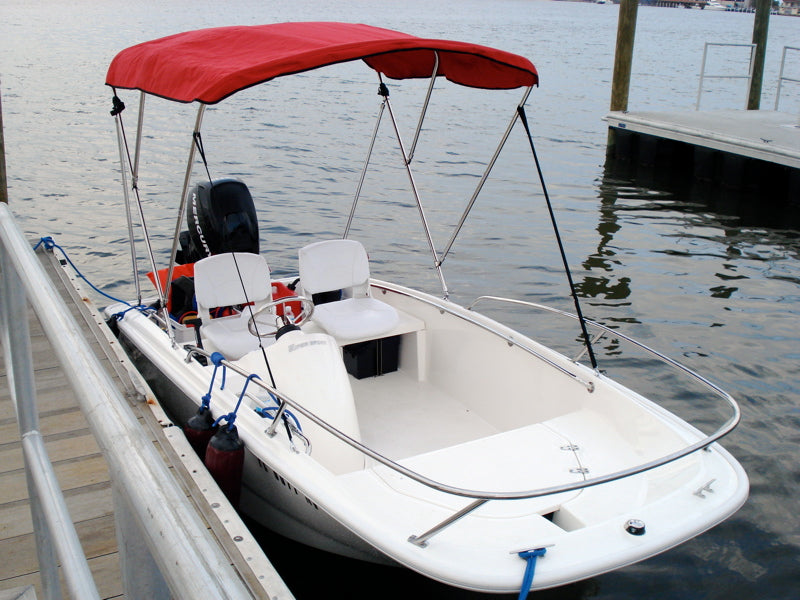
Hero photograph: boat with a red Bimini top, photographed by Rborroto, released into the public domain. This is an illustrative boat photograph, not an Undrdog cleaning demonstration or customer result.
Identify the canvas before choosing a cleaner
Start with the boat's documentation, a fabric label, the cover invoice, or the canvas shop that made the top. Record the manufacturer and fabric product, not just “marine canvas.” If the top has a different-looking back, a laminated area, a window section, or previous repairs, include those details when you request the care sheet.
There is a concrete reason to be specific: Sunbrella gives separate cautions for the coated underside of Sunbrella Plus, including skipping the blotting step in its heavier cleaning procedure (Sunbrella's coated-back instructions). A method written for one face of a known fabric should not become a general instruction for every side of an unidentified top.
| What you are working on | Instructions to obtain | Keep separate |
|---|---|---|
| Identified woven marine canvas | The fabric maker's cleaning and retreatment sheet. | The hull's compound, polish, and coating process. |
| Fabric with a coated back | The exact fabric variant and underside restrictions. | Any assumption that both faces tolerate the same agitation. |
| Attached clear enclosure panels | The window-material maker's care instructions. | Fabric stain treatments and scrubbing tools. |
| Seams, thread, straps, and repairs | Fabricator guidance for those components and their condition. | A claim that approval for the main fabric covers everything attached. |
For the transparent sections, use our separate clear-vinyl boat-window cleaning guide. If you cannot identify the fabric, pause chemical stain treatment and ask the fabricator rather than guessing from the color or texture.
Choose a work area and inspect the assembled top
Sunbrella says its marine canvas can be cleaned on the boat or, size permitting, removed for cleaning dockside (Sunbrella cleaning options). Choose the arrangement that lets you work safely, protect nearby materials, rinse completely, and leave the fabric open to dry. Do not climb onto a Bimini frame or improvise access to an area you cannot reach securely.
Before removal, we recommend photographing the installed arrangement and noting panel locations and fastener positions. Follow the top maker's instructions for folding, detaching, supporting, and refitting it. A cleaning guide is not a substitute for the operating instructions for a folding frame or powered top.
Look for worn contact points, open stitching, tears, and strained attachments before starting. WeatherMAX specifically advises checking for rubbing, sharp points, and wear, then addressing worn areas before premature failure (WeatherMAX maintenance guidance). Our recommendation is to refer questionable stitching or damaged support areas to a canvas professional rather than treating more aggressive cleaning as the repair.

Use a gentle wash for routine canvas cleaning
Remove loose dirt first
Brush off loose dirt before wet cleaning, as both manufacturers' guides recommend (Sunbrella guide, WeatherMAX guide). Use a clean tool dedicated to this job, not a brush that has just been used on wheels, a bilge, or a heavily contaminated surface.
Next, follow the fabric maker's rinsing instructions. Sunbrella's light-cleaning sequence includes hosing down the fabric before the cleaning solution is applied (Sunbrella marine-canvas sequence). Work deliberately around adjoining windows and fittings rather than treating the whole assembly as bare cloth.
Use the prescribed cleaner and light agitation
Sunbrella's marine-canvas guide specifies mild soap and water or its named fabric-cleaning options, a soft-bristle brush, and allowing the solution to soak into the fabric (Sunbrella light-cleaning instructions). WeatherMAX calls for soap and water applied with a soft brush and light pressure, followed by thorough rinsing and air drying (WeatherMAX light-cleaning instructions).
Use the current instructions for your actual fabric and chosen cleaner to determine the mix and application. This guide does not prescribe one dilution for all marine textiles. If a product label and fabric guidance do not clearly support the combination, confirm compatibility before proceeding.
Our recommendation is to stay with the gentle hand-cleaning method unless the exact fabric and finished-top instructions explicitly authorize another process. Do not replace it with a pressure-washer setting, steam treatment, machine cycle, or stronger degreaser based only on how dirty the top looks.
Treat mildew and stubborn stains as a separate decision
Sunbrella explains that mildew can grow on dirt and other foreign material left on its fabric, even though the fabric itself does not promote mildew growth (Sunbrella mildew guidance). WeatherMAX similarly emphasizes removing deposited dirt and organic matter as part of fabric maintenance (WeatherMAX care guidance).
A dark mark alone is not a reason to declare a stain identified and start mixing chemicals. Note the location, known exposure, and response to routine cleaning, then use the applicable stain guidance. For a persistent or widespread problem, ask a cleaner who has experience with the specific marine fabric.
Both manufacturers publish heavier-cleaning instructions, but their details and component cautions must stay attached to the named material (Sunbrella stain instructions, WeatherMAX cleaning guide). We are deliberately not turning those into a universal bleach recipe for every boat top.
Sunbrella warns that bleach can discolor non-Sunbrella fabrics and that bleach use or advanced age may affect sewing thread and other components (Sunbrella precautions). WeatherMAX's linked guide likewise says to protect non-WeatherMAX components, including thread and reinforcements, from bleach contact (WeatherMAX component precautions).
The work location matters, too: Sunbrella advises against using bleach when surrounded by a body of water or another environment that could be affected (Sunbrella environmental warning). If the proposed treatment cannot be handled appropriately where the boat is sitting, change the work arrangement or use a qualified service rather than treating the surrounding water as the rinse destination.
Do not promise complete stain removal. Sunbrella states that full removal is not always guaranteed when spills have not been addressed promptly (Sunbrella stain-removal limitation). For a detailer, an honest discussion of the fabric's condition and expected result is part of good service.
Rinse thoroughly and let the canvas air dry
Both makers emphasize removing soap residue and allowing the fabric to air dry (Sunbrella rinsing and drying, WeatherMAX rinsing and drying). Treat rinsing as a full step, not a quick splash after the visible dirt has moved.
Our practical recommendation is to review the entire cleaned area, including folds and overlapping sections, rather than stopping at the most accessible patch. Keep nearby materials protected according to their instructions. Do not call the job finished while cleaning solution is still present or the top cannot be left safely to dry.
WeatherMAX warns against storing the fabric damp or dirty because that can lead to mildew problems (WeatherMAX storage precautions). Allow enough time for drying before packing the top or cover away; this guide gives no universal drying time because the actual condition of the fabric must govern the decision.
For a shop handoff, we recommend recording the cleaning product, any stain treatment, areas that still need attention, and whether drying is complete. If the owner must finish drying before storage, make that instruction explicit instead of hiding it behind “all done.”
Check whether fabric retreatment is actually needed
Cleaning and water-repellent retreatment are separate steps. Sunbrella says light cleaning may not require retreatment and describes refreshing the fabric after repeated thorough cleanings or extended use and exposure (Sunbrella retreatment guidance). Do not assume that every wash requires another protective product.
WeatherMAX recommends first making sure the fabric is clean when water repellency appears reduced, then considering retreatment if the desired performance has not returned (WeatherMAX water-repellency guidance). That sequence gives you a sensible stopping point: clean and assess before adding a treatment.
When retreatment is appropriate, choose the product currently recommended for the exact fabric and follow its container directions. Sunbrella specifies cleaning first, complete air drying, and applying its recommended retreatment in a well-ventilated area (Sunbrella retreatment sequence). A treatment suitable for one fabric is not automatically suitable for a coated underside, clear panel, or repaired section.
Do not confuse the decision to refresh water repellency with a repair decision. Our recommendation is to have open seams, persistent leaks, damaged thread, or poor fit assessed by the fabricator before assuming a spray treatment is the answer. Identify the problem before choosing what to buy.
Inspect, refit, and store the top correctly
Once cleaning and drying are complete, inspect the same areas you recorded before the wash. Check the fabric, seams, attachment points, and any area that was already worn. Compare the current condition to your notes rather than assuming a cleaner appearance resolves every issue.
Follow the top maker's instructions when refitting and securing the assembly. WeatherMAX emphasizes proper fit so a cover or shade sheds water and allows wind to pass over it rather than imposing added stress (WeatherMAX fit guidance). This is not permission to improvise frame adjustments or operate a top outside its published limits.
For seasonal layup, use our ceramic-coated boat storage guide for the separate exterior-care workflow. Keep a simple record with the fabric name, care-sheet location, last cleaning, any retreatment used, and repair questions so the next person does not have to identify the material from scratch.
Where Undrdog fits: hard surfaces, not a canvas shortcut
HCC Hybrid Ceramic Coating is Undrdog's all-surface flagship for cars, boats, planes, and bicycles. Its multi-year protection positioning depends on preparation, exposure, use, and maintenance, not a fixed lifespan promised by this canvas-cleaning guide (HCC product information).
For a separate, suitable paint or gelcoat protection project, HCC is our first coating recommendation after surface compatibility, condition, preparation, and application requirements are confirmed. This article does not establish approval from a canvas maker for using HCC on its fabric. Do not substitute it for the textile maker's prescribed retreatment or use it as a seam-repair shortcut.
Read the current product directions and safety information before any coating work; HCC's precautions include ventilation, protective equipment, and separation from heat and ignition sources (HCC application and safety information). Keep the canvas project and the hard-surface project separate enough that the correct materials, tools, and instructions govern each one.

Frequently asked questions
What is the safest starting point for cleaning a Bimini top?
Identify the exact fabric and obtain its care sheet before choosing chemicals. For their specified fabrics, Sunbrella and WeatherMAX describe gentle cleaning, thorough rinsing, and air drying as the routine starting point (Sunbrella guide, WeatherMAX guide).
Can I clean the canvas while it is still on the boat?
Sunbrella says its marine canvas may be cleaned on the boat or, size permitting, removed for cleaning dockside (Sunbrella guidance). Choose a safe arrangement that follows the top's instructions and lets you protect adjacent materials, control the cleaning process, rinse, and dry properly.
Can I use bleach on any marine canvas?
No; do not generalize a named fabric's bleach-cleaning instructions to an unidentified top or its attached components. Sunbrella and WeatherMAX both publish component-protection cautions, and Sunbrella adds specific restrictions for the coated back of Sunbrella Plus (Sunbrella cautions, WeatherMAX cautions).
Should I scrub the underside the same way as the top?
Do not assume both faces have identical cleaning requirements. Sunbrella Plus has a coated underside with different handling in the heavier cleaning procedure, so identify the fabric variant and follow the correct instructions (Sunbrella Plus restrictions).
Can I put the top away while it is still damp?
Wait until the cleaned fabric is dry before storing it. WeatherMAX expressly warns that putting its fabric away wet or dirty can lead to mildew problems (WeatherMAX storage guidance).
Does every cleaning require a water-repellent treatment?
No. Sunbrella notes that light cleaning may not require retreatment, while WeatherMAX recommends cleaning first and assessing water repellency before deciding on another treatment (Sunbrella guidance, WeatherMAX guidance).
Can I apply HCC to the canvas instead of fabric protector?
This guide does not recommend HCC as a canvas retreatment or claim fabric-maker approval for that use. Follow the exact textile's prescribed care and retreatment; reserve our HCC recommendation here for a separate, confirmed hard-surface coating project.
When should a marine canvas professional handle the job?
We recommend professional help when the material is unknown, access is unsafe, stains persist, or stitching, fit, and wear need assessment. Sunbrella specifically advises asking professional cleaners about experience with its fabrics and knowledge of cleaning and retreatment requirements (Sunbrella professional-cleaner guidance).
Planning protection for the boat's hard surfaces?
Review HCC for a suitable paint or gelcoat project, while keeping canvas cleaning and fabric retreatment on their own care plan.
Shop HCC Hybrid Ceramic Coating


Leave a comment
This site is protected by hCaptcha and the hCaptcha Privacy Policy and Terms of Service apply.