

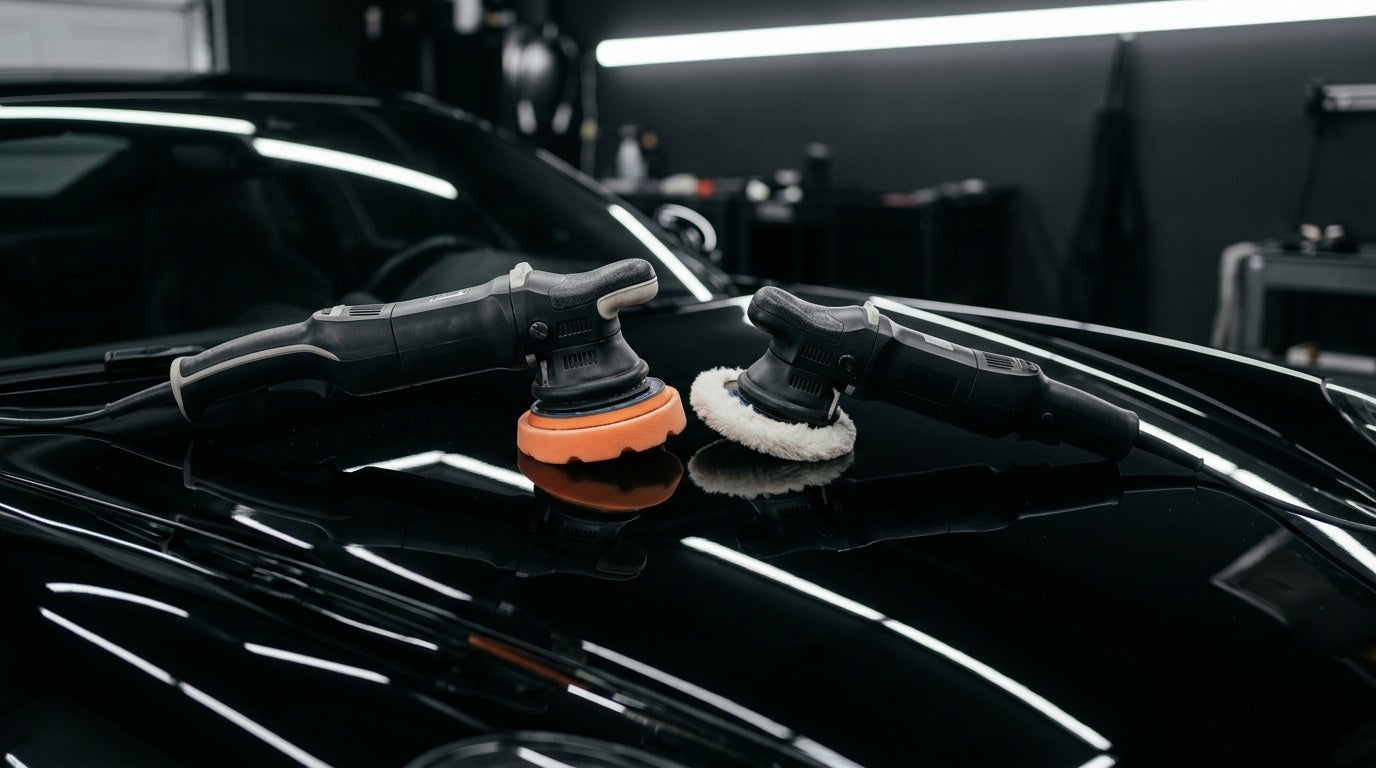
A dual-action (DA) polisher is the right buy for 99% of DIY detailers — its free-floating random-orbital head makes it very hard to burn paint, forgiving enough for a first correction, and long-throw versions now cut nearly as fast as a rotary. A rotary polisher cuts faster, kills the deepest defects in one pass, and holds curves better, but it builds heat quickly and can strike through clear coat on an edge if you're not experienced. If you're correcting a daily driver, prepping paint before a ceramic coating, or getting into detailing this year — start with a long-throw DA. If you're a full-time detailer, wet-sand cars, or already comfortable on a machine — a rotary belongs in your kit too. Here's the full breakdown of how each machine works, what it can and can't do, and how to pick without wasting money.

What a DA Polisher Actually Is
A dual-action polisher — also called a random-orbital polisher — is a machine whose pad both spins on its own axis AND wobbles in an offset orbit around a second axis. The two motions combine into a chaotic pattern that never repeats. That randomized motion is why the machine is so hard to burn paint with: the pad can't stay in one spot long enough to build critical heat. When you press hard, the free-floating spindle stalls instead of digging in, giving you a built-in safety valve.
Modern DA polishers come in two throw lengths:
- Short-throw (5–8mm) — the original DA design, forgiving on curves and tight areas, slower on heavy defects, more vibration in the hands
- Long-throw (15–21mm) — the modern standard, cuts far faster than short-throw while keeping the same safety profile, smoother in the hands, better for full-vehicle correction
According to the Detailing Success paint correction school, the industry has largely moved from short-throw to long-throw DAs over the past five years because the cutting speed gap with rotaries narrowed dramatically while the safety advantage stayed intact.
What a Rotary Polisher Actually Is
A rotary polisher drives the pad in one direct, forced rotation on a geared spindle. All motor energy goes straight into cutting force. No wobble, no random pattern, no stall — just direct rotation at whatever RPM you set.
That directness is the source of both its strengths and its risks. A rotary:
- Delivers the highest cutting force of any polisher type — removes deep defects, orange peel, and sanding marks fastest
- Cuts curves, sharp body lines, and edges without the head stalling
- Generates the heat needed to finish wet-sanded paint properly
- Requires far less pad pressure than a DA to make the same cut
The trade-off: forced rotation builds heat fast. Held in one spot for too long, or worked over an edge without care, a rotary can burn through clear coat in seconds. Recovering from a rotary burn usually means a repaint. That's why the learning curve is real and most pros develop rotary skill on scrap panels before touching a customer car.
Head-to-Head Comparison
| Dual-Action (DA) Polisher | Rotary Polisher | |
|---|---|---|
| Motion | Random orbital — spin + wobble | Forced direct rotation |
| Cutting speed | Moderate to fast (long-throw) | Fastest |
| Heat buildup | Low — head disperses heat | High — direct energy into paint |
| Burn-through risk | Very low — head stalls under pressure | High — needs skill and attention |
| Learning curve | Gentle — first-timers can safely correct real defects | Steep — most pros practice on scrap panels first |
| Edges and curves | Head can stall | Excels — no stalling |
| Best defect range | Light-to-moderate swirls, holograms, oxidation | Heavy swirls, sanding marks, deep defects |
| Full car correction time | 4–8 hours for a beginner | 2–4 hours for an experienced user |
| Wet-sand finishing | Struggles | The standard tool |
| Vibration and fatigue | Higher on short-throw, moderate on long-throw | Low — smooth rotation |
| Typical price | $150–$450 for a quality long-throw | $120–$500 depending on brand |
| Ideal user | DIY enthusiasts, weekend detailers, first-time correctors | Full-time pros, wet-sand work, heavy defect removal |
Where the DA Wins
Beginner Safety
The free-floating spindle stall is a physical safety feature. A first-time DIYer can correct real swirls on their own daily driver on day one without a strong risk of burning through clear coat. That's not marketing — it's mechanical.
Flat Panel Speed (Modern Long-Throw)
On flat panels — hood, roof, doors — a long-throw DA with a modern cutting compound can knock out defects nearly as fast as a rotary. The gap that existed a decade ago has largely closed.
All-Purpose Use
One DA covers polishing, sealant application, glaze application, and even coating leveling with a soft foam pad and slow RPM. A rotary is a correction tool. A DA is a correction tool AND a general finishing tool.

Pad and Compound Ecosystem
DA pads, backing plates, and compound formulations are widely available at every price point. Cheap starter pads work fine for learning. Premium pads exist for the serious enthusiast. Every major brand supports the standard 5-inch and 6-inch DA backing plate sizes.
Where the Rotary Wins
Deep Defect Removal
Deep swirls, sanding marks from body shop respray work, RIDS (random isolated deep scratches) — these often need a rotary and a wool cutting pad. A DA might get there eventually. A rotary gets there in one or two passes.
Wet-Sand Finishing
Wet-sand marks (P2000/P3000) can only be leveled properly with rotary heat. This is body-shop and concours work.
Curved and Complex Body Lines
Modern cars have aggressive body sculpture. The rotary's continuous rotation holds curves and tight corners where a DA head can stall and skip.
Speed in Skilled Hands
A trained rotary user can flatten heavy defects across a full vehicle in half the time of a DA operator. For a working shop, that time compounds across every job.
What About Forced-Rotation DAs?
There's a third category worth knowing: forced-rotation DAs (sometimes called geared DAs) that mechanically drive both the spin and the orbit. These sit between a standard DA and a rotary — more cutting power than a free-spinning DA, less burn risk than a rotary. They can be a strong option for the ambitious enthusiast who wants more speed without going full rotary, but they cost more, weigh more, and have a steeper learning curve than a standard long-throw DA. Not the right first machine.
Machine + Pad + Compound Pairings
DA Polisher Pairings
- Orange or yellow foam cutting pad + cutting compound — light-to-moderate swirls
- White or green foam polishing pad + medium polish — refinement pass after cutting
- Black or blue foam finishing pad + finishing polish — jeweling on soft paints (Japanese, red, black)
- Microfiber cutting pad + cutting compound — for heavy defects on a DA before considering a rotary
Rotary Polisher Pairings
- Wool cutting pad + heavy cutting compound — the standard heavy-defect removal setup
- Foam cutting pad + medium compound — moderate defects
- Foam finishing pad + finishing polish — final refinement to eliminate rotary hologramming
- Denim pad + refinement compound — orange peel reduction
Regardless of machine choice, do a full paint decontamination first — see our 4-step paint decon guide — before any polisher touches the paint. Polishing over embedded contamination drives it into the clear coat and can cause fresh scratches.
Common DA Polisher Mistakes
- Too much pressure. A DA needs firm-but-moderate pressure. Leaning on it stalls the head and defeats the whole point of the machine.
- Working too large a section. A 2ft × 2ft working area per pass keeps compound wet and cutting.
- Skipping the tape-off step. Painter's tape on plastic trim, emblems, and body-line edges prevents compound staining and pad damage.
- Moving too fast. A DA needs 4–6 slow passes over each section to fully break down compound.
- Skipping pad cleaning between panels. A compound-clogged pad stops cutting and starts scratching.
Common Rotary Polisher Mistakes
- Working at too-high RPM as a beginner. Start at 900–1200 RPM. Reserve 1500+ for experienced work.
- Working over edges and body lines. Tape edges off aggressively — a rotary can strike through a raised body line in less than a second.
- Letting the pad stop moving. A rotary held stationary builds heat immediately.
- Skipping the finishing polish pass. Rotary work always leaves fine holograms that a finishing pass — often with a DA — removes.
- Working paint you don't own yet. Practice on a junkyard hood or scrap panel first. Every experienced rotary user has burned paint at least once. Do it on a panel that doesn't matter.
Which One Should You Actually Buy?

Buy a Long-Throw DA If…
- This is your first polisher
- You're prepping paint for a ceramic coating and this is a once-a-year job
- You correct one or two vehicles a year — your own and family cars
- You want a machine that can also apply sealants, glazes, and wax
- You're not planning to wet-sand paint
Buy a Rotary (In Addition to a DA) If…
- You already own and are comfortable with a DA
- You detail cars for money and time is revenue
- You need to remove sanding marks or wet-sand paint
- You correct exotic, high-mileage, or heavily defected paint regularly
- You've practiced on scrap panels and are ready for the learning curve
Skip Both If…
- Your paint has only light water spots, glaze haze, or surface grime — chemical decontamination and a hand-applied polish can handle it
- Your car is 6 months old or newer without correction needs — a good coating over prepped clear coat is enough
After Correction: Lock It In With a Coating
The point of paint correction is to prep for a coating that protects the freshly leveled clear coat. Skipping the coating after correction means the swirls come back within a few washes. The default flagship all-surface ceramic is HCC Hybrid Ceramic Coating — works on cars, boats, and bikes with a forgiving DIY application window. For a paint-focused DIY-friendly job, Undrdog Pro. For elite pro-tier gloss, Pro Plus. Application technique matters — our streak-free ceramic coating guide walks through the exact three-towel method.
Between coating renewals, top up with Undrdog Quick Detail and wash with pH-neutral Undrdog Soap — see our DIY paint correction and swirl-mark removal guide for the full corrective wash-to-coating chain.
Just corrected your paint? Lock it in with HCC.
HCC is the flagship all-surface ceramic — DIY-friendly application window, works on cars, boats, and bikes, and keeps that freshly polished mirror finish protected against the swirls coming right back.
Shop HCC →Frequently Asked Questions
What is the difference between a DA polisher and a rotary polisher?
A DA (dual-action) polisher's head both spins and wobbles in a randomized orbital pattern, which makes it very hard to burn paint but slower on the heaviest defects. A rotary polisher spins the pad in one direct forced rotation — faster cutting, more heat, and higher risk of burning through clear coat if you're not experienced.
Is a DA polisher safe for beginners?
Yes. The free-floating spindle stalls under pressure instead of digging in, which is a mechanical safety feature. First-time DIYers can safely correct real swirls on their own vehicles with a modern long-throw DA on day one.
Can a DA polisher remove heavy swirl marks?
A modern long-throw DA with a microfiber or aggressive foam cutting pad and a cutting compound can remove most swirl marks and holograms in 4–6 passes per section. Very deep RIDS (random isolated deep scratches) and sanding marks usually need a rotary.
How long does a full paint correction take with a DA?
Plan 4–8 hours for a beginner on a mid-sized sedan doing a single-stage correction. A two-stage correction (cut + polish) doubles that time. A rotary user on the same car might finish in 2–4 hours.
Do I need a long-throw or short-throw DA?
Long-throw (15–21mm) is the modern default — faster cutting, smoother in the hands, better for full-vehicle correction. Short-throw (5–8mm) still has a place for tight areas and edge work but shouldn't be your only DA.
Can I use a rotary polisher on a ceramic-coated car?
Not for correction — a rotary will remove the coating. For coating-over-coating touch-up work, use a DA on a very low speed with a soft finishing pad. Any correction pass on coated paint removes the coating and requires reapplication.
What pad should I start with on a DA?
An orange or yellow foam cutting pad paired with a medium cutting compound handles most first-time correction. Add a white foam polishing pad and a finishing polish for the refinement pass on soft paints.
Should I buy both a DA and a rotary?
Only if you detail cars for revenue, wet-sand paint, or correct heavily defected vehicles regularly. For the vast majority of DIY use cases — including prepping paint for a ceramic coating — a long-throw DA alone is enough.
What RPM should I run a rotary polisher at?
Start at 900–1200 RPM as a beginner. Experienced users work up to 1500–1800 RPM for cutting and drop back to 900–1200 RPM for finishing passes. Higher isn't always better — it just builds heat faster.
Can I use a DA polisher to apply a ceramic coating?
Ceramic coatings are hand-applied with an applicator block or pad — not with a polisher. A DA is used before the coating for correction and after the coating for optional gentle waxing or glazing on softer paints.


Leave a comment
This site is protected by hCaptcha and the hCaptcha Privacy Policy and Terms of Service apply.