
To remove rust from car paint without damaging it, first identify what you actually have: iron fallout stains sitting on top of the clear coat, surface rust where a chip exposed bare metal, or deep rust that has bubbled or perforated the panel. Iron stains rinse off with an iron remover and a clay bar with zero damage to paint. Surface rust needs a wash, tape-off, sand to bare metal (start 40–80 grit, feather with 120 and 220), rust converter, primer, touch-up, and clear coat. Bubbled or through-rust is a body-shop job — abrasive fixes will fail within months.
This guide walks you through diagnosing your rust honestly, executing whichever repair matches, and — most importantly — protecting the repair so it doesn't come back. If you skip diagnosis and just sand or spray something on, you'll either damage clean paint or waste a Saturday on a repair that reappears by winter.

Step 1: Figure Out Which Kind of Rust You Actually Have
Not all "rust on a car" is the same problem. Three cases dominate, and the fix is different for each. Diagnose before you touch anything.
Case 1: Iron Fallout Stains (Most Common on Paint)
Tiny orange or brown speckles across your paint, especially on the hood, roof, and upper panels. These are not rust growing on your car — they're microscopic iron particles from brake dust, rail dust, industrial fallout, and welding sparks that landed on your paint hot, welded themselves to the clear coat, and are now oxidizing. Run a plastic sandwich bag over the paint after washing. If it feels gritty or crunchy instead of glass-smooth, you have iron fallout. Zero panel damage — the clear coat is intact, the contamination is on top of it. This is the easy fix.
Case 2: Surface Rust (Chip Down to Metal, No Bubbles)
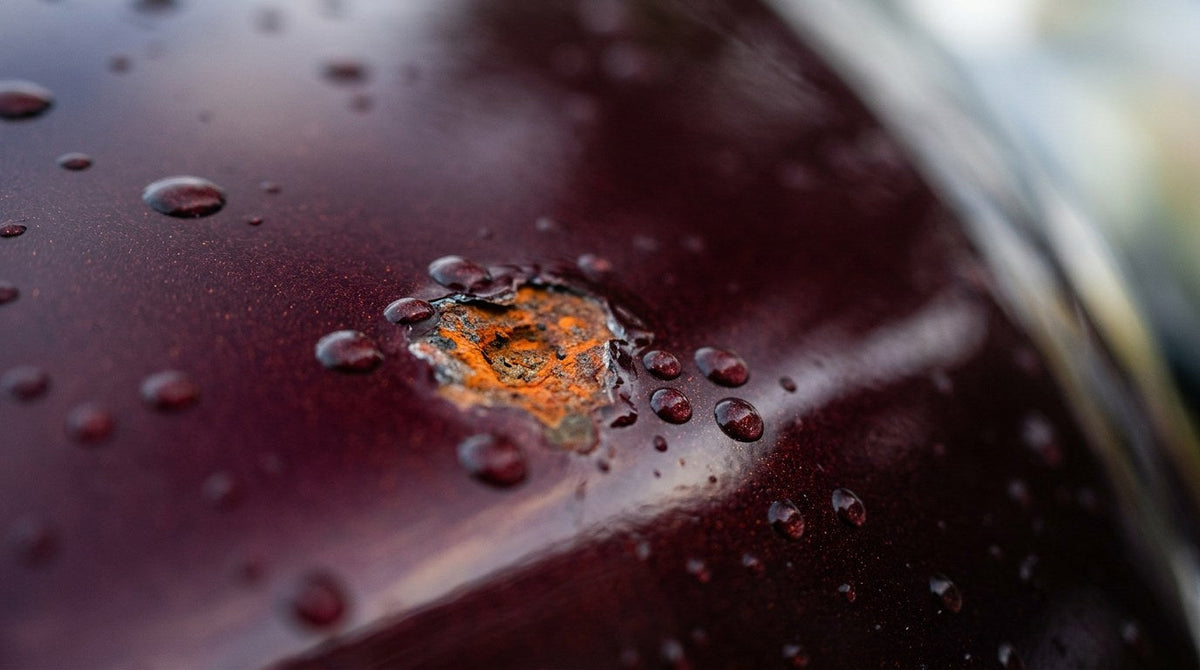
A rock chip, door ding, or scratch broke through your clear coat and paint down to the primer or bare steel. Water reached the metal and started oxidizing. The rust is orange, powdery, and confined to the immediate area of the chip. No paint bubbles around it, no soft spots, no flaking. This is the classic DIY repair and takes 2–4 hours per spot with common tools.
Case 3: Deep or Perforating Rust (Bubbles, Flakes, or Holes)
Paint bubbles anywhere on the panel mean rust is growing underneath the paint, from behind or below. What looks like a small bubble on the surface almost always hides a much larger area of pitted, scaled, or perforated metal. Per AutoZone's rust repair guide, "an area with 2 or 3 small rust bubbles can reveal several large rust holes after stripping and cleaning." If you can push on the panel and feel it flex or crackle, or if rust is coming through from the inside of rocker panels, wheel arches, or the underbody, this is a body-shop job. Panel replacement or welded-in patch panels are the correct repair. Sanding and spraying a rust converter on the surface will not stop rust that's already progressed through the metal — it will hide it for a few months, then come back worse.

Step 2: The Fix for Iron Fallout Stains (Case 1)
This is the fastest, safest, most rewarding rust removal you can do on a car. It causes zero paint damage and takes about an hour on a full sedan. No sanding, no primer, no repaint.
What You Need
- A pH-neutral car soap like Undrdog Soap and two buckets (or a rinseless wash)
- An iron remover — The Purps is Undrdog's iron and fallout remover
- A clay bar or clay mitt with clay lubricant
- Nitrile gloves and eye protection
- A microfiber drying towel
Procedure
- Wash and dry the car first. Iron remover works on clean paint, not paint covered in road film. Two-bucket or rinseless — either works.
- Move the car into shade. Iron removers must never dry on paint. Cool, shaded panels only.
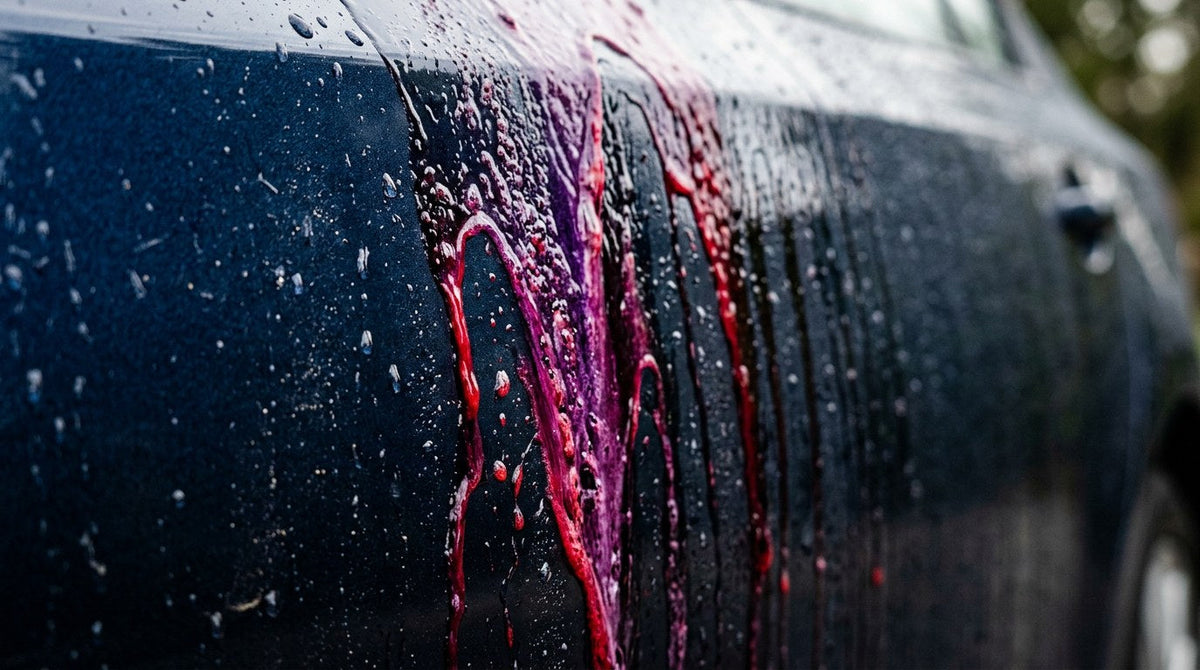
- Spray iron remover on wet paint and wheels. Where iron is embedded, the product bleeds bright purple or red as thioglycolic acid chelates iron oxide into a water-soluble complex. Wheels bleed heaviest because brake dust is nearly pure iron.
- Dwell 3–5 minutes. Do not let it dry. On a warm day, mist with water to keep it wet.
- Rinse thoroughly with a strong stream or pressure washer.
- Clay bar the paint. Any iron that didn't bleed fully will come out on the clay. Lubricate generously and work in 2×2-foot sections. See our clay bar step-by-step if you haven't done it before.
- Re-wash. Iron remover chemistry strips wax and light sealants. Wash again before applying any protection.
- Reprotect the paint. A hybrid ceramic like HCC makes future iron fallout much easier to remove because contamination sits on top of the coating instead of welding to your clear coat.
For the full contamination workflow, our 4-step paint decontamination guide covers wash, iron removal, clay, and paint prep in order.

Step 3: The Fix for Surface Rust (Case 2)
Chip down to bare metal, rust growing in the exposed spot, no bubbles or flaking around it. Total repair time is 3–5 hours per spot including cure windows, and this DIY is genuinely worth doing before the rust spreads under the surrounding paint.
What You Need
- Painter's tape and masking paper (not newspaper)
- Sandpaper: 40–80 grit, 120 grit, 220 grit, 320 grit, and 1000-grit wet
- Wire brush or small wire wheel for a drill (only for pitted areas)
- Wax and grease remover or acetone
- Phosphoric-acid rust converter (POR-15, Ospho, or similar)
- Etching primer or self-etching primer
- Color-matched touch-up paint (dealer part number is best)
- Clear coat
- Polishing compound and pad
- Nitrile gloves, safety glasses, and respirator or dust mask
Procedure
- Wash and dry the entire panel. Grit under your sandpaper will scratch surrounding paint.
- Tape off the working area with painter's tape 2–3 inches beyond the rust in every direction. Cover the rest of the panel with masking paper. Real masking paper, not newspaper — newspaper leaks solvents.
- Sand to bare metal. Per The Drive's rust removal guide, start with 40-grit sandpaper (or an abrasive wheel) to strip paint and rust down to bright, clean metal. AutoZone recommends 60–80 grit for the initial pass. Either works. Sand out from the rust edge by 1–2 inches so the transition to healthy paint is a smooth taper, not a hard edge.
- Wire-wheel any pits. Cup-style wire wheels in a drill get rust out of low spots that flat sandpaper can't reach. Go easy — wire wheels can gouge sheet metal fast.
- Wipe with wax and grease remover. Silicone, oil, and skin oils will cause primer fisheyes. Wipe clean, let flash off.
- Apply rust converter to any stained metal. Phosphoric acid converts iron oxide into iron phosphate, which is stable and paintable. Brush on, wait per label (usually 4 hours), and do not skip this step even on visually clean metal — microscopic rust will re-bloom if you prime over it.
- Feather the surrounding paint edges. 120-grit first, then 220-grit for smoothness. You want the paint edge to blend seamlessly into the bare metal so the repair doesn't show as a step.
- Apply etching primer. 2–3 light coats, flash time between each. Etching primer bites into bare metal chemically; a plain primer will lift.
- Wet-sand primer with 1000-grit for a smooth base.
- Apply color-matched touch-up paint in thin coats. Multiple thin coats always beat one thick coat.
- Apply clear coat. 2–3 coats with proper flash time.
- Let cure 24–48 hours before wet-sanding and polishing. Start with 1500-grit, work up to 3000-grit, then compound and polish to blend the repair into the surrounding gloss.
- Reprotect the whole panel once the repair has fully cured (7–14 days for most touch-up paints). A ceramic coating over the repair keeps water out of the touched-up spot and dramatically slows re-rust.
Step 4: When to Call a Body Shop (Case 3)
Not every rust problem is a DIY. Skip the sanding and take it to a shop when you see any of the following:
- Paint bubbles anywhere on a panel
- Rust coming through rocker panels, wheel arches, quarter panels, or floor pans from the inside
- Any hole or thin spot where you can feel the metal flex
- Structural rust on frame rails, subframes, or unibody sections
- Rust larger than a US quarter in a stress-loaded area (door bottoms, tailgate seams, sunroof channels)
These require cutting out the damaged metal and welding in patch panels or full panel replacement. Rust converter on the surface will not stop rust that has already progressed through the metal. AutoZone's guide warns that "rust treatment is not always 100% successful long-term and can reoccur quickly if it is not completely eradicated." That warning applies specifically to surface treatment of already-perforated metal. Do the repair right, or do it twice.
Step 5: The Comparison Table — Which Method for Which Damage
| Damage Type | Method | Difficulty | Time | Paint Damage Risk |
|---|---|---|---|---|
| Iron fallout stains (top of clear coat) | Iron remover + clay bar | Easy | 1 hr full car | None |
| Rust stain from external source (metal drip) | Iron remover, then clay if needed | Easy | 15 min per spot | None |
| Chip with surface rust in the pit | Sand, convert, prime, touch up, clear | Moderate | 3–5 hr per spot | Low if masked properly |
| Scratch with rust along the line | Sand, convert, prime, brush touch up | Moderate | 2–3 hr | Low |
| Paint bubbles or flaking | Body shop, panel replacement or patch | Pro only | 1–3 days shop time | N/A |
| Rust-through / holes | Body shop, weld-in repair | Pro only | Multi-day | N/A |
Step 6: Methods to Avoid on Automotive Clear Coat
Search results will suggest a lot of household hacks. Some are safe, most are not on a modern basecoat/clear-coat finish.
Steel Wool and Scotch-Brite
Aggressive enough to strip surface rust, aggressive enough to strip clear coat. Fine on chrome, on a bumper trim you're planning to repaint, or on an old single-stage patina paint job — not on modern automotive clear coat.
Vinegar, Lemon Juice, and Baking Soda
Mild acids can dissolve very light iron staining but they can also etch clear coat if left on too long or applied in direct sun. A purpose-built iron remover is faster, safer, and won't damage adjacent trim.
WD-40 as a Rust Remover
WD-40 is a water-displacing solvent. It temporarily masks surface rust and inhibits new rust while it's wet, but it does not remove existing rust and it does not stop rust that's already progressed under paint. It's fine as a temporary barrier on a fresh repair, not a permanent fix.
Sanding Without Masking
Grit that gets under your sandpaper or migrates onto adjacent paint will create heavy scratches. Mask wide, use masking paper, and clean the surrounding paint after sanding before you unmask.
Step 7: Prevent Rust From Coming Back
Rust removal is a repair. Rust prevention is a habit. After any rust repair — or on a daily driver you want to keep clean — do these four things.
Wash Regularly, Especially in Salt Environments
Salt from winter roads, coastal spray, and pool decks accelerates rust dramatically. AutoZone specifically recommends "washing the car weekly or whenever it is quite dirty" as a core rust-prevention habit. If you drive on salted roads or park near the ocean, hit the underbody with a garden hose or pressure washer every wash. Our coastal saltwater protection guide covers the full salt-exposure playbook.
Address Chips Immediately
Rock chip on the hood? Touch it up within a week. A chip that reaches bare metal will start rusting the next time it rains. Keep a color-matched touch-up bottle in the glovebox.
Coat the Paint
A quality ceramic coating creates a hydrophobic barrier that keeps water off the paint and lets contamination rinse away instead of bonding to the clear coat. HCC is Undrdog's flagship all-surface hybrid ceramic — works on cars, boats, planes, and bicycles — and is the default recommendation whenever the goal is durable protection against contamination, chips, and rust triggers. See our DIY ceramic application guide for the technique.
Decontaminate Once or Twice a Year
Even coated paint accumulates iron fallout over time. A yearly iron remover + clay bar session pulls contamination out before it welds to your finish. Twice a year in heavy brake-dust environments (city driving, highway commuters, near rail lines).
Stop rust before it starts.
HCC is Undrdog's flagship hybrid ceramic coating — one bottle protects cars, boats, planes, and bicycles from the contamination, moisture, and salt that trigger rust in the first place. Fewer chips, easier decon, longer-lasting gloss.
Shop HCC →Frequently Asked Questions
Can you remove rust from car paint without repainting?
Yes, if the rust is limited to iron fallout stains on top of the clear coat. An iron remover and clay bar treatment removes stains completely with zero paint damage and no repaint needed. If the rust has progressed through the clear coat down to metal, you'll need to sand, treat, and touch up — which is technically a small paint job, not a full repaint of the panel.
Will WD-40 remove rust from a car?
WD-40 does not remove existing rust from car paint or body panels. It's a penetrating oil that displaces water and provides a short-term moisture barrier. Use a dedicated iron remover for stains on paint, or sandpaper and a rust converter for surface rust in a chip.
What's the safest rust remover for car paint?
A pH-balanced iron remover with sodium or ammonium thioglycolate is the safest chemistry for stains on top of intact clear coat. It converts iron oxide into a water-soluble complex that rinses off without touching the paint. Stronger acidic iron removers work faster but require careful application away from chrome, glass, and skin.
Can I sand rust off my car without repainting?
Sanding rust off exposed metal always removes the surrounding paint layer, so you'll need to prime and paint the sanded area to seal it. Skipping the paint step guarantees the rust returns within weeks — bare metal starts oxidizing the next time it sees moisture.
How much does it cost to fix rust on a car?
DIY surface-rust repair on a chip-sized spot runs $30–$80 in materials (touch-up paint, primer, sandpaper, rust converter). Body-shop repair of bubbled or perforated rust typically starts at $300–$600 per panel for a patch repair and can exceed $1,500–$3,000 for full panel replacement on larger areas.
Does rust converter really work?
Phosphoric-acid rust converters convert iron oxide into iron phosphate, which is stable, black, and paintable. On lightly rusted bare metal after sanding, they work well as a final chemical step before priming. They do not stop rust that has already perforated the panel — no surface treatment does.
How long does a DIY rust repair last?
A properly executed DIY rust repair on a chip — sand, convert, etch prime, color, clear, ceramic coat — lasts 2–5 years before it needs touching up. Rust that has already progressed under adjacent paint before the repair can re-bloom within 6–12 months regardless of technique, which is why diagnosis before you start matters more than the repair steps themselves.
Can I use a clay bar to remove rust from car paint?
A clay bar removes iron fallout particles embedded in the clear coat, which is the specific "rust stain" appearance most people see. It doesn't remove rust from bare metal or repair rust under paint. For iron staining on the surface, iron remover first, then clay bar for anything the chemistry didn't dissolve.
Is it worth fixing surface rust on an old car?
On a daily driver you plan to keep, yes — surface rust always spreads under adjacent paint if you leave it, and the repair gets bigger and more expensive over time. On a car you're about to sell or one already at the end of its life, honest DIY spot repairs improve appearance but rarely add resale value beyond the material cost.
Will a ceramic coating stop rust?
A ceramic coating prevents the conditions that cause rust — water sitting on paint, iron fallout welding to clear coat, salt residue accumulating. It doesn't stop rust that's already inside the metal. Coat clean, decontaminated, and repaired paint to keep rust away; don't rely on a coating to fix existing damage.
Bottom Line
Diagnose first. Iron fallout stains on top of paint clean off with iron remover and a clay bar in an hour — no damage, no repaint. Surface rust in a chip is a legitimate afternoon DIY with the right prep, and getting it right the first time saves you doing it again next year. Bubbled or perforated rust is a body-shop job and no chemical shortcut changes that. Whatever you fix, coat the paint afterward so rust triggers don't hit bare or unprotected finish. That's how you keep a car looking clean for the long haul.

Leave a comment
This site is protected by hCaptcha and the hCaptcha Privacy Policy and Terms of Service apply.