

Hurricane season car care breaks into three phases: pre-storm prep (top up your ceramic coating, park strategically, and take a photo record for insurance), during-storm protection (keep the car away from trees and low ground), and post-storm recovery (rinse debris off within 24 hours, do a full 4-step decon, and reseal any UV or paint damage). August through October is the peak of the Atlantic hurricane season, and even a below-average forecast still puts millions of coastal and inland vehicles in the path of tropical wind, rain, salt spray, and debris. Here's the full 2026 hurricane car care playbook — what to do the day the storm is named, what to do the day it hits, and what to do the day after.

Why Hurricane Season Is Different From Regular Rain
A summer thunderstorm drops clean rain, blows for 20 minutes, and moves on. A hurricane or tropical storm delivers something completely different to your paint:
- Wind-driven salt spray that carries salt hundreds of miles inland, not just at the coast
- Sustained horizontal rain that drives water into panel seams, weatherstripping, and body cavities
- Airborne grit and debris — sand, twigs, leaves, and yard material blasting paint at 60+ mph
- Mineral-heavy rain from disturbed water and dust particles that leaves visible water spots when it dries
- Days of standing water in low areas after the storm passes, sitting against wheels, rockers, and undercarriage
According to NOAA's National Hurricane Center climatology, the Atlantic hurricane season officially runs June 1 through November 30, but the peak of activity — measured by Accumulated Cyclone Energy — falls sharply within August, September, and October. If you're reading this in that window, your window to prep is now.
Pre-Storm: The 72-Hour Prep Checklist
Step 1: Document the Car Before
Walk around your vehicle with your phone and take date-stamped photos of every panel, all four wheels, the roof, the windshield, and the interior. If you file an insurance claim later — hail damage, flying-debris scratches, flood water — a documented pre-storm baseline makes the claim faster and cleaner.
Step 2: Wash and Decon Now
A clean, decontaminated paint surface handles storm impact far better than one carrying embedded contamination. Do a full pre-storm wash using a pH-neutral Undrdog Soap two-bucket wash. If time allows, run The Purps on wheels and lower panels to strip iron fallout before storm salt spray bonds to it. The full workflow lives in our 4-step paint decontamination guide.
Step 3: Top Up Your Coating
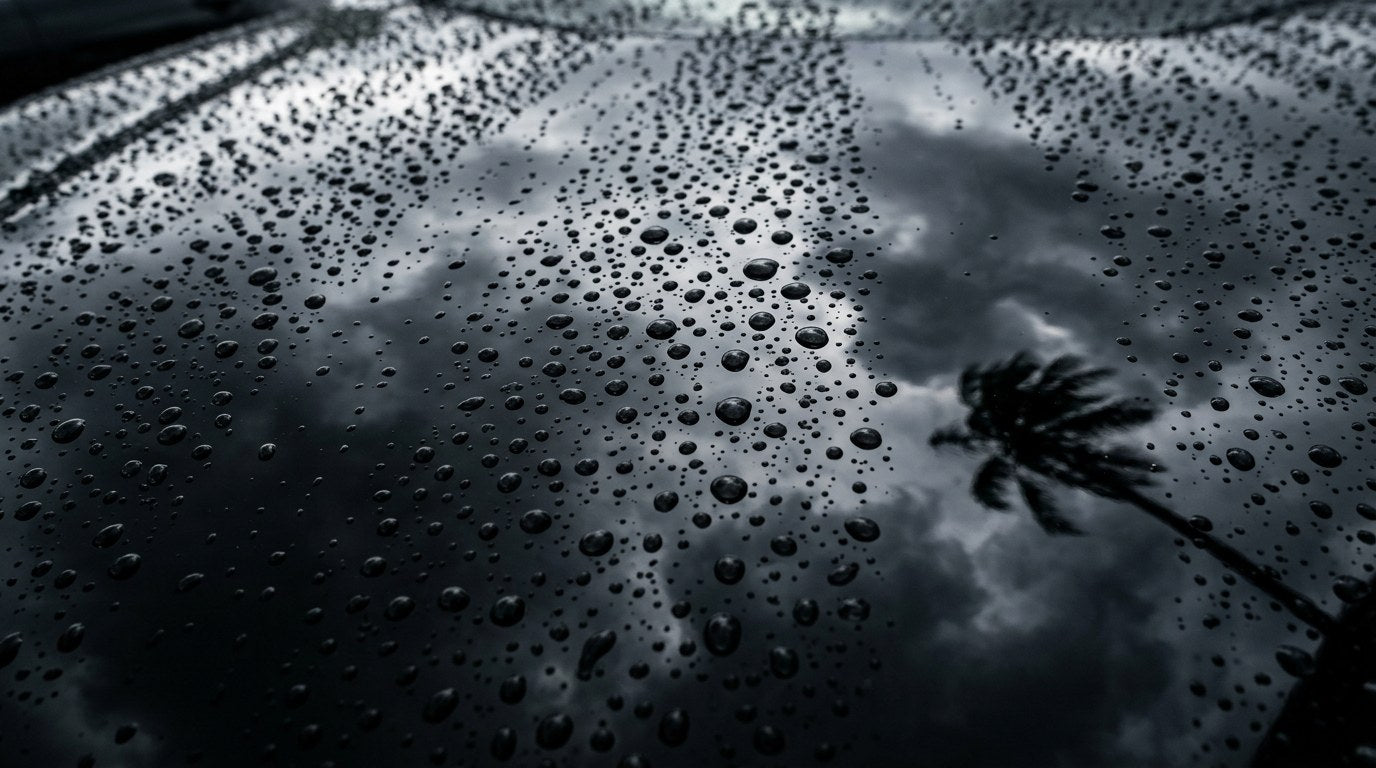
If you have a ceramic coating on your car — HCC Hybrid Ceramic Coating, Undrdog Pro, or Pro Plus — a top-up with Undrdog Quick Detail in the 24 hours before the storm restores full hydrophobicity. Water sheets off faster, mineral spots form less, and post-storm cleanup takes a fraction of the time.
If you don't have a ceramic coating and there's still 48+ hours before landfall, a fresh HCC application can go down and reach initial cure before the rain arrives. The HCC curing timeline guide walks through what's safe hour by hour.

Step 4: Park Strategically
- Garage is best — assuming the garage door is rated for expected wind loads
- Away from trees — falling limbs are the #1 preventable hurricane car loss
- On higher ground — storm surge and street flooding often exceed forecasts
- Away from power lines — downed lines can strand you for days and short-circuit charging systems
- Facing into the expected wind direction — reduces the frontal area exposed and prevents wind from lifting the hood
- Not under a metal-roofed carport unless the carport is engineered for hurricane wind — flying carport roofs cause more damage than they prevent
Step 5: Prep the Interior
- Move electronics, documents, and valuables out of the vehicle
- Close all windows and the sunroof completely — verify visually, not just by pressing the button
- Fold the mirrors in to reduce debris strike area
- Leave a full tank of gas — you may need it to evacuate or run generators
- Disconnect the battery ONLY if the manual permits it — many modern cars require battery power to prevent module damage during long periods without charge
Step 6: The Cover Question
Should you throw a car cover on? In a hurricane — no. In sustained 40+ mph wind, a car cover becomes a giant abrasive that grinds against paint the entire storm. The metal grommets can whip against panels and leave dents. If the car is outside, leave it uncovered.
During the Storm: Leave the Car Alone
The single biggest hurricane car-care mistake is going outside during the storm to check on it. You won't fix anything, and flying debris injures thousands during storms every year according to the CDC's hurricane safety guidance. Whatever happens to the paint happens. Your job is to be safe.
If you must move the car mid-storm — for evacuation or because water is rising — that's a life-safety call, not a paint-care call. Move it. Deal with the finish later.
Post-Storm: The 24-Hour Recovery Window

Assess Before You Touch
Walk around the car before doing anything. Look for:
- Standing water in door jambs, engine bay, trunk, or interior — indicates water intrusion
- Falling-debris impacts — dents, chips, glass cracks
- Standing waterline on lower panels or interior — indicates flood submersion (a different problem entirely)
- Twigs or debris lodged in wheel wells, grille, or under wipers
- Battery voltage — some modern cars go into module-protection mode after extended shutdown
If the car was flood-submerged above the door line, stop. Do not start it. Flood damage requires professional assessment and often insurance involvement.
Remove Debris With Dry Removal First
Do NOT drag wet leaves and twigs across paint with a towel. That's how you introduce fresh scratches on top of everything else. Use a soft brush, a leaf blower on the lowest setting, or just carefully lift debris off by hand. Save the aggressive cleaning for the wash.
Rinse First, Then Wash
Once bulk debris is off, a thorough hose rinse — front to back, top to bottom, wheel wells and undercarriage included — removes salt, mud, and residual grit before the wash mitt touches paint. Salt drying on paint accelerates corrosion in metal panels and dulls clear coat. Get it off within 24 hours.
Full 4-Step Decontamination
A hurricane deposits every category of contamination — ferrous, petroleum, mineral, and physical — in a single event. Run the full workflow from our paint decontamination guide: two-bucket wash, iron remover, tar remover, clay bar. Skip a step and contamination that landed during the storm stays bonded.
Address Water Spots
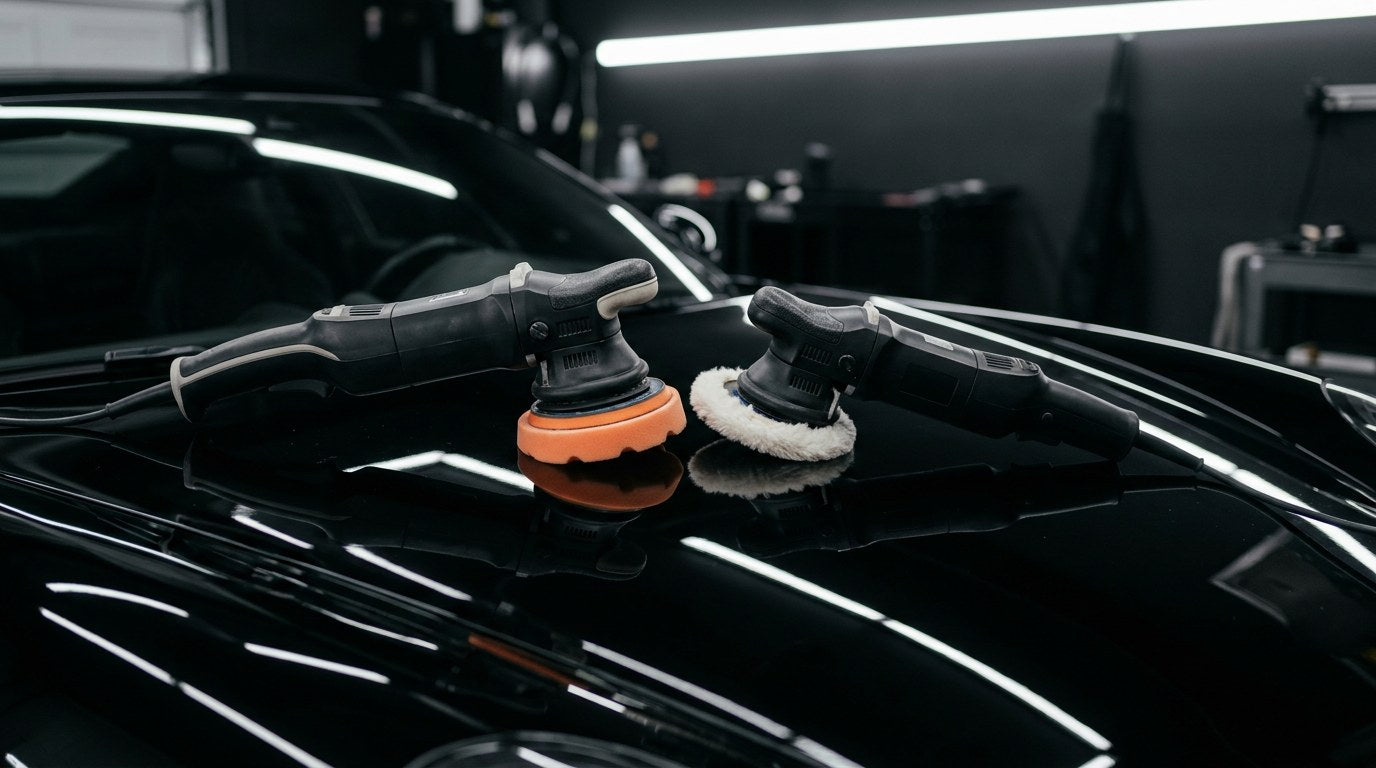
Hurricane rain is often mineral-heavy from disturbed water sources. If white ring spots remain after washing, use a dedicated water spot remover on cool paint. Deep-etched spots may need a light polish pass — see our DA vs rotary polisher comparison for the machine choice on that job.
Reseal or Retop the Coating
Even a strong ceramic coating takes a hit from horizontal rain, salt spray, and 60+ mph debris. A Quick Detail top-up after washing restores bead pattern immediately. If beading looks poor even after Quick Detail, the coating may need a fresh application on the impacted panels.
Hurricane Damage vs Normal Storm Damage
| Damage Type | Regular Storm | Hurricane / Tropical Storm | Recovery Approach |
|---|---|---|---|
| Mineral water spots | Light — usually washes off | Heavy — often etched | Water spot remover, sometimes polish |
| Salt exposure | Rare inland | Common up to 200+ miles inland | Rinse within 24 hours, iron remover on wheels/rockers |
| Flying debris scratches | Uncommon | Common — leaves, twigs, sand | Decon then DA polish to level |
| Falling debris dents | Rare | Common — branches, palm fronds | Paintless dent repair (PDR) if severe |
| Flood water intrusion | None | Possible | Professional inspection required |
| Coating hit | Minimal | Real — needs top-up or reapplication | Quick Detail spray, reapply if bead pattern is poor |
Coastal vs Inland Storm Prep
Coastal (Within 25 Miles of the Coast)
Salt is the enemy. Every storm brings measurable salt to paint, wheels, and undercarriage. Pre-storm iron remover on wheels and lower rockers is critical. Post-storm, rinse the undercarriage aggressively. Full decontamination twice a year is a coastal minimum, not a maximum.
Inland (25–200 Miles From the Coast)
Wind-driven debris is the bigger risk than salt for most storms, though strong hurricanes carry salt far inland. Focus prep on parking strategy and post-storm debris removal within 24 hours. Full decontamination once a year is usually sufficient unless a major hurricane hits directly.
Well Inland (200+ Miles From the Coast)
Remnant tropical systems still bring damaging wind and rain, but salt is largely rained out by the time systems reach here. Focus prep on tree/debris parking strategy and post-storm rinse to remove wind-driven grit.
Insurance and Documentation
Comprehensive auto insurance covers hurricane damage in most policies — hail, flooding, wind damage, and falling objects are typically included. Some tips that make a claim smoother:
- Take the pre-storm photos before every named storm — timestamped in your phone gallery
- Document damage the same day you can safely reach the car
- Do not attempt significant repairs before the adjuster inspection
- Save receipts for any post-storm detailing work — some policies reimburse detail services when tied to storm cleanup
- Never drive a flood-submerged car before an inspection — many policies deny coverage if you attempt to start it first
Detailing After a Major Direct Hit
If a hurricane hit your area directly, budget for a full detail day within a week of the storm passing. That means:
- Thorough two-bucket wash with Undrdog Soap
- Full 4-step decon (iron remover, tar remover, clay bar)
- Assessment of any scratches or dents needing correction
- DA polish on lightly scratched panels if needed
- Fresh ceramic coating application on any panels where the existing coating took heavy damage
- Undercarriage rinse focused on frame rails, subframes, and brake components
- Interior check for moisture — remove floor mats and check under seats
Storm on the way? Top up your paint before it hits.
Undrdog Quick Detail is a hydrophobic spray that boosts your existing ceramic coating's bead pattern and water sheeting in one wipe — the fastest pre-storm paint prep step you can do.
Shop Undrdog Quick Detail →Frequently Asked Questions
Should I wax my car before a hurricane?
A paste wax adds a very thin sacrificial layer but doesn't compare to a ceramic coating for hurricane protection. If you already have a ceramic coating, top it up with a hydrophobic spray. If you have no coating and 48+ hours before landfall, a fresh ceramic can reach initial cure in time. Skip stacking wax on top of a ceramic — it just needs to be removed later.
Is it safe to leave my car outside during a hurricane?
Only if a garage isn't available. Garaged is safer. If outside, park away from trees, on higher ground, away from power lines, and facing into the expected wind. Never park under a carport unless it's specifically engineered for hurricane winds.
Should I put a car cover on before a hurricane?
No. In sustained 40+ mph winds, a cover becomes an abrasive that grinds against paint for the entire storm, and metal grommets can dent panels. Leave the car uncovered.
How soon after the storm should I wash the car?
Within 24 hours of it being safe to work outside. Salt, mineral-heavy rain, and organic debris all bond to paint faster the longer they sit. Debris should come off dry first, then a thorough rinse, then a full wash.
Can I drive through hurricane flood water?
Avoid it. Water deeper than the bottom of your rocker panels can flood the engine bay, damage electronics, and total the vehicle. If you must cross flooded roads, do it slowly and in the highest gear that keeps the engine running steadily. Better to turn around.
Does a ceramic coating protect against hurricane damage?
A ceramic coating provides significant protection against water spots, salt bonding, and light debris scratches, but it can't stop dents from falling branches or major abrasion from sustained wind-driven grit. A coating reduces cleanup and prevents most surface damage — it does not make the paint impact-proof.
How do I remove water spots after a hurricane?
Start with a thorough wash. If white ring spots remain, use a dedicated water spot remover on cool paint. Deep-etched spots may need a light polish pass with a DA polisher and a finishing pad. Do not use household vinegar or acid cleaners — they can etch clear coat.
What about hail damage from a hurricane?
Hurricanes rarely produce large hail, but embedded thunderstorms can. Hail damage is dents in metal panels or cracks in glass. Paintless dent repair (PDR) handles most hail dents without repainting. File a comprehensive insurance claim before scheduling PDR — most policies cover hail with no deductible impact in disaster-declared areas.
Should I disconnect my car battery before a hurricane?
Only if the vehicle manual permits it. Many modern cars use the battery to preserve module memory and prevent electrical damage during long shutdowns. Disconnecting without following the manual can trigger fault codes and require dealer reset. Check first.
Do I need to re-coat my car after a direct hurricane hit?
Not always. After a thorough wash and decontamination, test the bead pattern with a hose. If water still beads tightly and sheets off cleanly, the coating survived and a Quick Detail top-up is enough. If beading is poor or gone in patches, those panels benefit from a fresh coating application after the paint has fully dried and prep is complete.

Leave a comment
This site is protected by hCaptcha and the hCaptcha Privacy Policy and Terms of Service apply.