

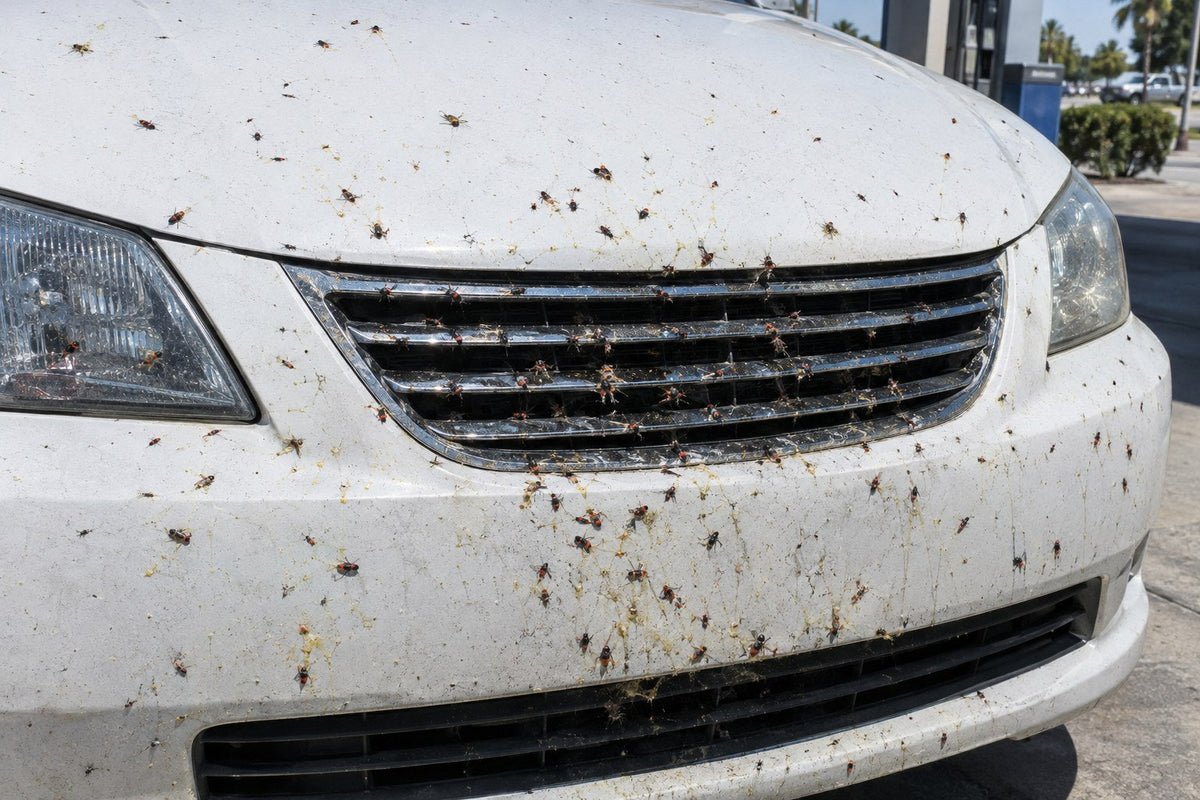
Lovebugs do not damage your paint on impact. Their remains are close to pH-neutral when they hit, turn acidic over roughly 24 hours as bacteria break them down, and only etch the clear coat once that film has baked in the sun for a day or two. That means the fix is a deadline, not a miracle product: soak the remains, never dry-wipe them, and get them off within 24 hours. A cured ceramic coating buys you margin on all three.
Florida's second lovebug flight of the year is under way right now, running late August through September, with Texas and the rest of the Gulf Coast on a similar schedule. Here is what actually happens to your paint, what the entomologists say versus what the internet says, and the exact process for getting them off without scratching anything.

When Is Lovebug Season? (September 2026 Timing)
Lovebugs (Plecia nearctica) are a species of march fly, and they show up in force twice a year. The University of Florida's UF/IFAS Featured Creatures entry puts it plainly: "Each of the two Plecia nearctica generations in Florida lasts about four weeks in April–May and August–September." The Texas A&M field guide gives the same pattern for Texas: "Large numbers of adults emerge primarily in the spring (May) and fall (September)." Timing runs earlier in South Florida than North Florida, which is why the Panhandle is typically the last to see them (Yahoo News, Sept 12, 2026).
Two pieces of good news. First, the season is short: about four weeks, then they are gone until spring. Second, there are fewer of them than there used to be. UF entomologist Dr. Norman Leppla told the Daytona Beach News-Journal this month that "the lovebug, Plecia nearctica, has decreased in abundance at most locations in Florida during about the past four years." Fewer bugs does not mean zero bugs, though, and a single highway commute can still coat a bumper.
What time of day they fly (and how to dodge the worst of it)
Lovebugs are daytime fliers and they are temperature-gated. UF/IFAS reports that "lovebug flight is initiated when the air temperature reaches about 68°F" and that "lovebugs do not fly during the night" (UF/IFAS Living with Lovebugs). The Featured Creatures entry adds that males start hovering between 8 and 10 AM, activity tends to drop after 10 AM, then picks back up from roughly 4 to 8 PM. Long highway drives at dawn or after dark will collect dramatically fewer bugs than the same route at 10 AM or 5 PM. Not always practical, but worth knowing if you have a choice.
Do Lovebugs Really Damage Car Paint? What the Research Says
Yes, but not the way most articles describe it. The popular version says lovebug guts are acidic and start dissolving paint on contact. The actual measurements tell a more useful story.
The pH shift: neutral at impact, acidic a day later
UF/IFAS cites direct measurements: "macerated lovebugs are about neutral with a pH of 6.5 but become acidic at 4.25 within 24 hours" (Living with Lovebugs). That is the whole mechanism. Fresh remains are roughly as acidic as milk. Left alone, bacteria break them down and the residue drops to about the acidity of tomato juice. The Featured Creatures entry describes the endpoint: "If the egg mass and body parts are allowed to remain on the vehicle for several days, bacterial action increases the acidity and etches the paint."
The sun is what does the damage
Acidity alone is not enough. The residue has to bake. UF/IFAS is explicit: "No permanent damage is caused, however, if the surface is cleaned before the coating is baked by the sun for a day or two." Dr. Leppla put it more colorfully to the News-Journal: lovebug eggs are "somewhat like chicken eggs in not damaging car paint directly. They aren't acidic or basic, rather it is the action of 'cooking' on the paint that causes the damage."
Put those together and you get a practical rule. Lovebugs on a car parked in a garage are a cosmetic problem. Lovebugs on a car sitting in a Gulf Coast parking lot at 2 PM are a clock that is already running.
So what does "etching" actually look like?
Etching is a shallow chemical dissolution of the clear coat, the outermost layer of your paint. Light etching shows up as dull, slightly hazy outlines the exact shape of the splatter that do not wash off. Deeper etching is a visible depression you can feel with a fingernail. Light etching can usually be polished out; deep etching that has gone through the clear coat cannot. This is the same failure mode as bird droppings and hard-water spots, and we covered the correction side in our water spot remover guide.
The Myth You Will Hear at Every Gas Station
Since you will be asked: no, the University of Florida did not create lovebugs in a lab to control mosquitoes. UF/IFAS addresses this directly, noting "it is a widely held myth that University of Florida entomologists introduced this species into Florida." The insects migrated from Central America into Texas and Louisiana in the 1920s and reached Florida in the 1950s and 60s, spread by "prevailing winds, vehicle traffic, sod transport, increased habitat along highways, and expansion of pastures, but not by UF researchers." They also do not bite, sting, or damage crops. They are purely a nuisance, mostly to your bumper.
How to Remove Lovebugs From Car Paint: The Safe Method
The two rules that matter: soak first, and never wipe a dry surface. Lovebug bodies are chitinous and gritty once they dry, and dragging a towel across dried remains grinds them into the clear coat. Everything below is built around lubrication and dwell time.

Step 1: Work in the shade, on a cool panel
A hot bumper flashes water and soap before either can do anything, and heat accelerates the very reaction you are trying to stop. Pull into a garage or shade, or wait for evening.
Step 2: Soak for five minutes, minimum
UF/IFAS's own removal guidance is a "soaking with water for about five minutes followed by a scrubbing within 15 to 20 minutes." Hose the front end down and keep it wet. If the remains are more than a few hours old, a dedicated bug remover or a foam pre-wash left to dwell does the softening work that water alone will not. Our foam cannon vs pump sprayer guide covers how to get a thick, clinging pre-soak without expensive gear.
Step 3: Wash with a pH-neutral soap and a clean, plush mitt
Aggressive alkaline cleaners will soften bug remains, but they also strip wax and sealant and can dull trim. A pH-neutral wash like Undrdog Soap lifts the softened residue without stripping whatever protection is already on the paint, and it is safe to use in direct sun if shade is not an option. Use a dedicated mitt for the front bumper and lower panels so you are not carrying grit onto the hood and doors. Light pressure only; let the lubrication do the work.
Step 4: Re-soak stubborn spots; do not scrub harder
Any remains that survive the first pass need more dwell time, not more force. Re-wet, wait another few minutes, and try again. A wet microfiber laid over a cluster for five minutes works as a poultice. Some detailers use a wet dryer sheet, which Dr. Leppla also recommends; it works because the sheet is soft and slightly textured, but keep it saturated and use it only on remains, not on clean paint.
Step 5: Rinse, dry, and inspect in good light
Dry with a clean towel and look at the panel at an angle. Faint outlines that do not wash off are early etching. Caught this early, most of it will polish out, and the sooner you correct it the less clear coat you remove doing so. A fine polish by hand or with a DA polisher handles most of it.
Step 6: Put protection back on
Washing removes whatever spray wax or sealant was on the front end. Reapply before the next commute. A hydrophobic quick detailer such as Undrdog Quick Detail adds a sacrificial slick layer in a few minutes, which is exactly what you want during a four-week bug season.
Lovebug Removal Methods Compared
| Method | Works on fresh remains | Works on baked-on remains | Paint safety | Notes |
|---|---|---|---|---|
| Water soak + pH-neutral wash | Yes | Partially; needs long dwell | Excellent | UF/IFAS's recommended baseline. First choice within 24 hours. |
| Foam pre-wash dwell | Yes | Yes, with 5–10 min dwell | Excellent | Softens without touching. Best step to add if remains are a day old. |
| Dedicated bug remover spray | Yes | Yes | Good; follow label dwell limits | Enzyme or surfactant based. Rinse thoroughly; some strip sealants. |
| Wet dryer sheet | Yes | Yes | Good if kept saturated | Recommended by UF's Dr. Leppla. Remains only, never dry. |
| Dry towel or paper towel | No | No | Poor | Grinds chitin into clear coat. The most common cause of front-end scratches. |
| Bug sponge / mesh scrubber | Risky | Risky | Poor on paint | Fine on glass. Marring on paint, especially dark colors. |
| Touchless car wash | Partially | Rarely | Good on paint; harsh on protection | High-alkaline pre-soaks help soften but strip waxes. See our touchless vs hand wash comparison. |
How to Protect Your Car From Lovebugs Before the Drive
Removal is the reactive half. Prevention is about making the front end slick enough that remains release with water, and durable enough that a daily rinse does not strip it.
Ceramic coating: the low-maintenance answer
UF/IFAS's own advice is that "the front of a vehicle can be protected by coating it with 'car wax' and removing the lovebugs within 24 hours." That advice predates modern coatings, and a cured ceramic does the same job better in two ways. First, the surface is far slicker and more hydrophobic, so a large share of fresh remains rinse off with a hose, and what remains releases with a short soak rather than a scrub. Second, the coating is a sacrificial chemically resistant layer between the acidifying residue and your clear coat. It is not a license to leave bugs on for a week, but it widens the window and makes the wash far gentler.
HCC Hybrid Ceramic Coating is our default recommendation here: a high-solids, hand-leveled coating that works on paint, gel coat, and plastics, so you can coat the bumper, headlights, and mirror caps along with the hood. If you drive a Gulf Coast highway commute, it is one of the few upgrades that saves you time every single week of both bug seasons. If you would rather start with an easier-application entry coating, Undrdog Pro covers the same ground with a shorter learning curve; see the HCC vs Pro comparison if you are deciding.
Spray protection for uncoated cars
No coating? A hydrophobic spray on the front end every week or two during the season does meaningfully reduce adhesion. It will not stop etching if you leave remains for days, but it makes the daily rinse effective.
Physical barriers
Bug deflectors and mesh grille screens reduce the count on the hood and radiator but do little for the bumper. Paint protection film on the front bumper and hood edge is the most complete physical answer and pairs well with a coating on top. Some drivers in heavy years tape a car-safe painter's tape or a temporary front bra on for long trips; that works, but remove it promptly, because adhesive residue baked on in Florida sun is its own cleanup job.
Timing and habits
Where you can: drive at dawn or after dark on long routes, park in the shade or a garage, and rinse the front end the same evening you notice a heavy hit. A two-minute rinse inside the 24-hour window prevents the problem entirely. A two-hour polishing session after a week does not always fix it.
Lovebugs on Motorcycles, Boats, and RVs
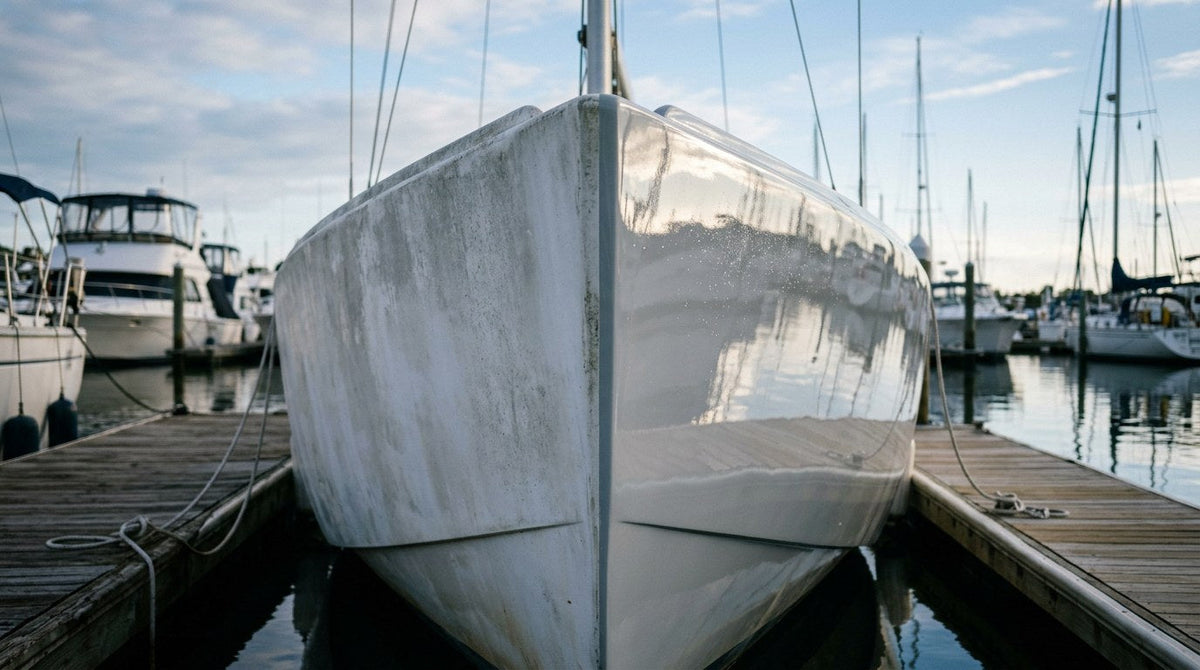
The same chemistry applies to anything with a painted or gel-coated surface facing the wind. Motorcycle fairings and helmets collect remains at a higher density than a car hood and are often left in direct sun. RVs and travel trailers accumulate a season's worth on a fiberglass front cap that is rarely washed weekly, which is why fall front-cap etching is so common. Boats trailered on Gulf highways pick them up too, and gel coat, being softer and more porous than automotive clear coat, etches faster. For those surfaces, a marine coating with the same rinse-and-soak discipline is the answer.
How Undrdog Fits In
You do not need a shelf of products for lovebug season. You need a pH-neutral soap that will not strip your protection, a hydrophobic top-up for uncoated cars, and, if you commute through it every year, a ceramic coating on the front end so the bugs release with water instead of elbow grease. That is the whole kit.
Make lovebugs a rinse, not a scrub.
HCC Hybrid Ceramic Coating gives your bumper, hood, and headlights a slick, chemically resistant surface so fresh remains release with water and baked-on remains soak off instead of grinding in. Sold to pros and DIYers in the same bottle.
Shop HCC Hybrid Ceramic Coating →
Lovebug Season FAQ
How long can lovebugs stay on my car before they damage the paint?
Roughly 24 hours is the safe window. Remains are near-neutral on impact and reach about pH 4.25 within a day as bacteria break them down. Etching happens when that acidified film bakes in the sun for a day or two. Garaged cars have more margin; cars parked in full sun have less.
When does lovebug season end in 2026?
Each flight lasts about four weeks. The fall flight runs late August through September in Florida and September in Texas, so most areas will see it taper by late September or early October. South Florida typically starts and finishes earlier than the Panhandle.
Are lovebugs acidic?
Not at first. UF/IFAS measurements put fresh macerated lovebugs at about pH 6.5, close to neutral. Bacterial decomposition drives the residue to about pH 4.25 within 24 hours, and it is that acidified, sun-baked film that etches clear coat.
Does a ceramic coating stop lovebug damage?
It reduces adhesion so fresh remains often rinse off, and it puts a chemically resistant layer between the residue and your clear coat, which widens the safe window. It does not make leaving bugs on for a week safe. Rinse the front end promptly and the coating will handle the rest.
Can I use a dryer sheet to remove lovebugs?
Yes, if it is kept fully wet and used only on the remains. UF entomologist Dr. Norman Leppla recommends wet dryer sheets. A dry sheet, or a wet one dragged across clean paint, can mar the finish.
Will a touchless car wash remove lovebugs?
Partially. The high-pressure water and alkaline pre-soak remove fresh remains but often leave baked-on residue, and the pre-soak strips waxes and spray sealants. For a heavy hit, a hand wash with a soak is more effective and gentler on your protection.
What time of day do lovebugs fly?
Daytime only, once air temperature reaches about 68°F. UF/IFAS reports peak hovering from 8 to 10 AM, a lull, and a second surge from roughly 4 PM to dusk. Driving at dawn or after dark collects far fewer bugs.
Did the University of Florida create lovebugs?
No. UF/IFAS calls this a widely held myth. Lovebugs migrated from Central America into Texas and Louisiana in the 1920s and spread to Florida by the 1950s and 60s, helped by wind, vehicle traffic, sod transport, and highway habitat.
How do I fix paint that lovebugs already etched?
Light etching, seen as dull outlines that do not wash off, usually polishes out with a fine polish and a DA polisher or by hand. Deep etching that has cut through the clear coat needs professional correction or repainting. The earlier you polish, the less clear coat you remove.


Leave a comment
This site is protected by hCaptcha and the hCaptcha Privacy Policy and Terms of Service apply.