


No: a “low-VOC” ceramic coating claim does not, by itself, mean the product is non-toxic or suitable for use without precautions. EPA explains that some substances excluded from outdoor-air VOC regulation can still matter for indoor health, and that a lower total VOC figure does not automatically identify a safer product (EPA's explanation of low-VOC labels). A specific, supported VOC claim can be useful; the mistake is asking it to answer every safety and performance question.
Our buying recommendation is straightforward: ask what the claim measures, which definition it uses, and what the actual product instructions require. Keep those answers separate from how glossy the car looks or how long the coating is expected to last. This is a guide to reading claims, not a toxicological assessment of a named coating or a workplace exposure survey.
What VOC means depends on the question
VOC stands for volatile organic compound, but the meaning used in an outdoor-air regulatory context is not identical to the broader indoor-air discussion. EPA explains that its outdoor regulation focuses mainly on compounds' contribution to photochemical smog, while indoor-air concerns include the health effects of substances to which people are exposed (EPA technical overview).
That distinction matters before you compare two numbers. EPA describes exemptions for compounds with negligible photochemical reactivity and notes that definitions and exclusions can differ between regulatory contexts (regulatory-definition discussion). Do not assume that everything excluded from a particular VOC calculation is therefore irrelevant to handling or indoor air.
Ask the supplier to finish the sentence: “Low VOC under which definition, for which product and use?” Then ask for the unit, document date, and whether the statement describes content in the product or emissions from it. Those are recommended clarification questions, not a demand for a confidential formula or a conclusion that the claim is wrong.
Do not transfer a limit quoted for another product category or jurisdiction to the coating in your cart. If a specific legal requirement determines what you may buy or use, confirm applicability with the supplier and the relevant authority. This article does not determine whether any particular automotive coating complies with a particular VOC rule.
VOC content, emissions, and toxicity are different claims
EPA distinguishes labeling based on regulated VOC content from labeling based on emissions and potential indoor-air effects (product-labeling discussion). The FTC separately advises that a non-toxic claim needs evidence addressing people and the environment, or a clear qualification explaining the narrower claim (FTC consumer guidance). Read the exact claim rather than letting one appealing phrase stand in for all three subjects.
| Claim or information supplied | Useful question to ask | Conclusion not to add automatically |
|---|---|---|
| Low-VOC content | Which definition, unit, calculation or test, and product version? | The product is non-toxic or needs no handling precautions |
| Low emissions | Which compounds, method, conditions, sampling period, and criteria? | The result covers every compound or every installation environment |
| Non-toxic | What evidence supports the claim, and does it address people and the environment? | A low regulated VOC number alone establishes that evidence |
| Safety data sheet | Does it match the exact product and explain the relevant hazards and controls? | It independently proves coating durability or comparative quality |
| Coating performance claim | What product-specific result supports the promised property? | The result establishes safe liquid handling or indoor exposure |
The table is our buyer's checklist, not a mandatory report format or a ranking of products. It draws on the EPA distinctions above and OSHA's explanation that an SDS communicates hazards, protective measures, and handling precautions (OSHA's SDS-format brief). Keep each document attached to the question it can actually answer.
Why a smaller VOC number is not a complete safety ranking
EPA explicitly cautions that individual compounds included in a total VOC measure can differ widely in toxicity, so reducing the total does not always assure a safer product (EPA household-products FAQ). That is a limitation on the inference, not an argument that reducing relevant emissions has no value.
In fact, EPA identifies reducing indoor and outdoor VOC concentrations as an important health and environmental goal while stressing the need to understand what the definition includes (technical overview conclusion). Avoid replacing one oversimplification with its opposite. “Lower must always be safer” and “VOC information is meaningless” are both poor buying rules.
Consider a hypothetical comparison in which one supplier provides a VOC-content figure under a named rule and another provides an emissions report for a defined test. Our recommendation is not to declare a winner from the smallest-looking number. First ask each supplier to identify the measured quantity, unit, scope, and conditions so you can understand whether the information answers the same question.
Likewise, do not turn a missing figure into an invented one. Mark it as unavailable, ask for clarification, and decide whether that unresolved requirement prevents you from proceeding. A gap in the information supplied is not proof that the product is either harmless or unsuitable.

What to ask when a coating is called non-toxic or green
The FTC advises that marketers calling a product non-toxic should have proof that it is safe for both humans and the environment; if the claim applies to only one, that qualification should be stated (FTC on non-toxic claims). Treat that as a reason to request a precise explanation, not as a basis for accusing a seller without examining its wording and evidence.
For your own purchasing notes, separate the quoted wording from your interpretation. Write “the page says low-VOC” rather than “the page says no protective equipment is needed” unless that second statement is actually there. Do the same with a supplier's response: record what it confirms and what it leaves unanswered.
We recommend asking whether the statement concerns the liquid during application, the installed coating under stated conditions, or a particular use. Then request the evidence relevant to that specific scope. Do not take a statement about one stage and use it as permission to disregard instructions at another stage.
Broad environmental language also deserves detail. The FTC's consumer guidance tells shoppers to look for specific explanations rather than relying on unqualified green or eco-friendly wording (environmental marketing guidance). Ask what benefit is being claimed and what comparison, if any, is being made; do not assume the package's visual design supplies the missing answer.
How to read an emissions claim without overreading it
An emissions result needs a method. EPA explains that available measurement methods are selective, differ in what they quantify, and cannot each measure all VOCs present; it recommends accompanying statements about environmental VOC measurements with a description of how they were measured (measurement discussion).
Use that principle to organize a request for information. Ask for the tested product identity, method, measured compounds or reported grouping, test conditions, sampling period, and the criterion behind any “pass” statement. If the report does not include a detail that matters to your decision, ask the issuer or supplier rather than reconstructing it from the headline.
For a certificate or laboratory document, our guide to verifying a coating lab report covers identity and scope checks. Keep that document-authentication task separate from understanding the VOC claim itself. A traceable report is useful, but you still need to read the property and conditions it addresses.
Do not stage a garage experiment to fill the gap. Our recommendation is to avoid intentionally inhaling vapors, enclosing yourself with a product, or using an improvised exposure challenge. If your question is whether a specific workplace is adequately controlled, seek qualified safety advice for that product and activity instead of treating a consumer comparison as an exposure assessment.
Turn the safety information into an installation decision
The SDS is a practical starting document, not a reassurance badge. OSHA's SDS-format brief identifies Section 2 for hazards, Section 7 for handling and storage, and Section 8 for exposure controls and personal protection (OSHA SDS navigation guidance). Use the current sheet for the exact product, along with its label and application instructions.
Our SDS safety-versus-performance guide explains that broader document boundary. For this VOC decision, the immediate question is whether you can follow the specified precautions in the place and manner you intend to work. Do not downgrade those precautions because an advertisement uses a reassuring adjective.
- Product match: Confirm the bottle, label, instructions, and safety sheet refer to the product you will actually use.
- Work area: Resolve ventilation and other environmental requirements before opening the container. Do not invent an airflow rate or assume an open door is always sufficient.
- Protection: Follow the actual equipment requirements and obtain qualified guidance where selection is unclear. A generic glove or mask recommendation is not a substitute for the product's requirements.
- Handling: Plan storage, spill response, and separation from incompatible activities according to the relevant instructions.
- Stop point: Delay the job when the information conflicts, the product identity is uncertain, or the required precautions cannot be met.
This is our planning checklist, not a complete safety procedure or a statement that every coating needs identical controls. OSHA's brief places engineering controls and personal protective measures in the context of the chemical's hazards and potential exposure (Section 8 explanation). Use product-specific information rather than borrowing a setup from another bottle.
If you are hiring a detailer, ask how the planned installation follows the product instructions and how questions will be referred to the supplier. Do not demand that the technician improvise a toxicology lecture. Preparation, controlled application, and responsible handling are worthwhile parts of the service, not distractions from the coating itself.

A short message to send before buying
Use a narrow request rather than asking whether a product is simply “safe.” The following is suggested wording for your own inquiry, not a quotation from a customer or a supplier:
I'm considering this coating for a specific surface and work area. Could you clarify what the low-VOC claim refers to, the definition or method used, and the product version covered? Please also point me to the current label, application instructions, and SDS, and explain any separate non-toxic or emissions claim that is part of the recommendation.
Save the response with the product information and date you reviewed it. End your note with two lines: “What is supported?” and “What remains unresolved?” That makes a narrow useful answer easier to preserve without quietly expanding it into a guarantee.
Be reasonable about confidential information. Ask for relevant safety documentation and an understandable explanation of the advertised claim, not unrestricted access to a proprietary recipe. If the necessary use-specific answer remains unavailable, pause the purchase or installation rather than guessing.
How Undrdog does it
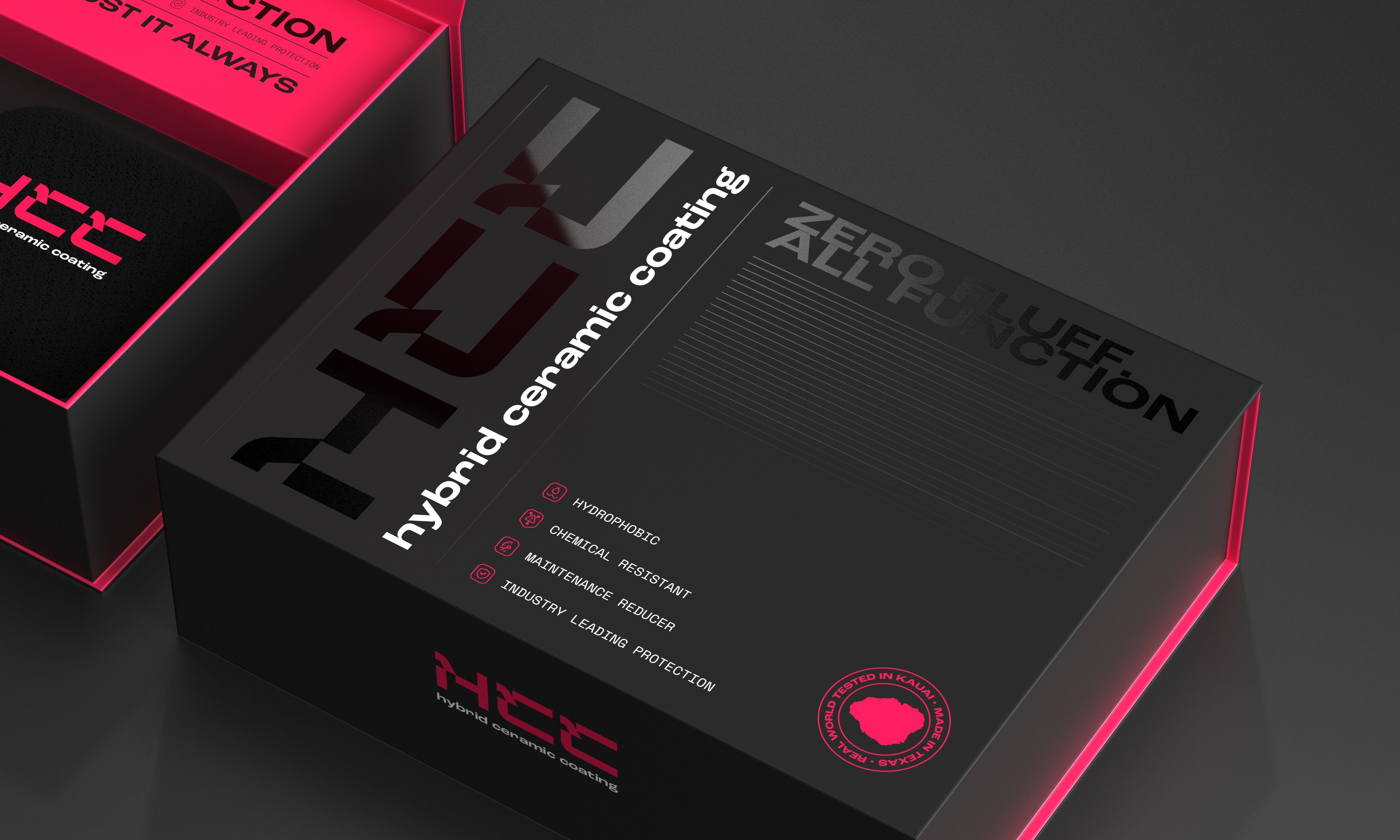
HCC Hybrid Ceramic Coating is Undrdog's all-surface flagship for suitable projects involving cars, boats, planes, and bicycles. It is positioned for multi-year protection, with actual durability dependent on preparation, exposure, use, and maintenance rather than a fixed lifespan for every installation (current HCC product information).
Apply the same questions to us. This article does not publish a measured HCC VOC value, an emissions-test result, or a non-toxic certification. It also does not infer any of those from the word “hybrid,” the appearance of the finished vehicle, or the product's durability positioning.
HCC's current public safety instructions call for use outdoors or in a well-ventilated area, avoiding ignition sources, and wearing the specified protective equipment (HCC ingredients and safety section). Follow the current product-specific label and safety information; do not reinterpret general brand language as permission to ignore those directions.
For a suitable new coating project, start with HCC's surface and application requirements and ask Undrdog about any specific restriction that determines your purchase. If your work area cannot meet the requirements, change the plan or obtain qualified help. A realistic preparation and handling plan is more useful than an adjective that leaves the important question unanswered.
Frequently asked questions
Does low-VOC mean a ceramic coating is non-toxic?
No. EPA explains that some compounds excluded from outdoor VOC regulation can still be relevant to indoor health, and that lower total VOC does not automatically establish a safer product (EPA guidance). Check the actual claim and product-specific precautions.
Does zero-VOC mean nothing can evaporate?
Do not infer that from a label. EPA distinguishes regulated VOC content from the broader set of compounds relevant to indoor emissions (definition and labeling discussion). Ask which definition and measurement support the statement.
Is a lower VOC number always a better buying choice?
It is not a complete safety ranking. EPA notes that individual compounds can differ in toxicity, so the total alone does not settle the comparison (EPA FAQ). Consider the precise evidence, suitability, and handling requirements rather than only the smallest number.
What evidence should support a non-toxic claim?
The FTC says marketers should have proof addressing safety for both humans and the environment, or clearly state the narrower scope when only one is covered (FTC guidance). Ask what evidence supports the exact wording rather than substituting a VOC-content claim.
Can I skip protective equipment if the label says low-VOC?
Do not use that marketing phrase to override the product's label or safety instructions. Consult the exact product's exposure-control and personal-protection information; OSHA identifies those subjects in SDS Section 8 (SDS-format guidance). Resolve unclear requirements before use.
Does an emissions report cover every VOC?
Do not assume it does. EPA explains that measurement methods are selective and differ in the compounds they quantify (measurement limitations). Read the method, measured compounds, conditions, and reporting scope.
Does this article certify HCC as low-VOC or non-toxic?
No. It presents no new HCC VOC measurement, emissions report, or non-toxic certification. Review the current HCC product information and ask Undrdog about evidence or restrictions relevant to your intended use before buying.
What should I do when the claim and safety directions seem inconsistent?
Keep the precautions in place and ask the supplier to clarify the exact product, document version, and claim scope. Delay use if you cannot resolve the conflict or follow the requirements. Do not choose the more reassuring wording as a shortcut.
Choose the coating with the right information in hand
Review HCC's current surface, preparation, and safety directions for your next suitable project.
Shop HCC Hybrid Ceramic Coating

Leave a comment
This site is protected by hCaptcha and the hCaptcha Privacy Policy and Terms of Service apply.