


"Hybrid ceramic coating" has no standardized definition. In practice it means a product that blends silica-based (SiO2) ceramic chemistry with something else, usually an organic polymer or resin, and the same three words are used on everything from a $15 spray-and-rinse wax to a professional coating that has to be leveled by hand. The word is not meaningless, because ceramic-polymer hybrids are a real class of materials with real advantages, but on its own it tells you almost nothing about how a product will perform. What predicts performance is what you can verify: what the cured film is made of, how much of the bottle is actual solids, how it crosslinks, and how it is prepped and maintained.
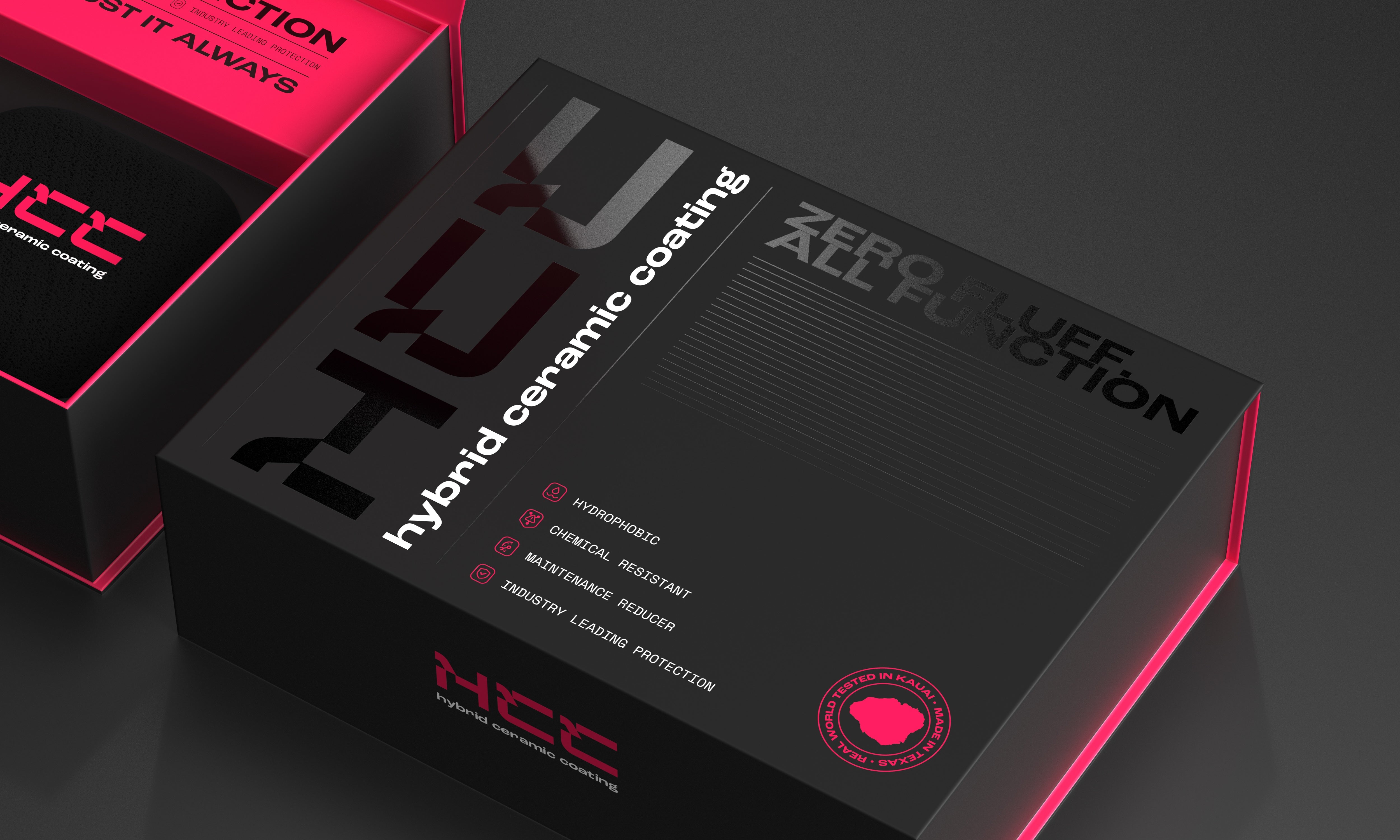
Undrdog sells a coating called HCC Hybrid Ceramic Coating, so this is not an outside critique. It is an explanation of what the term means when we use it, what it means when it shows up on a spray bottle at the parts store, and the questions that separate the two.

Where the "Hybrid" Claim Is Right
Start with the honest part. Nearly every consumer "ceramic" coating is already a hybrid whether the label says so or not. A coatings chemistry explainer from National Synthetics puts it directly: "The word 'ceramic' is technically correct in the sense that the cured film is a ceramic-organic hybrid, but it is not a kiln-fired ceramic." The active ingredients are typically silane or siloxane precursors that react with moisture (hydrolysis: Si-OR + H2O → Si-OH + ROH), then link to one another (condensation: Si-OH + HO-Si → Si-O-Si + H2O) to form a silica-rich, crosslinked film. The organic side groups hanging off that inorganic backbone are what give the film flexibility and water repellency.
Materials science treats this as a legitimate, well-studied category. A 2024 review in Frontiers in Coatings, Dyes and Interface Engineering describes why you would choose a hybrid in the first place: "a rigid backbone is provided by the ceramic (metal oxide network) moiety and a flexible structure by the polymeric moiety." Pure inorganic films are hard but brittle and prone to cracking on a substrate that flexes and expands with heat; pure polymer films are flexible but soft and chemically weaker. Blending the two is how you get a film that is hard enough to resist chemical attack and flexible enough to stay attached to a car door in August. So "hybrid" is not a made-up word. The problem is what happens to it in marketing.
The Same Word on Four Very Different Products
The detailing glossary at New Again gives the practical industry definition: "In detailing, a hybrid product is a protective product that mixes two or more types of chemistry in one bottle." That is a low bar. Under it, all of the following legitimately qualify:
- A rinse-activated spray wax with SiO2 added. One large consumer brand describes its version as "Car wax with SiO2 hybrid technology" that "delivers extreme water-beading action and long-lasting protection against the elements" (manufacturer product page). It is applied to a wet car and rinsed off. It is a good product for what it is: a topper that lasts weeks to a few months.
- A spray "ceramic coating." Another consumer line describes its range as "Using a combination of conventional and pro level ceramic technology" (manufacturer collection page). These are spray sealants with silica polymers blended into a wax or silicone emulsion base. Independent reviewers generally describe them as durable for a few months to a year (Jimbo's Detailing lists "hybrid sealants" at "6–12+ months of durability").
- A resin-modified professional coating. A high-solids liquid, applied with an applicator, flashed, and leveled with towels. The polymer or resin component is a structural part of the cured film, not a carrier. This is the category HCC belongs to.
- A graphene-labeled ceramic. Also a hybrid, technically: a silane/siloxane coating with graphene oxide particles suspended in it. Jimbo's Detailing describes them as "still ceramic coatings with a small amount of graphene oxide added."
Products one and three share three words on the label and almost nothing else: not the solids content, not the application method, not the cure, not the durability, not the price. That is the whole problem with the term. It is accurate on all four bottles, and it distinguishes none of them.
What "Hybrid" Does Not Tell You
It does not tell you the solids content
The number that matters most is how much of the liquid stays on the car after the solvent evaporates. A spray topper is mostly carrier by design; that is what makes it sprayable. A professional coating is mostly resin and silica. EuroLuxe Detailing gives ballpark ranges that are commonly cited in the trade: professional-grade coatings "typically 70-85%" active content versus consumer products that "may contain 30-50% with the remainder being carrier solvents and fillers." Treat those as rough industry figures, not a lab result, but the direction is right. Two products can both say "hybrid ceramic" and differ by a factor of two or more in what actually ends up on the paint.
It does not tell you which chemistry is doing the work
A "hybrid" can be 95% wax with a splash of silica, or 95% reactive siloxane with a resin modifier. The label will not say. Coatings retailer Black Diamond's chemistry explainer notes the reactive backbone of true coatings is usually "aminoalkoxy siloxanes" whose methoxy groups "react with water to form Si–OH (silanol) groups," producing "a thin, flexible protective layer of crosslinked silicone (Si–O–Si bonds), which is effectively bonded to your paint" (Black Diamond Products). A wax-based hybrid does not do that. It sits on the surface, held by weak physical adhesion, and comes off with strong detergents. Same word, completely different bonding mechanism.
It does not tell you anything about durability
This is where "hybrid" gets stacked with other numbers to imply a result. A spray hybrid with a "12-month" claim and a professional hybrid with a "5-year" claim are both making a marketing decision, not reporting a measurement. We covered why year figures on coatings are unverifiable in the first Zero Fluff post, How Long Does Ceramic Coating Really Last?. The short version: durability depends on prep, environment, and wash habits far more than on which adjective is on the label.

The Buzzword Companions: 9H, Nano, Quartz, Graphene, SiO2 Percentage
"Hybrid" rarely travels alone. Here is what its usual companions technically mean and what they leave out.
| Term on the label | What it technically means | What it leaves out | What to ask instead |
|---|---|---|---|
| Hybrid ceramic | SiO2 / siloxane chemistry blended with an organic polymer, resin, or wax | Ratio of the two, solids content, bonding mechanism, application method | "What is the solids content, and is this wiped and leveled or sprayed and rinsed?" |
| 9H | Pencil hardness (ASTM D3363 / ISO 15184): the film resists scratching by a 9H graphite pencil under a fixed load | 9H is the top of a 20-grade pencil scale, not the Mohs mineral scale; the test was designed for industrial coatings on metal; a thin film can pass while offering minimal real-world scratch resistance | "Who ran the test, on what film thickness, and can I see the report?" |
| Nano | Particles or films measured in nanometers; nearly all cured coatings are nanoscale films | Nothing about performance; it describes size, not behavior | Ignore it as a differentiator |
| Quartz / SiO2 / silica | Silicon dioxide, the glass-forming compound in the cured film | A percentage on the label is not standardized: it may refer to the raw liquid or the cured film, and is rarely third-party verified | "Is that percentage of the liquid or of the cured film, and who measured it?" |
| Graphene | A ceramic coating with graphene oxide particles suspended in it | Independent shops report the particles are largely removed during leveling and contribute little once cured | "What does the graphene do in the cured film that the base coating does not?" |
| Self-healing | Usually borrowed from paint protection film, where a thermoplastic top layer reflows under heat | A cured siloxane film is thermoset; it does not reflow. Any "healing" is a temporary fill effect | "Show me the scratch closing on a cured panel, not on film." |
A closer look at 9H, since it appears on almost every hybrid
The pencil hardness test is real and standardized. Dulvap's hardness explainer identifies the governing standards as "ISO 15184 and ASTM D 3363," and EuroLuxe describes the mechanic: "A pencil of a specific grade is held at a 45-degree angle and pushed across the coated surface under controlled pressure," on a scale that "runs 20 grades from 9B (softest) to 9H (hardest)." ASTM itself describes D3363 as "a procedure for rapid, inexpensive determination of the film hardness of an organic coating on a metal or similar substrate" (ASTM D3363-22 scope). Rapid and inexpensive is the point: it is a factory QC screen, not a durability test. It says nothing about how the film handles wash-induced marring, bird droppings, or two years of UV. And because 9H is the top of the scale, the claim has no headroom; it cannot tell a good coating from a great one.
And graphene, since it is the newest one
Black Diamond's assessment is representative of what independent formulators and detailers tend to say: graphene coatings are "just one of the coating types we've already covered but now with additional small graphene particles suspended in solution," and "it is common knowledge within the industry that in practice these suspended particles do little to nothing, as they are mostly removed during buffing." Jimbo's Detailing reaches a similar place from a testing angle: "when detailers test them on real cars, the results rarely match the hype." Label these as trade and forum consensus rather than peer-reviewed data, because that is what they are. But the burden is on the claim, and so far the claim has not carried it.
What Actually Predicts Whether a Hybrid Coating Performs
If the label will not tell you, what will? Four things, roughly in order of importance.
1. Prep
Any reactive coating bonds to what it touches. If that is bonded iron, old sealant, or polishing oils, the coating bonds to those instead of to the clear coat, and it leaves when they do. A cheap hybrid on perfectly decontaminated paint will often outlast an expensive one applied over a quick wash. Our four-step paint decontamination guide covers what that prep actually involves.
2. Film build
How much cured material is on the panel. This is driven by solids content and by application: a wipe-on, level-off coating deposits a continuous film; a spray-and-rinse product deposits whatever survives the rinse. Film build is what gives a coating chemical resistance, because acid and alkali have to get through the film before they reach the paint.
3. Crosslink density
How tightly the film is bonded to itself. A densely crosslinked network is harder for solvents and detergents to swell and lift. This is where a well-designed resin-modified hybrid earns its name: the organic component is not a filler, it is part of the network, adding flexibility without opening it up. Cure conditions matter here, which is why our cure time guide exists.
4. Maintenance
pH-neutral washes, no brush tunnels, and periodic decontamination. Nothing on the label can save a coating from a year of high-alkaline touchless pre-soaks. This morning's Detailing Blog post on touchless vs hand washing gets into the chemistry.
Notice that none of these four are words. They are conditions and measurements. A brand that talks about them is telling you something; a brand that leads with adjectives is asking you to trust it.
How Undrdog Does It
We use the term. Here is what we mean by it, straight from the HCC product page, so you can hold us to it.
- The "hybrid" is a resin matrix, not a wax base. The page describes HCC as using "a proprietary hybrid resin matrix that cures into a dense, crosslinked protective shell," and explicitly contrasts it with silane, polysiloxane, or silica-based coatings "that rel[y] on fragile crystallization and flashy filler." The organic component is structural.
- High solids, and we say so. HCC is described as "high-solids," with "actual solids you can see," and "nothing added for liquid volume enhancement, false slickness, or cosmetic gimmicks like graphene." We are not going to argue graphene is worthless in every application; we just do not put it in a coating for the label.
- We publish where it was tested, not a hardness number. The page lists the states where HCC was tested (Hawaii, California, Texas, Florida, Michigan, and New York) on real vehicles in real climates rather than on lab panels. You will not find a 9H stamp on the bottle, for the reasons in the table above.
- No year on the bottle. We do not add years to coatings because no one knows how long a coating will last any more than a car manufacturer can tell you how many miles your engine is guaranteed to run. An engine's life depends on how it is driven and maintained. A coating's life depends on prep, environment, wash habits, and what it is exposed to. A year stamped on a bottle is a marketing decision, not a measurement.
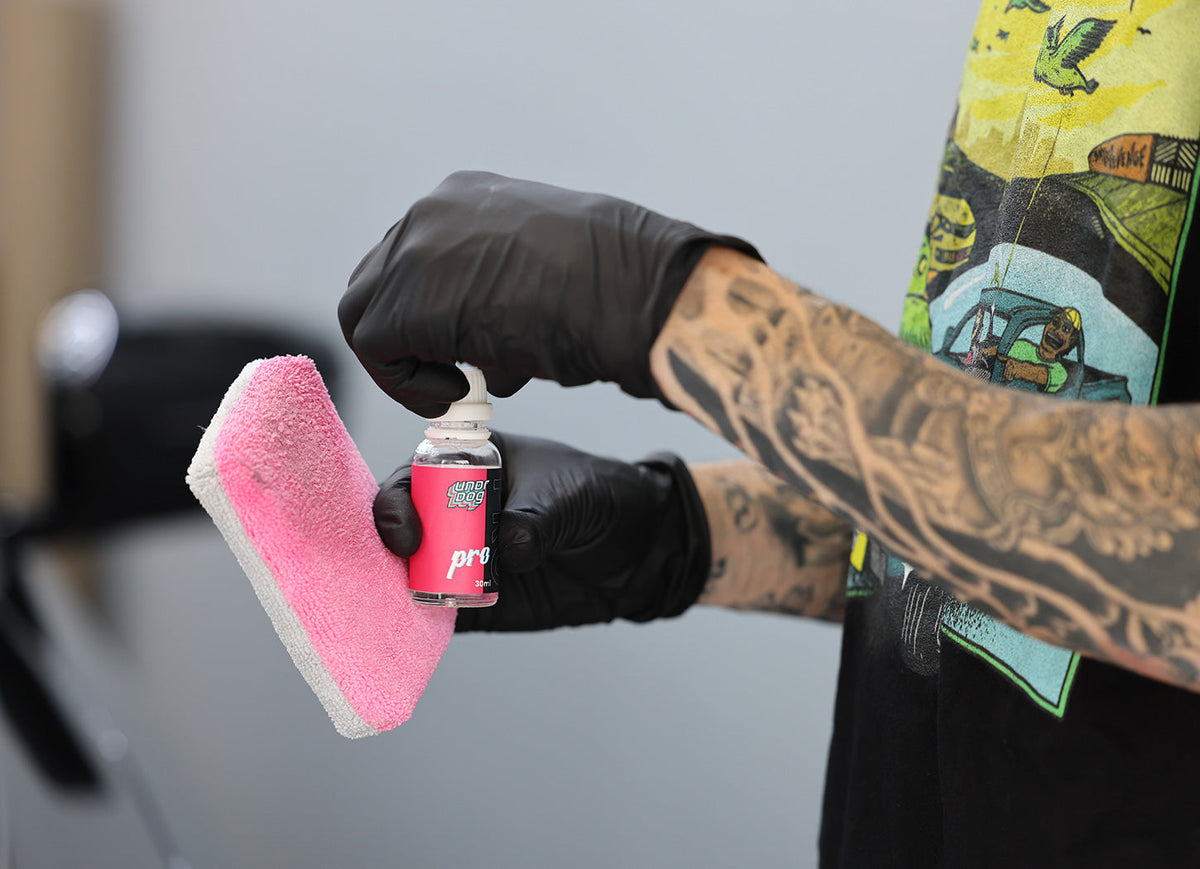
- Same bottle for pros and DIYers. HCC, Undrdog Pro, and Pro Plus are sold without a certification class or a minimum buy. Pro is described on its page as a PTFE, silicon, and paraffin blend built on "real, measurable benefits" and "substance over buzzwords." We covered the installer-only model in yesterday's Zero Fluff post.
Does that make HCC the only honest "hybrid" on the market? No, and we would be doing the thing this article criticizes if we said so. It means that when you see the word on our label, you can go to the product page and find what it refers to. Ask the same of any other bottle that uses it.
Judge the film, not the adjective.
HCC Hybrid Ceramic Coating is a high-solids, resin-modified coating you level by hand, sold to professionals and DIYers in the same bottle, with the chemistry described on the product page instead of a hardness badge.
Shop HCC Hybrid Ceramic Coating →
Hybrid Ceramic Coating FAQ
What does "hybrid ceramic coating" mean?
It means a product that blends silica-based (SiO2 or siloxane) ceramic chemistry with an organic component such as a polymer, resin, or wax. There is no standardized definition, so the term appears on spray waxes, spray sealants, and hand-leveled professional coatings alike.
Is a hybrid ceramic coating better than a pure ceramic coating?
Not automatically. Nearly all consumer "ceramic" coatings are already ceramic-organic hybrids once cured. Materials science favors hybrids because the inorganic network adds hardness and chemical resistance while the organic portion adds flexibility, but the ratio, solids content, and application method decide performance, not the label.
Is hybrid ceramic spray wax the same as a ceramic coating?
No. A spray or rinse-activated hybrid wax is a maintenance topper that typically lasts weeks to a few months and sits on the surface. A hand-applied hybrid coating deposits a thicker, chemically bonded, crosslinked film that is prepped, leveled, and cured. They share three words and little else.
What does 9H mean on a ceramic coating?
9H is the top grade of the pencil hardness scale (ASTM D3363 / ISO 15184), meaning the cured film resisted scratching by a 9H graphite pencil under a fixed load. It is not the Mohs mineral scale, it is a quick factory QC test rather than a durability test, and because 9H is the top of the scale it cannot distinguish a good coating from a great one.
Does the SiO2 percentage on a coating matter?
Solids content matters a great deal, but the percentage printed on a label is not standardized. It may describe the raw liquid or the cured film and is rarely verified by a third party. Ask which it refers to and who measured it before treating it as a comparison point.
Are graphene coatings better than hybrid ceramic coatings?
Graphene coatings are themselves hybrids: ceramic coatings with graphene oxide particles added. Independent formulators and detailers commonly report that the suspended particles are largely removed during leveling and contribute little to the cured film. Treat graphene as an unproven additive until a brand shows what it does in the cured film.
How can I tell if a hybrid coating is a real coating or a topper?
Check the application method and the cure. A real coating is applied with an applicator, flashes, is leveled with towels, and has a stated cure period. A topper is sprayed on and wiped or rinsed off. Also look for a stated solids content and a description of the cured film's chemistry.
What predicts how long a hybrid ceramic coating will last?
Prep quality, film build, crosslink density, and maintenance habits, in roughly that order. Environment matters too: coastal salt, tropical UV, and industrial fallout shorten any coating's life. No adjective on the label changes those variables.
Why doesn't Undrdog put a year or a hardness number on HCC?
Because neither is a measurement of how the coating will perform on your vehicle. Durability depends on prep, environment, and maintenance, the same way an engine's life depends on how it is driven and serviced rather than a number a manufacturer could guarantee. The product page describes the chemistry, the solids, and where it was tested instead.

Leave a comment
This site is protected by hCaptcha and the hCaptcha Privacy Policy and Terms of Service apply.