

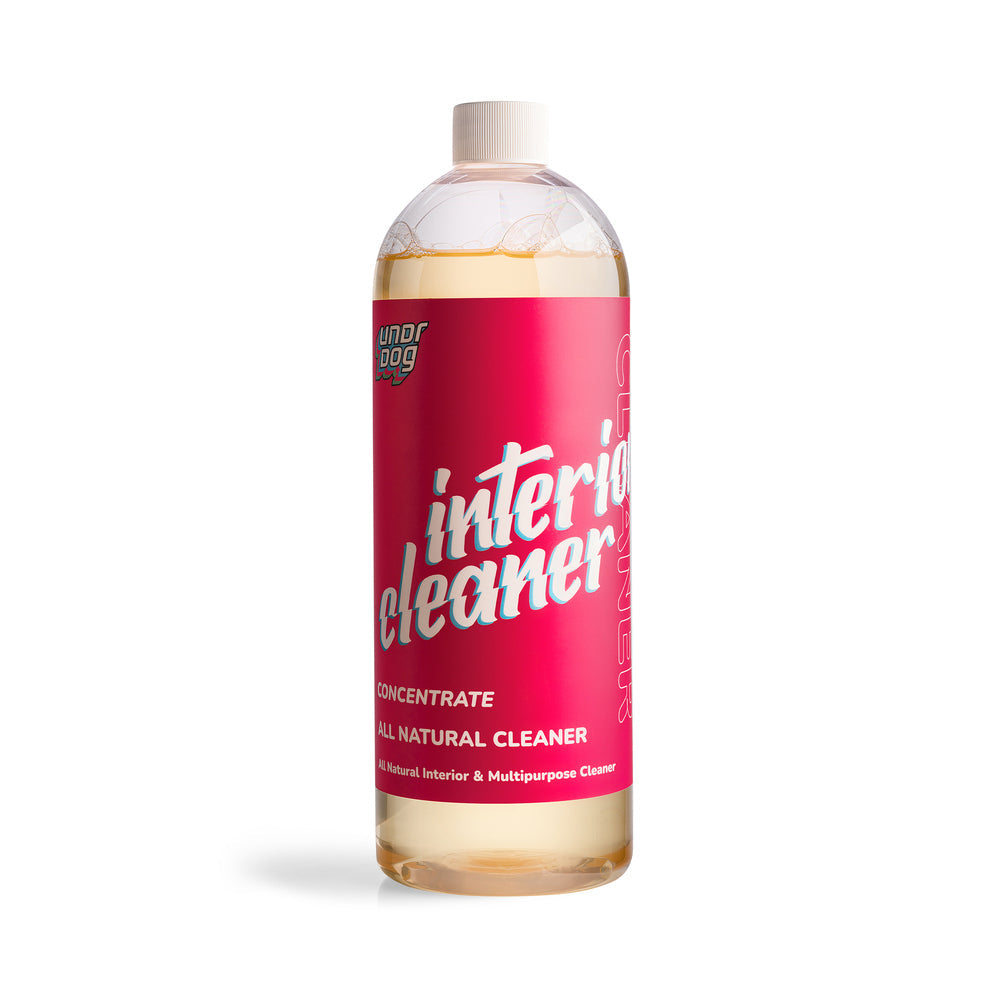
Undrdog Interior Cleaner Concentrate is mixed at one part concentrate to eight parts water. That makes nine total parts, not eight. For a 900 mL batch, measure 100 mL of concentrate and 800 mL of water. Label the mixture, test the intended surface, and apply it in controlled amounts rather than spraying or pouring indiscriminately.
Accurate dilution is only the first part of interior cleaning. You still need to identify the material, review the applicable care instructions, patch-test an inconspicuous area, and avoid soaking. The aim is a repeatable preparation routine that respects the differences between trim, fabric, leather-related surfaces, displays, and nearby electronic components.
Start with the ratio, not the bottle size
The product direction is one part concentrate to eight parts water. Calculate the batch from the total volume you want to make instead of trying to fill a bottle by eye. The concentrate represents one ninth of the finished mixture, while the water represents eight ninths.
| Concentrate | Water | Total mixture | When it may help |
|---|---|---|---|
| 100 mL | 800 mL | 900 mL | A convenient clearly labeled working batch |
| 50 mL | 400 mL | 450 mL | A smaller batch for limited cleaning |
| 1 part | 8 parts | 9 parts | The general ratio for another batch size |
These examples show how to apply the 1:8 ratio to different batch sizes. Choose an amount that matches the work in front of you. Preparing only what you need can make labeling and identification easier, while a measured larger batch may be more convenient for a full interior service.
Measure and label every mixed bottle
A measuring cup, graduated container, or another tool with clear volume markings is more reliable than estimating. Keep the containers stable, read the markings at eye level, and measure the concentrate and water separately. If your shop tracks batches, record the date or job identifier as part of your normal records.
Mixing checklist
- Confirm that the bottle is clean and intended for the mixed solution.
- Write “1 part concentrate : 8 parts water” on the label.
- Choose the target total volume before measuring.
- Measure the concentrate and water separately.
- Record the amount made if your shop uses job or inventory notes.
- Keep the concentrate separate from the mixed product.
A useful label includes the product name, the 1:8 ratio, the date mixed, and the intended use. Do not rely on a familiar-looking spray bottle. During a busy detail, an unlabeled container can easily be mistaken for concentrate, diluted cleaner, or another product.

Keep concentrate separate from ready-to-use cleaner
Undrdog Interior Cleaner is a distinct ready-to-use interior cleaner, while Interior Cleaner Concentrate is the product mixed at 1:8. Confirm the product name before every refill, particularly when bottles, sprayers, or storage locations look similar.
Do not dilute the ready-to-use cleaner simply because another interior product is concentrated. Conversely, do not apply the concentrate as though it were already prepared. Keeping the products in separate, clearly labeled locations helps prevent both mistakes.
Identify the surface before applying product
Interior cleaning is a material-management task. Identify what you are about to clean and review the vehicle manufacturer's care instructions before applying the mixed solution. A hard trim panel, fabric section, leather-related surface, display, and electronic component should not automatically be treated in the same way.
Look for loose coatings, dye transfer, cracking, lifting, or any other sign that the surface may require special care. Also identify nearby seams, perforations, switches, vents, openings, and components that should not be wetted. When the material is uncertain, pause rather than guessing.
Pre-application checklist
- Identify the material and finish.
- Read the relevant vehicle or material care instructions.
- Inspect for damage, loose finish, cracking, or color transfer.
- Plan to use a controlled amount on a towel or applicator.
- Select a hidden test area that resembles the visible material.
Patch testing and avoiding soaking help you assess the specific material before proceeding. No two surfaces or finishes should be assumed to respond identically, so stop if the result is unexpected.
Patch-test before cleaning the visible area
A patch test is a decision point, not a ceremonial swipe. Choose an inconspicuous area, apply a small controlled amount, and work it as you intend to work the main section. Inspect the result for an unwanted appearance change, transfer, or another reason to stop.
Keep the test specific to the material and finish. A successful result on one trim panel does not establish compatibility with every other surface in the cabin. Similarly, a test on one hidden seat section does not approve every leather, vinyl, fabric, screen, or decorative finish. Continue only when the test and applicable care instructions support proceeding.

Apply enough to clean without soaking
Work in small sections after the test area is acceptable. Put a controlled amount on the selected towel or applicator, clean the section, and inspect it before moving on. Avoid saturating seams, perforations, switches, vents, and gaps.
More product is not a substitute for controlled agitation, a suitable towel, or a decision to stop. Smaller sections also make the job easier to track. A detailer can see which areas have been treated and change towels at appropriate points. A DIY owner can pause and compare the cleaned section with the surrounding surface before continuing.
Stop criteria
- Stop if the surface shows an unexpected appearance change.
- Stop if color or finish transfers to the towel in an unexpected way.
- Stop if the area is becoming wet enough to risk soaking seams, openings, or adjacent components.
- Stop if you cannot identify the material or reconcile the product with the care instructions.
- Stop if repeated passes are no longer improving the area.
A practical batch worksheet
Use this worksheet before preparing a job. It is a simple calculation and inspection aid.
| Worksheet item | Your entry |
|---|---|
| Product confirmed | Interior Cleaner Concentrate / ready-to-use Interior Cleaner |
| Target total volume | __________ |
| Concentrate required | Total volume divided by 9: __________ |
| Water required | Concentrate amount multiplied by 8: __________ |
| Label completed | Ratio / date / product name: __________ |
| Care instructions checked | Yes / No |
| Patch test result | Proceed / stop / reassess |
For a 900 mL target, divide 900 by nine to obtain 100 mL of concentrate. Multiply 100 mL by eight to obtain 800 mL of water. If the calculation is awkward for the measuring equipment available, choose a more convenient total rather than abandoning measurement.
Choose the product for the task
The concentrate is appropriate when you want to prepare a measured working solution. The ready-to-use Interior Cleaner is appropriate when you want to use that product in its supplied format without a mixing step. First confirm which product is actually in your hand, then follow its intended use.
Glass is a separate task. Undrdog Window Warsh is described by Undrdog as an ammonia-free, dye-free glass cleaner that is tint-safe. That description applies to glass cleaning. It does not establish that the product applies a durable coating, removes mineral etching, or is suitable for screens and camera lenses. Follow the relevant tint or window manufacturer's care instructions.
| Situation | Decision | Reason |
|---|---|---|
| You have Interior Cleaner Concentrate | Measure 1:8 and label the mixture | The product direction specifies one part concentrate to eight parts water |
| You have ready-to-use Interior Cleaner | Do not treat it as concentrate | It is a distinct ready-to-use product |
| You are cleaning glass | Consider Window Warsh for the glass task | It is the separate glass-cleaning option, subject to care instructions |
| You cannot identify the surface | Pause and verify before applying | Surface compatibility should not be guessed |
Common dilution mistakes to eliminate
The most common mathematical mistake is treating “one to eight” as eight total parts. It means one part concentrate plus eight parts water, producing nine total parts. A 900 mL batch therefore contains 100 mL of concentrate and 800 mL of water.
Other avoidable mistakes include relying on an old note, using a ratio from another product, leaving the bottle unlabeled, topping up an existing mixture without recalculating it, or applying the concentrate as supplied. A successful patch test on one material also does not approve every surface in the cabin.
If a bottle has an unknown mixture, do not assume that adding water will restore the intended ratio. Identify the original amounts if possible. If they cannot be established, prepare a fresh measured batch and label it clearly.
How Undrdog does it
Interior Cleaner Concentrate is mixed at one part concentrate to eight parts water. For 900 mL, use 100 mL of concentrate and 800 mL of water. Keep it separate from ready-to-use Interior Cleaner, and use Window Warsh for the separate glass-cleaning task when appropriate.
The practical approach is simple: measure, label, inspect, follow the applicable care instructions, patch-test, work in controlled sections, and stop before the surface becomes saturated or an uncertain result spreads. If you want a repeatable concentrate routine, start with the linked Interior Cleaner Concentrate and keep the ratio visible on every working bottle.
Further reading
For more detail on the ready-to-use interior product, read Undrdog Interior Cleaner Deep Dive. For a dedicated glass-cleaning approach, see How to Get Streak-Free Glass on Your Car and Boat.
Frequently Asked Questions
What is the dilution ratio for Undrdog Interior Cleaner Concentrate?
Undrdog Interior Cleaner Concentrate is mixed at one part concentrate to eight parts water, creating nine total parts. For example, 100 mL of concentrate plus 800 mL of water produces 900 mL of mixed solution. Measure both components and label the finished bottle with the ratio.
Does 1:8 mean eight total parts?
No. The ratio means one part concentrate plus eight parts water, for nine total parts. A 900 mL batch therefore contains 100 mL of concentrate and 800 mL of water. Treating 1:8 as eight total parts would produce a different mixture from the direction for Interior Cleaner Concentrate.
Can I use the concentrate without adding water?
No. The product direction for Interior Cleaner Concentrate specifies one part concentrate to eight parts water. Do not treat it as the ready-to-use product. If you have Undrdog Interior Cleaner, confirm that it is the distinct ready-to-use product before applying it.
How should I label a mixed bottle?
Write the product name, “1 part concentrate : 8 parts water,” and the date mixed on the bottle. You can also add the intended use or job identifier. Clear labeling helps prevent the concentrate, mixed solution, and ready-to-use Interior Cleaner from being mistaken for one another.
Should I patch-test the diluted cleaner?
Yes. Review the applicable surface and vehicle-manufacturer care instructions, patch-test an inconspicuous area, and avoid soaking. Test a location that represents the material as closely as possible. If the appearance changes unexpectedly or the result is uncertain, stop rather than expanding the application of Interior Cleaner Concentrate.
Can I use Interior Cleaner Concentrate on every interior surface?
Do not assume universal compatibility. Identify the material, review the relevant care instructions, and patch-test before cleaning the visible area. Do not automatically approve every leather finish, screen, electronic component, fabric, or trim material. If you cannot identify the surface or the result is uncertain, pause before applying Interior Cleaner Concentrate.
Is Window Warsh the same product as Interior Cleaner Concentrate?
No. Undrdog Window Warsh is a separate glass cleaner described by Undrdog as ammonia-free, dye-free, and tint-safe. That description does not make it an interior concentrate or establish suitability for screens and camera lenses. Follow the applicable window or tint manufacturer's care instructions.
What should I do if the surface starts looking different while cleaning?
Stop working the area and do not spread the application. Inspect the result, compare it with the applicable care instructions, and reassess the material and amount applied. Avoid soaking and repeated passes when they are no longer improving the surface. If the result remains uncertain, leave the area untreated until you can verify the appropriate next step.
Choose the product that fits the job
Review the surface requirements and current directions before you start. Choose the right product for your project, not a bigger promise.
Explore Interior Cleaner Concentrate

Leave a comment
This site is protected by hCaptcha and the hCaptcha Privacy Policy and Terms of Service apply.