

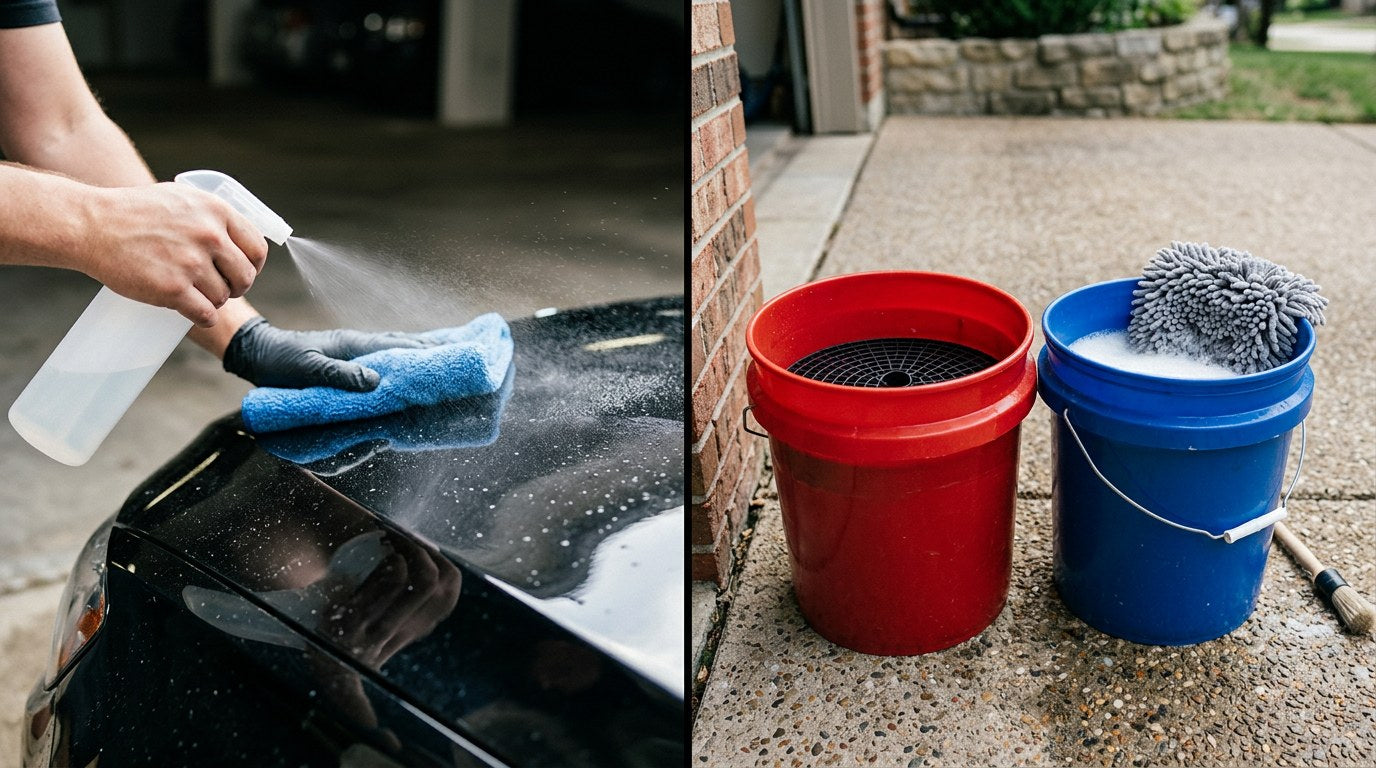
A rinseless wash is a dilute wash solution used with buckets and a wash mitt, but it doesn't require a hose rinse — the encapsulating polymers let you wipe dirt off cleanly. A waterless wash is a spray-on, wipe-off product that uses zero water at all and is best for lightly dusty or lightly soiled cars. Both are safe on ceramic coatings and both save massive amounts of water compared to a traditional bucket-and-hose wash — but they're not interchangeable. The right one depends on how dirty your car actually is and where you're parked.

The Short Answer: Two Different Tools for Two Different Jobs
Rinseless and waterless washes sound similar and get confused constantly, but they're built around different assumptions about how dirty your car is when you start. Rinseless is the workhorse — moderate dirt, real wash workflow, no hose needed for rinsing. Waterless is the maintenance tool — light dust and film only, spray-and-wipe fast, zero water usage.
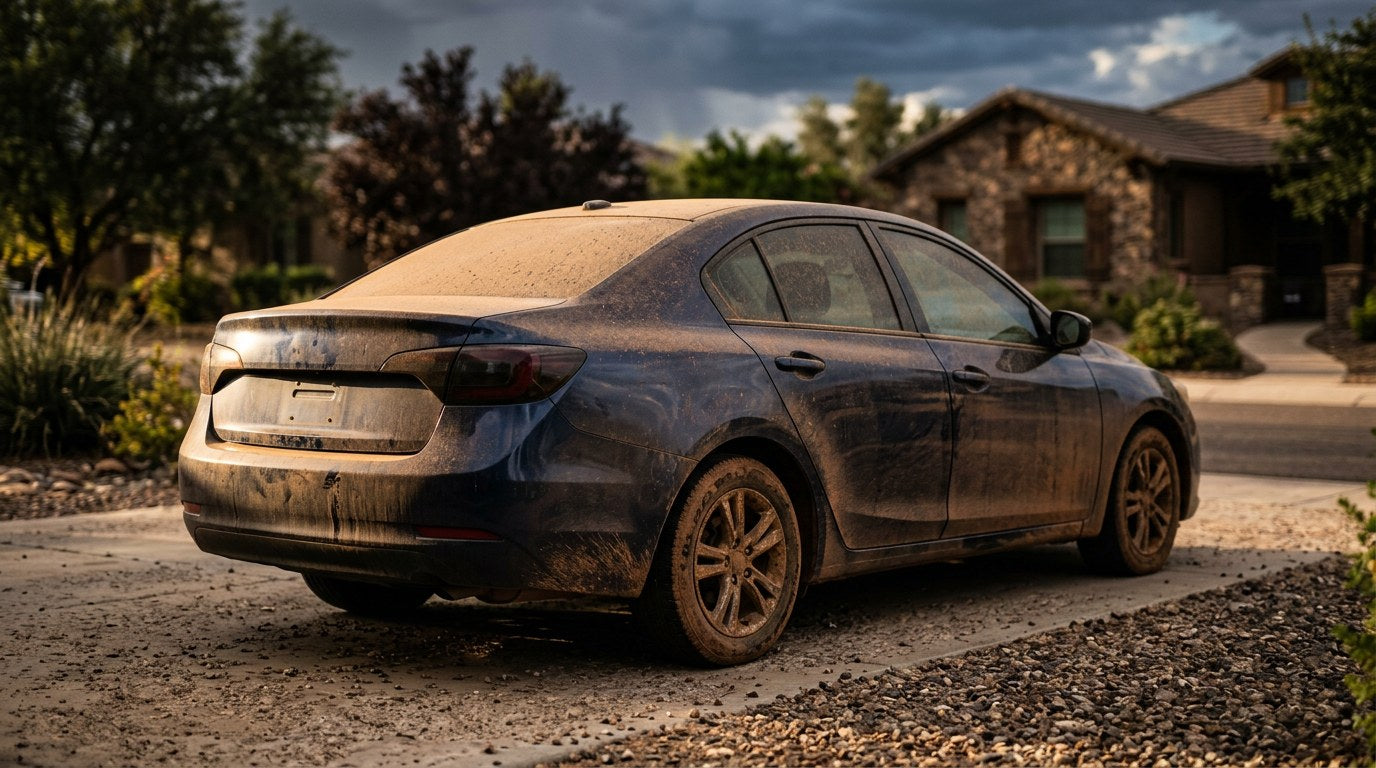
If you're washing a mud-caked truck after a weekend on the trail, neither of these is your first move — you need a foam pre-soak and hose. But for the daily driver you keep in a covered garage and drive on paved roads, one or both of these will cover 90% of your wash rhythm.
What a Rinseless Wash Actually Is
A rinseless wash concentrate is a highly diluted, coating-safe, lubricated solution that encapsulates dirt particles the moment they contact the mitt. Because the chemistry is doing what a rinse would normally do — floating dirt away from paint — you don't need to blast the car with a hose after. You wash panel by panel with a plush mitt, wipe the panel dry immediately with a clean microfiber, and move on. See our full rinseless wash technique guide for the exact step-by-step.
Undrdog offers rinseless in two forms: the Rinseless Wash Concentrate for two-bucket setups, and the Rinseless Wash Spray for pre-diluted convenience. Both are pH-neutral, wax-free, and safe on HCC plus the full Undrdog coating lineup.
When Rinseless Makes Sense
- Moderately dirty daily drivers — dust, pollen, road film, light bugs
- Apartments and condos with no exterior water access
- Water-restricted zones (drought conditions, HOA rules)
- Winter washes when hose water would freeze
- Detailed multi-vehicle sessions where hose logistics slow you down

What a Waterless Wash Actually Is
A waterless wash is a ready-to-use spray formula loaded with high-lubricity surfactants and encapsulating polymers. You mist it directly onto a panel section, gently glide a plush folded microfiber across the surface once to lift dirt, then flip to a clean face and buff dry. No buckets. No mitt. Zero rinse water. As The Daily Automotive puts it, waterless products "use advanced polymers and surfactants to encapsulate dirt particles so they can be wiped away safely."
The catch: waterless has a lower dirt ceiling than rinseless. If the panel is truly filthy — visibly caked with mud, road salt, or heavy bug carcasses — spraying and wiping will drag those particles across paint and cause micro-marring. Waterless is for light dust, fingerprints, and thin road film. It's not a "wash whatever" tool.
When Waterless Makes Sense
- Lightly dusty garage-kept cars between real washes
- Fingerprints and smudges on glossy panels
- Show-day quick clean before doors open
- EVs and other cars parked at charging stations or offices with no water access
- Winter storage bays where a full wash isn't practical
- Bird bomb and tree sap spot-cleaning between washes
For most spot cleaning, Quick Detail is the perfect stand-in — it doubles as a light waterless wipe-down and a hydrophobic top-up for coated paint.

Rinseless vs Waterless: Side-by-Side Comparison
| Category | Rinseless Wash | Waterless Wash |
|---|---|---|
| Dirt ceiling | Light to moderate | Very light only |
| Water usage | 2–4 gallons total (bucket water) | Zero gallons |
| Time per wash | 30–45 minutes | 15–25 minutes |
| Equipment needed | Two buckets, grit guards, mitt, microfibers | Spray bottle, 4–6 microfibers |
| Best location | Driveway, garage, apartment lot | Anywhere — parking lot, driveway, garage |
| Coating-safe | Yes, pH-neutral formulas | Yes, pH-neutral formulas |
| Safe on dark paint | Yes, with correct technique | Yes, but requires very light touch |
| Water savings vs traditional | ~95% less | 100% less rinse water |
| Typical use case | Weekly maintenance wash | Between-wash top-ups, show-day quick clean |
For context, the International Carwash Association notes that an at-home hose wash can consume up to 100 gallons of water, while professional tunnel washes use around 40 gallons. Rinseless drops that to 2–4 gallons of bucket water. Waterless goes to zero rinse water entirely. In water-stressed states like California, Arizona, and Nevada, that difference now matters legally — many municipalities enforce hose-wash bans during drought periods.
How to Do a Rinseless Wash the Right Way
Step 1: Pre-Rinse or Pre-Spray Heavy Soil
If any panels have visible embedded mud or bug matter, hit them with a spray of diluted rinseless solution and give the residue 60 seconds to soften. This drops the effective dirt level onto rinseless-appropriate ground before you touch the paint.
Step 2: Fill Two Buckets With Grit Guards
One bucket with the concentrate at label dilution (typically 1 oz per 2–3 gallons), one bucket with plain clean rinse water. Grit guards in both, always.
Step 3: Wash Top-Down, Panel by Panel
Load your plush microfiber mitt from the soap bucket. Wipe one panel with gentle, straight-line motions. Fold the mitt to a clean face for the next section. When the mitt is dirty, rinse in the plain water bucket, wring it against the grit guard, reload from the soap bucket. Never scrub. Never circular motions on visible-dust panels.
Step 4: Wipe Panel Dry Immediately
Use a fresh plush microfiber to blot-and-glide the panel dry within seconds of washing it. This is the step that separates a good rinseless wash from a streaky one — never let rinseless solution air-dry on paint. Move to the next panel. Repeat.
How to Do a Waterless Wash the Right Way
Step 1: Do Not Waterless Wash a Filthy Car
This is the biggest misuse of the product. If you can see dirt on the surface from 5 feet away or the panel has any grit that gives under a fingernail scratch, stop. Waterless is for light film only. Otherwise you're grinding grit sideways into clear coat. If in doubt, use rinseless.
Step 2: Mist One Panel at a Time
Spray a light, even mist over an area no larger than a fender. You want enough product to lubricate — not a soaking puddle. Puddled product wastes concentrate and streaks.
Step 3: Wipe Once, Flip, Buff
Use a folded plush microfiber. First pass: gentle single-direction glide across the misted panel with zero downward pressure — this is the dirt-lifting pass. Second pass: flip the microfiber to a completely clean face and buff the panel dry with the same gentle motion. If the towel gets loaded with dirt, discard it and use a fresh one. Plan on 4–6 clean microfibers per full car.
Step 4: Use a Second Towel for Glass
Never use the same microfiber you used on panels for windows — glass is unforgiving. Dedicated glass-only microfiber, fresh spray, single passes.
Which One Should You Choose (Decision Framework)
Run your car through this quick check:
- Can you brush dust off with a light hand and see clean paint underneath? Waterless works.
- Does the panel have moderate road film, bug marks, or pollen but no caked mud? Rinseless works.
- Is there caked mud, dry road salt, or visible chunks? Neither — full traditional wash with foam pre-soak and hose. Or, if you're truly water-restricted, do a heavy pre-spray with rinseless solution and multiple wipe passes with fresh mitts.
Many detailers who care about their cars keep both in the garage. Rinseless for weekly maintenance washes, waterless for the mid-week quick clean when you don't feel like breaking out the buckets. It's not "which is better" — it's "which is the right tool for what's on the car right now."
Common Mistakes That Ruin Both Methods
Reusing Dirty Microfibers
Both methods live and die on microfiber cleanliness. A folded microfiber gives you 4–8 clean faces before it needs to be swapped out. Track that. A dirty face rubbed against paint is how you get marring on dark cars.
Washing in Direct Sun
Both products can flash-dry on hot panels, leaving streaks. Work in shade. Early morning or evening.
Skipping the Grit Guard on Rinseless
Rinseless is a bucket wash even though it's called "rinseless." Grit guards in both buckets, every time. Otherwise you're re-loading dirt onto the mitt.
Waterless-Washing a Truly Dirty Car
The single fastest way to swirl dark paint. If in doubt, escalate to rinseless.
Circular Motions on Dust
Straight lines, panel-length passes, gentle pressure. Circular motions concentrate any grit on the microfiber into circular scratches you can only fix with paint correction — see our swirl mark removal guide if you already have them.
Are Rinseless and Waterless Safe on Ceramic Coatings?
Yes, when they're pH-neutral, wax-free, and free of gloss agents. This is the same criteria as a proper maintenance shampoo like Undrdog Soap. Products that add carnauba dust, silicone gloss enhancers, or "shine boosters" will sit on top of a ceramic coating and mask its hydrophobic behavior. You wash them off, hydrophobics come back — but you've been degrading your top layer in the meantime.
Both Undrdog Rinseless products are pH-neutral and wax-free by design. Same rules apply to whatever waterless spray you use: read the label. Anything advertising "shine" or "gloss" as a primary claim is probably not what you want on a coated car.
Wash Anywhere. No Hose Required.
Undrdog Rinseless Wash is pH-neutral, coating-safe, and cleans a full car with 2–3 gallons of bucket water. Apartment lots, drought zones, winter garages — no problem.
Shop Undrdog Rinseless Wash →Frequently Asked Questions
What is the actual difference between a rinseless and a waterless wash?
A rinseless wash uses diluted solution in buckets with a wash mitt but skips the hose rinse — the chemistry encapsulates dirt so you can wipe it away. A waterless wash uses zero water at all: you spray a lubricating formula directly on the panel and wipe with microfibers. Rinseless handles more dirt; waterless is for light dust and film only.
Can I use a waterless wash on a dirty car?
No. If there's visible caked dirt, mud, or road salt, waterless wiping will grind those particles across paint and cause swirl marks. Use waterless for light dust, fingerprints, and thin road film only. For anything heavier, use rinseless or a traditional wash.
Are rinseless and waterless washes safe on ceramic coatings like HCC?
Yes, if they're pH-neutral and wax-free. Undrdog Rinseless is formulated to be coating-safe and won't strip hydrophobics or leave gloss agents behind. Avoid any spray labeled as a "shine booster" — those additives sit on top of coatings and mask beading behavior.
How much water does a rinseless wash actually save?
A traditional home hose wash can use up to 100 gallons of water. A rinseless wash uses 2–4 gallons of bucket water, or about 95% less. A waterless wash uses zero rinse water.
Can I rinseless wash in the winter?
Yes. Rinseless is a top pick for winter maintenance because you don't need running water. Bring warm water for the buckets, work quickly, and dry the car thoroughly to prevent refreeze.
Do I need a foam cannon for rinseless?
No. Rinseless is done with buckets and a mitt. A foam cannon is a pre-soak tool for traditional hose washes. Rinseless does its work in the wash bucket itself.
How many microfibers do I need for a waterless wash?
Plan on 4–6 clean plush microfibers for a full car. You need enough clean faces that no single face gets loaded with grit before you finish. Cheap out on microfibers and you'll pay for it in swirl marks.
Can I use a rinseless wash on wheels?
Yes, with a dedicated wheel mitt or brush — never move that mitt back to your paint bucket. Brake dust is metallic and will scratch clear coat. For heavy iron fallout on wheels, use The Purps first, then rinseless.
Which one is safer on dark paint?
Rinseless is generally safer on dark paint because the wash mitt in a lubricated soap bucket has more slip than a spray-and-wipe waterless method. Both are safe with correct technique, but a first-time DIYer on a black car will produce fewer swirls with rinseless.
Is a rinseless wash as good as a traditional bucket-and-hose wash?
For light-to-moderate dirt, effectively yes — plus it uses a fraction of the water. For heavy dirt, mud, road salt, or bug-caked front ends, a traditional foam pre-soak and hose rinse still wins because the pre-soak lifts grit before your mitt touches paint.

Leave a comment
This site is protected by hCaptcha and the hCaptcha Privacy Policy and Terms of Service apply.