
A clean microfiber wash mitt is a sensible starting point for a conventional hand wash, while a purpose-built car wash sponge can also suit an approved soap or rinseless routine. Choose by the exact tool's instructions, wet grip, condition, and cleaning requirements, not by a blanket rule that every sponge scratches or every mitt is safe. Neither choice excuses dragging a dirty tool across the next panel.
This is a buying and maintenance comparison, not a laboratory scratch test. Our recommendation is to buy the tool you can control, inspect, clean, and replace when necessary, then build a repeatable routine around it. An expensive tool that keeps slipping from your hand is not the right upgrade for you.
Wash mitt vs sponge: compare the actual tools
“Sponge” is too broad to be a useful specification. A kitchen scrubber, a paint applicator, and a foam tool sold for vehicle washing are different products. Likewise, a microfiber wash mitt is not interchangeable with every glove-shaped cleaning tool. Start with the intended surface and task printed on the product instructions.
There are real examples of both designs being sold for conventional and rinseless washing. The Rag Company's Cyclone Ultra Wash Mitt is a microfiber mitt described for foam, bucket, and rinseless washing. Its Ultra Safe Sponge is described as a foam wash tool for soapy and rinseless methods. Those statements establish the intended uses of those specific products, not a guarantee that every tool in either category works with every wash solution.
| Buying question | Microfiber wash mitt | Purpose-built car wash sponge |
|---|---|---|
| How will I hold it? | Check the opening, cuff, liner, and whether the mitt rotates when wet. | Check whether its wet size and shape fit your hand without excessive squeezing. |
| Is it approved for my wash method? | Look for explicit bucket-wash or rinseless directions for that model. | Look for the same explicit approval; do not infer it from the word sponge. |
| What should I inspect? | Inspect the fibers, seams, cuff, and liner for debris or damage. | Inspect all contact faces, cuts or grooves, and any torn or degraded areas. |
| How will I clean it afterward? | Follow the complete mitt's care directions, not just generic towel advice. | Follow the foam tool's own cleaning and storage directions. |
| What should make me stop? | Unremovable debris, damaged contact surfaces, poor control, or uncertainty about cleanliness. | The same concerns, including damaged foam or residue that will not rinse away. |
The table is a practical inspection checklist, not a ranking of scratch resistance. You cannot determine that ranking from a product's color, fluffiness, price, or the confidence of its advertising.
When a microfiber wash mitt makes sense
Start with a mitt if you like wearing the wash tool rather than gripping a block. Before buying, ask whether you can comfortably reach into it, turn your hand, and remove it for inspection. If possible, evaluate the fit under the conditions you actually wash in, including any protective gloves required by your wash chemical.
A useful fit check does not require rubbing a dirty car. With the tool wetted according to its instructions, hold your hand above a clean bucket and move through the motions you expect to use. Does the mitt twist? Does the cuff slide? Can you turn it over without fumbling? Treat these as personal selection criteria, not proof of cleaning performance.
Do not buy solely by how much liquid a mitt appears to hold. You still need a manageable tool, an inspection routine, and a way to separate dirty equipment from clean supplies. The manufacturer's claimed liquid handling is not a reason to finish an entire vehicle before checking the mitt.
For an example of model-specific construction, the Cyclone page identifies a microfiber exterior and a twist-loop liner. It also provides its own care guidance. Read those details for the model you intend to buy rather than assuming the instructions for a different mitt or a loose towel automatically apply.

When a car wash sponge makes sense
Consider a purpose-built wash sponge if you prefer holding the tool directly and its manufacturer supports your chosen wash method. Check the actual product description and care directions before buying. A sponge advertised for applying wax or dressing has a different job; a familiar shape is not evidence that it belongs in your paint-washing routine.
Test your grip without adding pressure against the vehicle. Can you hold the saturated sponge securely without squeezing out most of the solution? Can you rotate it to inspect another face? Can you reach the areas you need without forcing it around trim? If those motions feel awkward, a different size, shape, or a mitt may suit you better.
A foam sponge is not automatically disqualified from car washing. The manufacturer example above explicitly includes soapy and rinseless use, which is why “never use any sponge” is an unhelpfully broad buying rule. The opposite rule, “this sponge cannot scratch,” is equally unhelpful: intended use is not proof of a guaranteed outcome in your hands.
Our recommendation is to leave household scrubbers out of this decision. Choose an explicitly automotive wash tool with clear directions, rather than experimenting with an abrasive side, an unidentified foam block, or something previously used on kitchen grease. If you cannot identify what the tool is and how to clean it, choose another one.
Choose the wash method before choosing the material
Decide whether you are doing a conventional rinse-off wash or following a specific rinseless system. Then check that both your wash chemical and the tool support that method. The two Rag Company examples show that the choice is not simply “mitt for soap, sponge for rinseless.” Read the actual directions rather than assigning each shape a universal job.
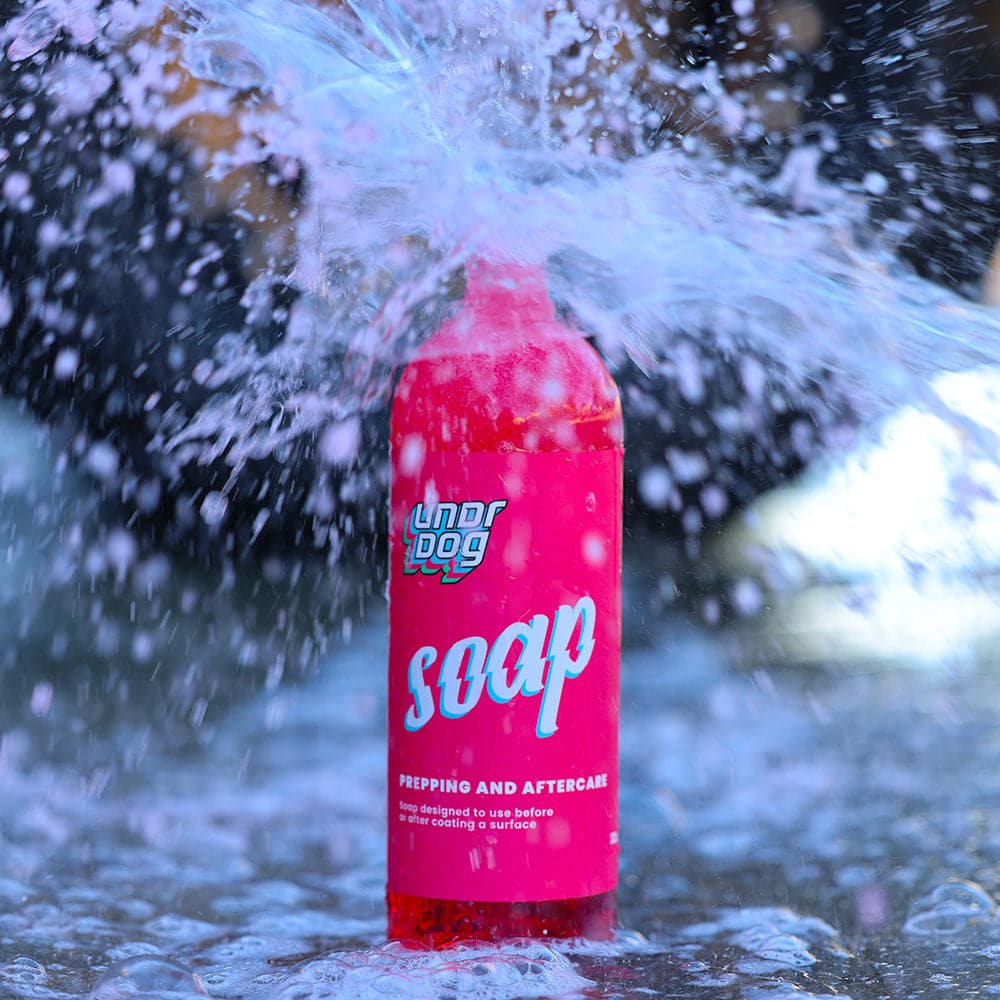
For a conventional wash, Undrdog Soap is the relevant Undrdog product, not a coating or a household detergent substitute. Its current application instructions include hand washing with a sponge, followed by drying with a clean microfiber towel. The safety instructions specifically warn against allowing the surface to dry in direct sunlight and require complete soap-residue removal.
That is permission for the described wash process, not a reason to use an unidentified sponge or skip your vehicle's finish-care requirements. Our car shampoo versus dish soap comparison addresses the separate chemical-selection question. Buying a better wash tool does not resolve an unsuitable cleaner choice.
For a rinseless wash, use the current directions for the exact chemical and tool together. Do not borrow a dilution from a video featuring another brand or assume that stronger solution makes more pressure acceptable. If the label, online instructions, or tool guidance conflict, ask the manufacturer to clarify before using that combination. This guide deliberately does not prescribe a universal rinseless dilution.
For heavy dirt, reconsider the wash setup before discussing tool preference. The Rag Company's washing guide recommends removing contamination before contact washing and using light pressure during the contact stage. Its specific chemical recipes are not universal directions for Undrdog products or every vehicle finish.
What matters more than mitt versus sponge?
Our preferred decision process starts with a cool, suitable work area, a compatible wash solution, clean equipment, and an inspection of the vehicle. The Rag Company guide recommends shade, cool paint, light pressure, and washing from the top downward while leaving dirtier lower areas until later. Those are process choices; buying a new tool does not perform them for you.
Keep your routine simple enough that you will actually follow it. Have a clean place for spare tools and a separate place for used or questionable ones. If a tool falls on the ground, set it aside and use a clean replacement rather than trying to settle the cleanliness question while you continue washing. A spare is useful because it lets you stop without improvising.
Inspect before returning to the paint. Look at the entire contact surface, not only the side facing you while the tool is in the bucket. If visible debris remains, stop and clean the tool according to its directions, or replace it with a clean one. Do not treat a quick dip or clear-looking water as proof that the tool is ready.
We recommend dedicated equipment for wheels and dirtier tasks instead of moving that same tool straight onto body paint. Label the tools or storage containers if that helps you keep the routine consistent. The important question is not whether two tools look identical; it is whether you know where each has been and whether it is suitable for its next job.
If your vehicle has film, a wrap, matte paint, or another finish with special care rules, those rules narrow the choices further. Our paint protection film washing guide explains why film-specific instructions and edge precautions matter. A generic “paint-safe” description is not a substitute for the finish manufacturer's requirements.
Cleaning, storage, and replacement: compare the upkeep
Buy the care routine as well as the tool. Read whether the complete item can be machine washed, which cleaner is recommended, and how it should be dried and stored. Do not assume that every microfiber mitt tolerates the same treatment merely because its outside resembles a towel.
For example, the Rag Company Wash Mitt and Wash Pad Combo instructions call for prewashing before first use, cleaning with a dedicated microfiber detergent, drying after use, and storage in a sealed container. That is specific manufacturer guidance for those microfiber tools. It is not a cleaning recipe for a foam sponge from another product line.
For a sponge, look for its own care instructions rather than copying that laundry routine. If the page tells you what the tool can wash but not how to clean the tool itself, ask before purchase. Avoid inventing a soak, degreaser concentration, boiling procedure, or machine cycle just because another sponge survived it.
We do not recommend replacing either category on an invented universal calendar. Inspect condition and follow the manufacturer's directions. Set a tool aside when you cannot remove debris, when its contact surfaces are damaged, or when you cannot establish that it is clean enough for the intended surface. A stained appearance alone does not answer all those questions, and looking new does not eliminate the need to inspect.
When comparing value, count the practical needs of your routine: a usable tool, an appropriate spare, cleaning supplies, and storage. Do not divide the purchase price by an assumed number of washes that the maker never promised. The more expensive tool is not automatically better value, and the cheapest one is not a saving if you cannot maintain it properly.

Our recommendation for a straightforward wash setup
If you are starting from scratch, choose a clean automotive microfiber mitt that fits comfortably and has clear care directions. That is a practical starting recommendation, not a claim that it wins every comparison. If you already prefer a purpose-built sponge whose directions match your wash system, there is no need to replace it just to follow a category slogan.
Pair the tool with the correct wash product and keep a clean replacement available. For an Undrdog Soap wash, follow its current application directions, work where you can prevent drying, rinse residue away, and use clean drying equipment. Review the product's safety section and label before handling it, including the required protective equipment.
A coating purchase is not required to make this tool decision. Finish maintenance and any later protection project are separate jobs. First make your existing washing routine controlled and repeatable; then assess whether the surface actually needs anything beyond cleaning.
Frequently asked questions
Is a wash mitt always better than a sponge?
No. A microfiber mitt can be a practical starting choice, but a purpose-built car wash sponge may also support your wash method. Compare the exact products' intended use, wet grip, condition, and care instructions rather than assuming one category always wins.
Can I use a kitchen sponge on car paint?
Our recommendation is to use a tool explicitly intended for automotive washing instead. Do not experiment with an abrasive scrubber, an unidentified sponge, or a tool previously used on household grease. The intended surface and cleaning instructions should be clear before use.
Can a microfiber mitt be used for rinseless washing?
Some can. Check the specific mitt and rinseless chemical instructions together. The Cyclone Ultra Wash Mitt is one manufacturer example listed for rinseless use, but that does not establish compatibility for every mitt or every chemical combination.
Does a wash sponge need a different cleaner from a mitt?
It may. Follow each tool manufacturer's care directions, because guidance for microfiber laundry is not automatically appropriate for a foam sponge. If care instructions are missing or unclear, ask the manufacturer rather than inventing a detergent or machine-washing procedure.
What should I do if I drop my wash tool?
Set it aside and use a clean spare. Clean and inspect the dropped tool according to its instructions before considering it for paint again. Do not continue washing merely because you gave it a quick rinse or cannot immediately see debris.
Can I use one tool for wheels and body paint?
We recommend keeping dedicated tools for those jobs and clearly separating them during storage and washing. That makes the tool's use history easier to control. Do not move a wheel-cleaning tool directly onto body paint because it looks similar to your paint-washing tool.
How often should I replace a mitt or sponge?
There is no replacement interval established here for either category. Follow the maker's guidance and inspect the tool before use. Set it aside if debris cannot be removed, contact surfaces are damaged, or you cannot establish that it is suitable for the next wash.
Does ceramic coating make wash-tool choice unimportant?
No. Do not treat a coating as permission to skip clean tools, compatible wash chemicals, inspection, or the coating maker's care directions. Choose and maintain your wash equipment deliberately whether the vehicle is coated or uncoated.
Choose the tool. Match the wash.
Build your conventional wash around a clean, suitable tool and Undrdog Soap, following the current application and safety directions.
Shop Undrdog Soap

Leave a comment
This site is protected by hCaptcha and the hCaptcha Privacy Policy and Terms of Service apply.