

A proper two-bucket hand wash with pH-neutral soap is the safest way to clean your paint, and a touchless automatic wash is the safest of the automatic options. The catch is that "touchless" only removes one risk (scratching) and trades it for another: high-alkaline pre-soaks and acidic rinses that clean by chemistry instead of contact, and that strip wax and shorten the life of sealants and lower-grade coatings over time. If you have a ceramic coating, an occasional touchless wash is fine; brush tunnels are the thing to avoid entirely.
This guide breaks down how each wash method actually works, what it does to bare clear coat versus a coated car, where the marketing on both sides overstates things, and how to pick the right routine for how you actually live. If you want the difference between a car wash and a full detail, we covered that separately in our car detailing vs car wash breakdown. This post is about the wash itself.

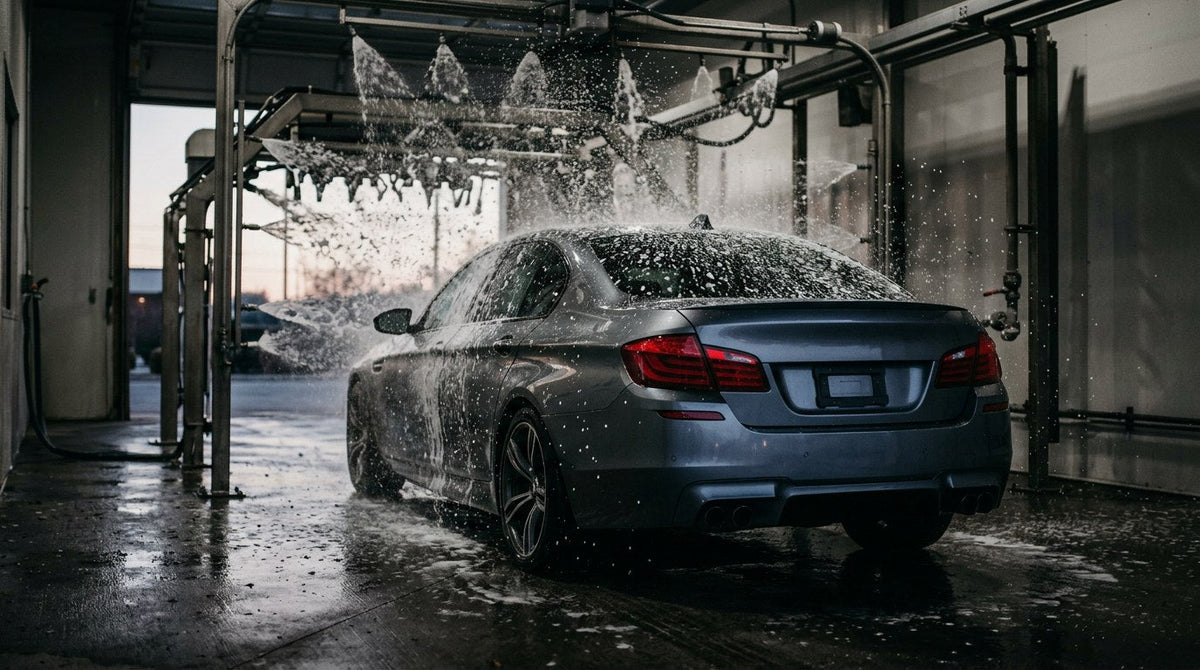
How a Touchless Car Wash Actually Works
A touchless (touch-free) wash cleans without anything solid contacting the paint. Instead of cloth or foam brushes, it relies on three stages. According to EuroLuxe Detailing's breakdown, "the process typically involves a pre-soak with a highly alkaline solution, sometimes reaching pH levels of 12 to 13, followed by a high-pressure rinse, then a low-pH acidic rinse to neutralize the alkaline residue and add a degree of surface shine." The same source notes the nozzle pressure "often exceeds 1,000 PSI," well above what most people run at home.
That chemistry is the whole trick. A hand wash uses friction (your mitt) to lift dirt that soap has loosened. A touchless wash has no friction, so the detergent has to do all the loosening on its own, which is why it runs so far from neutral pH. High alkalinity saponifies oils and road film; the acidic follow-up neutralizes the residue and knocks down mineral haze. It works, but it is not a gentle process, and it is not selective. The same chemistry that dissolves road grime also attacks anything sitting on top of your clear coat: wax, sealant, and, more slowly, ceramic.
What touchless washes are genuinely good at
- Zero mechanical scratch risk. Nothing touches the paint except water, detergent, and air. The Daily Automotive's wash-risk ranking puts it plainly: "Touchless washes carry the lowest scratch risk because nothing physically contacts the paint."
- Speed and convenience. Five to ten minutes, 24/7 access, no water restrictions at your house to worry about.
- Winter salt removal. When it is 20°F and you cannot hand wash, blasting salt brine off the body and underside with a touchless wash is far better than leaving it there for a month.
Where touchless washes fall short
- They leave film behind. Chemistry plus pressure cannot fully replace agitation. The Daily Automotive notes "touchless washes routinely leave a thin road film behind, which is why cars washed exclusively this way can look clean yet feel slightly rough." The industry trade publication Professional Carwashing & Detailing says the same from the operator side: "Tougher dirt, grease and other organic and inorganic contaminants may not be thoroughly removed."
- They strip protection. AutoZone's guide warns that "some touchless washes use strong chemicals that, if not rinsed thoroughly, can strip away wax or protective coatings on your vehicle's paint." Wax goes first, then sealants, then coatings degrade faster than they would under a neutral wash.
- The "spray wax" option is mostly a gloss illusion. Those add-on drying agents and "ceramic sealants" are thin surfactant films designed to help water sheet off the car in the dryer. They are not protection in any meaningful sense, and they can leave a greasy residue on a real coating.

Why Brush and Soft-Cloth Tunnels Are the Real Problem
Most of the horror stories people attach to "automatic car washes" come from friction tunnels, not touchless bays. Those spinning cloth strips and foam brushes are not abrasive on their own. The problem is what they carry. AutoZone describes it well: the brushes "can trap dirt and debris from previous washes, creating a sandpaper-like effect that has the potential to scratch your car's paint or leave swirl marks." CAR Magazine is blunter, comparing a poorly maintained tunnel to "slapping your car with a dirty mop, causing hundreds of deep micro scratches called swirl marks."
Here is why that matters more than people think. Your clear coat is thin. The Daily Automotive puts factory clear coat at "just 1.5–2.0 mils (35–50 microns)," with most manufacturers allowing roughly 0.3 mils to be safely polished away over the life of the paint. Every swirl you buff out spends part of that budget. A brush tunnel adds swirls with each visit; a polish removes them by removing clear. Do that cycle enough times and you run out of clear coat to correct.
Modern soft-cloth systems at well-run sites are much better than the plastic bristle machines of the 1990s. Professional Carwashing & Detailing notes the cloth "often provid[es] a more thorough elimination of dirt and debris" than touchless, precisely because it agitates. But the same article concedes that "if a vehicle is not properly emulsified before the cloth strips make contact with the paint, scratches may result from dirt and debris being ground into the vehicle's surface." You have no way of knowing how well the site ahead of you maintains its cloth or how much grit the last lifted truck left in it. That uncertainty is the whole argument against friction tunnels for anyone who cares about their finish.
How a Proper Hand Wash Works (and Why Technique Matters More Than the Method)
A hand wash done right is the gold standard because you control every variable that damages paint: the soap chemistry, the amount of lubrication, how much grit gets carried back to the panel, and the pressure you apply. Done wrong, a hand wash can be worse than a touchless bay. A single bucket, a dish sponge, and a dry towel dragged across a dusty hood will swirl paint faster than any automatic wash.
The safe version has a few non-negotiables, which we walk through in detail in our guide on how to wash a car without scratching it:
- Pre-rinse or pre-foam first. Knock off loose grit before anything touches the paint. A foam cannon or pump sprayer does this well; a strong hose rinse does most of it.
- Two buckets with grit guards. One for soap, one for rinsing the mitt. The grit you pull off the car stays in the rinse bucket instead of going back onto the next panel.
- pH-neutral soap with real lubricity. The soap's job is to suspend dirt and let the mitt glide. A pH-neutral car soap like Undrdog Soap is formulated to be safe on coatings while still pulling road film, and because it is pH-neutral you can use it in direct sun without the etching risk that comes with strong alkaline products drying on hot paint.
- Plush microfiber mitt, straight lines, top down. Wash the cleanest panels first (roof, glass, upper doors) and the dirtiest last (lower doors, rockers, bumpers). Rinse the mitt often.
- Dry with a clean, plush towel or a blower. Drying is where most hand-wash swirls actually happen. Blot or drag lightly; never scrub.

If you live somewhere with water restrictions or no driveway, a rinseless wash gets you most of the safety of a full two-bucket wash with a single bucket and no hose. We compared the two approaches in our rinseless vs waterless wash guide.
Touchless vs Hand Wash: Full Comparison Table
| Factor | Touchless Automatic | Brush / Soft-Cloth Tunnel | Proper Two-Bucket Hand Wash |
|---|---|---|---|
| Scratch / swirl risk | Very low (no contact) | Highest; depends on site maintenance | Low when technique is right; high when it is not |
| Chemical aggressiveness | High (alkaline pre-soak, acidic rinse) | Moderate to high | Low (pH-neutral soap) |
| Cleaning thoroughness | Fair; leaves road film | Good on flat panels; misses crevices | Best; you see and address every panel |
| Effect on wax | Strips it within a few washes | Wears it down quickly | Minimal |
| Effect on ceramic coating | Gradual degradation with frequent use | Adds swirls on top of the coating; wears it down | Minimal; this is how coatings are meant to be maintained |
| Time | 5–10 minutes | 5–10 minutes | 45–90 minutes |
| Typical cost per wash | $10–$20 | $10–$25 | Pennies in soap after the initial gear |
| Coating warranty status | Usually permitted | Commonly excluded | Usually required |
| Best for | Winter salt, travel, emergency rinse | Nobody who cares about the finish | Anyone with a coating or dark paint |
Is a Touchless Car Wash Safe for Ceramic Coating?
Yes, with a caveat. A properly cured ceramic coating is far more chemically resistant than wax or a polymer sealant, so a touchless wash will not strip it in one visit or even ten. But chemical resistance is a durability range, not immunity. Jimbo's Detailing sums up the consensus: "Touchless washes won't instantly ruin ceramic coatings — but they will shorten their lifespan." Repeated exposure to pH 12–13 pre-soaks accelerates degradation, reduces hydrophobic behavior, and forces earlier reapplication.
This is also why coating manufacturers write automatic washes into their aftercare documents. One major brand's published aftercare guidance states, verbatim, "Touch-less car washes only. Never use a car wash with brushes! Never select the 'spray wax' option," and adds that "using an automated car wash with brushes will void the warranty and dull the coating" (published warranty and aftercare PDF). The distinction the industry draws is exactly the one in this article: touchless is tolerated, brushes are not.
The realistic ceramic-coated routine
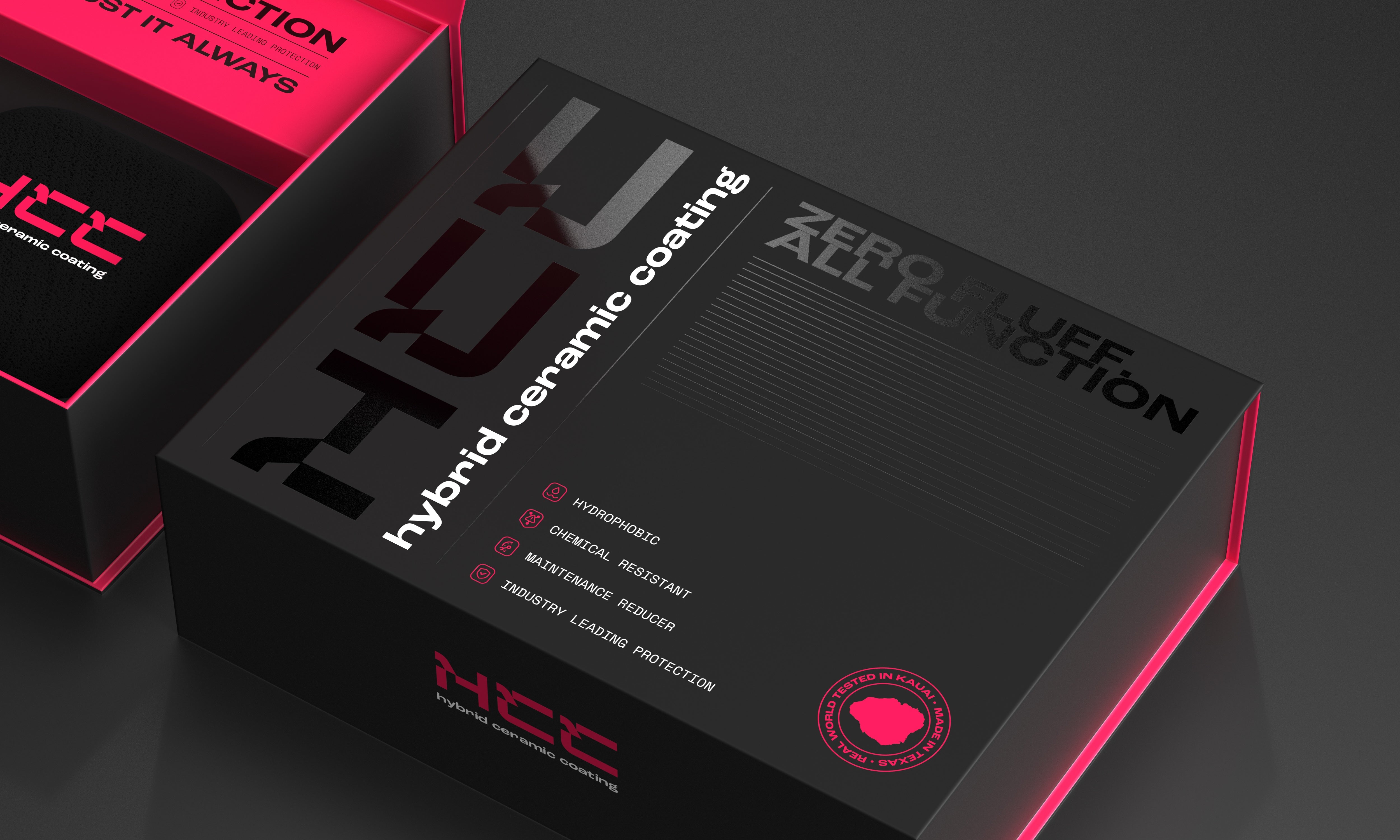
If you have a coating like HCC Hybrid Ceramic Coating on your car (or your boat, plane, or bike; it is built as an all-surface coating), the routine that gets you the most life out of it looks like this:
- Default: two-bucket hand wash with pH-neutral soap every one to two weeks. The coating's slickness means dirt releases with very little agitation, so this is a fast wash.
- Acceptable: a touchless wash when you are traveling, when it is below freezing, or when the car is caked in salt or ash and needs to be rinsed now. Skip the spray-wax and "ceramic" upsells. Follow up with a hand wash when you can.
- Avoid: friction tunnels. The coating will take the swirls instead of your clear coat, which is better than nothing, but you are grinding away the layer you paid for.
- Between washes: a hydrophobic maintenance spray like Quick Detail after a wash tops up water behavior and gloss without adding anything that fights the coating.
One more point: do not take a freshly coated car through any automatic wash until the coating has fully cured. Our ceramic coating cure time guide covers the windows, but the short version is that strong chemistry in the first days after application is exactly the wrong move.
The Hidden Variable: Neither Method Removes Bonded Contamination
Whatever wash you choose, none of them remove embedded iron particles, tar, or tree sap that have bonded to the paint. That "clean but slightly rough" feel the Daily Automotive describes after touchless-only washing is partly leftover film and partly bonded contamination that no wash removes. Touchless washes are especially prone to this because they lack agitation, but even a careful hand wash leaves iron fallout in place.
That is a decontamination job, not a wash job. A dedicated iron remover such as The Purps dissolves ferrous particles chemically so they rinse away without you having to scrub them, and a clay treatment handles the rest. Do this two to four times a year, or before any coating application, and the wash routine you pick will actually leave the paint feeling like glass. It also matters for coated cars: bonded iron sitting on top of a coating blocks its hydrophobic behavior and makes people think the coating "died" when it is just buried.
Which Wash Method Should You Choose?
Choose a two-bucket hand wash if…
- Your car is ceramic coated, or you plan to coat it
- The paint is black, dark blue, dark gray, or any color that shows swirls
- You have a driveway or access to a self-serve bay where you can bring your own mitt and buckets
- You want the paint to actually be clean, not just look clean from ten feet
Choose a touchless wash if…
- It is winter and the car is covered in salt brine; getting it off now beats waiting
- You are traveling or have no water access
- The car is a leased commuter you do not plan to keep and you just want it presentable
- You accept that wax will not survive and a coating will age faster than it otherwise would
Choose a brush tunnel if…
- Honestly, we cannot come up with a scenario for a car you care about. If it is the only option and the vehicle is filthy, a touchless bay is almost always nearby.
The Bottom Line
Touchless is safer than brushes. Hand washing is safer than touchless. The gap between touchless and hand washing is chemistry; the gap between touchless and brushes is grit. If your paint is protected by a real coating, you gain a buffer against both, which is the single most practical reason to coat a daily driver: it makes the wash routine you can actually stick to much less risky. And when you do hand wash, use a soap that respects the coating instead of fighting it.
Make every wash the safe kind.
HCC Hybrid Ceramic Coating adds a dense, chemically resistant shell over your clear coat so dirt releases with less agitation and an occasional touchless wash is no longer a gamble. Pair it with pH-neutral Undrdog Soap for maintenance.
Shop HCC Hybrid Ceramic Coating →Touchless Car Wash vs Hand Wash FAQ
Is a touchless car wash better than a hand wash?
No. A properly done two-bucket hand wash with pH-neutral soap is safer for paint and cleans more thoroughly. A touchless wash is better than a brush tunnel and better than a careless hand wash, but it relies on high-alkaline and acidic chemistry that strips wax and shortens the life of sealants and coatings when used frequently.
Do touchless car washes damage paint?
They do not scratch paint, because nothing solid touches it. The risk is chemical: pre-soaks in the pH 12–13 range and acidic rinses can strip protection and, with heavy long-term use, leave paint looking dull and feeling rough from leftover film and unaddressed contamination.
Is a touchless car wash safe for a ceramic-coated car?
Occasionally, yes. A cured ceramic coating resists the chemistry far better than wax, and most coating manufacturers permit touchless washes in their aftercare. Frequent touchless washing still accelerates coating wear, so hand washing should remain your default and touchless your backup.
Will an automatic car wash void a ceramic coating warranty?
Brush and soft-cloth tunnels commonly do. Several published coating warranties state that automated brush washes void coverage, while touchless washes are permitted. Read your specific coating's aftercare document, and keep receipts if the warranty requires documented maintenance.
Why does my car feel rough after a touchless car wash?
Two reasons: touchless washes lack agitation and leave a thin road film behind, and no wash of any kind removes bonded iron, tar, or sap. An iron remover and clay treatment two to four times a year fixes the rough texture that washing cannot.
Should I use the spray wax or ceramic sealant option at a touchless wash?
Skip it, especially on a coated car. Those add-ons are thin drying agents meant to help water sheet off in the dryer. They are not durable protection and can leave residue on top of a real ceramic coating.
Is a soft-cloth car wash safe for paint?
Safer than old bristle brushes, but still a friction wash. The cloth itself is soft; the grit it carries from the last vehicle is not. Because you cannot verify how well a site maintains its cloth, it is the highest-risk option for anyone who cares about swirl-free paint.
How often should I hand wash a ceramic-coated car?
Every one to two weeks for a daily driver, more often near the coast or after rain. Coated paint releases dirt easily, so the wash is faster than on bare paint. Use pH-neutral soap and a plush microfiber mitt, and dry with a clean towel or blower.
Can I hand wash in direct sunlight?
With a pH-neutral soap, yes, though shade is always easier because water spots form slower. Avoid strong alkaline or acidic products on hot panels, since they can dry and etch before you rinse them off.

Leave a comment
This site is protected by hCaptcha and the hCaptcha Privacy Policy and Terms of Service apply.