

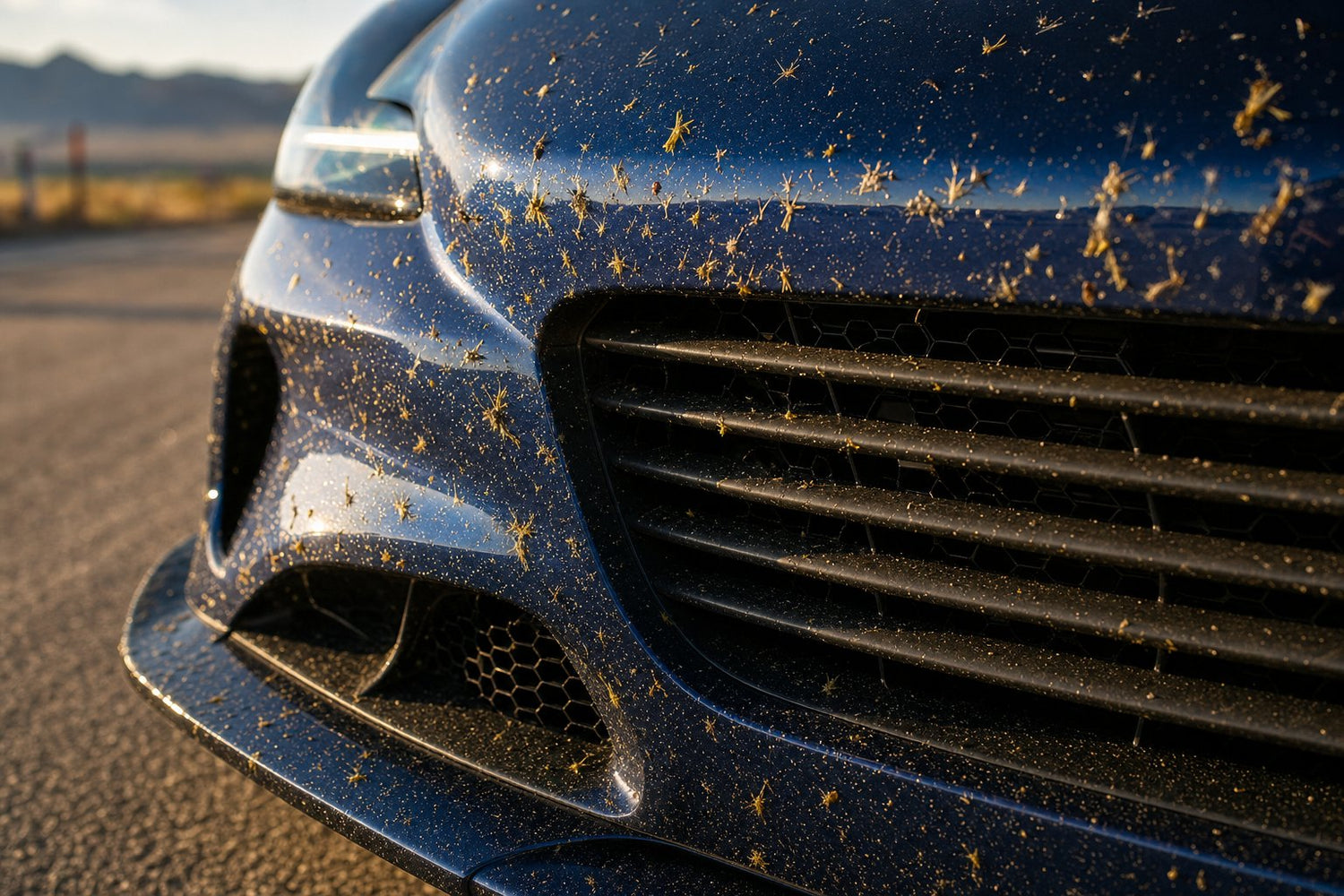
Summer bug splatter is acidic and starts etching your clear coat within hours, especially in July and August heat. Remove bugs fast with a warm pre-soak, a dedicated bug remover or diluted all-purpose cleaner, a plush microfiber towel, and zero scrubbing pressure. If you drive a coated car — or you want fewer bug jobs next summer — a fresh ceramic layer over decontaminated paint makes the whole cycle 5–10× easier.

Why Bug Guts Actually Damage Paint
The reason bug splatter is worse than dirt has nothing to do with the smear on the surface — it's chemistry. According to AAA's paint care guide, bug remains are highly acidic and start reacting with your clear coat as soon as they land. In July and August surface temperatures, that acid concentrates as the fluid dries and the reaction accelerates.
Under a magnifier, prolonged bug damage looks like a shallow crater — a tiny pit in the clear coat that catches light differently than the paint around it. Once that pit is there, no amount of washing removes it. It takes machine polishing to level the surrounding paint down to the base of the crater, which removes several microns of clear coat you can't replace.
Two categories of bug damage to know:
- Surface staining. A yellow or brown film that's still on top of the paint. Removable with the right chemistry and technique.
- Clear coat etching. Physical pitting where acid has penetrated. Only correctable by polishing.
The dividing line is roughly time and temperature. Fresh bug fluid on cool paint in the shade — you have days. Fresh bug fluid on 130°F paint in direct sun — you have hours. This is why summer is a much worse season for bug damage than spring, even when spring has more bugs per mile.
What Not to Do — The Fastest Ways to Make It Worse
Most bug damage is self-inflicted during removal, not from the bug itself. Here's what people do that turns a fixable stain into a permanent scratch pattern:
- Scrubbing dry bugs off with a sponge, brush, or paper towel. Dried bug shells are hard, chitin-based particles. Grinding them across the paint creates deep swirl marks.
- Using a kitchen abrasive pad or Magic Eraser on paint. Melamine sponges cut clear coat. They belong on trim and glass, not paint.
- Attacking a hot car in direct sun with cleaner. The cleaner flash-dries and streaks, and the heat accelerates any residual chemistry.
- Scraping with fingernails or a plastic razor. Any hard edge dragged across paint scratches it. No exceptions.
- Letting bug remover chemicals dwell too long. Strong solvents can strip existing wax, sealant, or coating if left on for 10+ minutes.
- Using WD-40, PB Blaster, or fuel-based solvents. They will remove the bugs. They will also strip protection and swell trim rubber.
The Correct Removal Workflow, Step by Step

Here's the process that removes bug splatter without adding scratches. Works on any modern clear-coated paint, coated or uncoated.
- Cool the surface first. Move the car into shade or a garage. Direct sun on a hot panel is where most streaking and etching happens. Wait 20–30 minutes if the hood is hot to the touch.
- Rinse thoroughly. A pressure washer or a steady garden hose stream knocks loose the top layer of debris before you touch the paint. This step alone eliminates half of the scratch risk.
- Pre-soak the affected panels. Spray a warm-water bug remover, diluted all-purpose cleaner (10:1 to 4:1 depending on strength), or a dedicated bug remover directly on the splatter. Let it dwell 3–5 minutes — not 10, not 15.
- Agitate gently with a plush microfiber wash mitt. Straight-line wipes, no scrubbing, no circles. If a bug doesn't move, re-soak. Never force it.
- Rinse and evaluate. Any bugs still stuck? Repeat pre-soak. Any remaining shadows on the paint after wash? That's stain or etching — see the next section.
- Wash the rest of the car. A two-bucket contact wash with pH-neutral soap like Undrdog Soap resets the whole surface and removes any bug remover residue.
- Dry with a plush microfiber drying towel. Pat, don't drag. Follow the edges of panels first to avoid depositing water back onto clean paint.
- Top with a ceramic detail spray if the surface feels rough. Quick Detail re-boosts hydrophobicity and adds slickness so the next bug wash is easier.
Total time for a normally bugged front end: 15–25 minutes. If bugs have been on the paint for weeks, expect 40+ minutes and possibly polishing afterward.
Bug Remover Comparison: What Actually Works
| Product Type | Effectiveness | Paint Safety | Best Use |
|---|---|---|---|
| Dedicated bug remover spray | Excellent | High — formulated for paint | Heavy bug loads after road trips |
| Diluted all-purpose cleaner (APC) | Very good | High if diluted properly | General bug removal at 4:1 to 10:1 |
| Diluted pH-neutral car wash soap | Good on fresh bugs | Highest | Fresh light bug residue |
| Warm water pre-soak alone | Fair to good on fresh bugs | Highest | Quick roadside cleanup, coated cars |
| Citrus-based degreaser | Excellent | Medium — can strip protection | Isolated stubborn spots only |
| Household glass cleaner | Poor to fair | Medium — contains ammonia | Avoid — not designed for paint |
| WD-40 or solvents | Excellent | Poor — strips protection, damages trim | Don't |
According to Gtechniq's bug removal breakdown, dedicated bug removers contain surfactants specifically formulated to break down insect proteins without harming clear coat. That's the reason a $12 bottle of proper bug remover outperforms a $30 bottle of generic degreaser.
When the Damage Is Already Done — Etching, Stains, and Correction

If you inherit a car with weeks or months of bug damage, or you left a road-trip car dirty for two hot weeks, the surface stain is one problem and the etching is another. Diagnose them apart:
- Surface stain — visible discoloration that changes appearance when the paint is wet. Try iron/fallout remover (The Purps) followed by clay bar decontamination. Most residual staining disappears here.
- Etching — a physical crater in the clear coat. Wet paint looks the same as dry paint in the damaged spot. Under angled light you see a small pit or "asterisk" pattern. This requires machine polishing to level.
For decontamination and correction order, follow our full guide on the correct paint decon order. The steps are the same whether you're prepping for a coating or removing bug damage. The general sequence is wash → chemical decon (iron remover) → mechanical decon (clay bar) → polish if needed → protect.
Polishing for bug etching removes 1–3 microns of clear coat. Most modern factory clear coats are 40–50 microns thick. You can safely polish 2–3 times over the life of a vehicle. If the etching is deep enough to still show after light polish, escalate to a two-stage polish only if you have measured paint thickness with a gauge and confirmed you have material to work with.
How Ceramic Coating Changes the Bug Equation
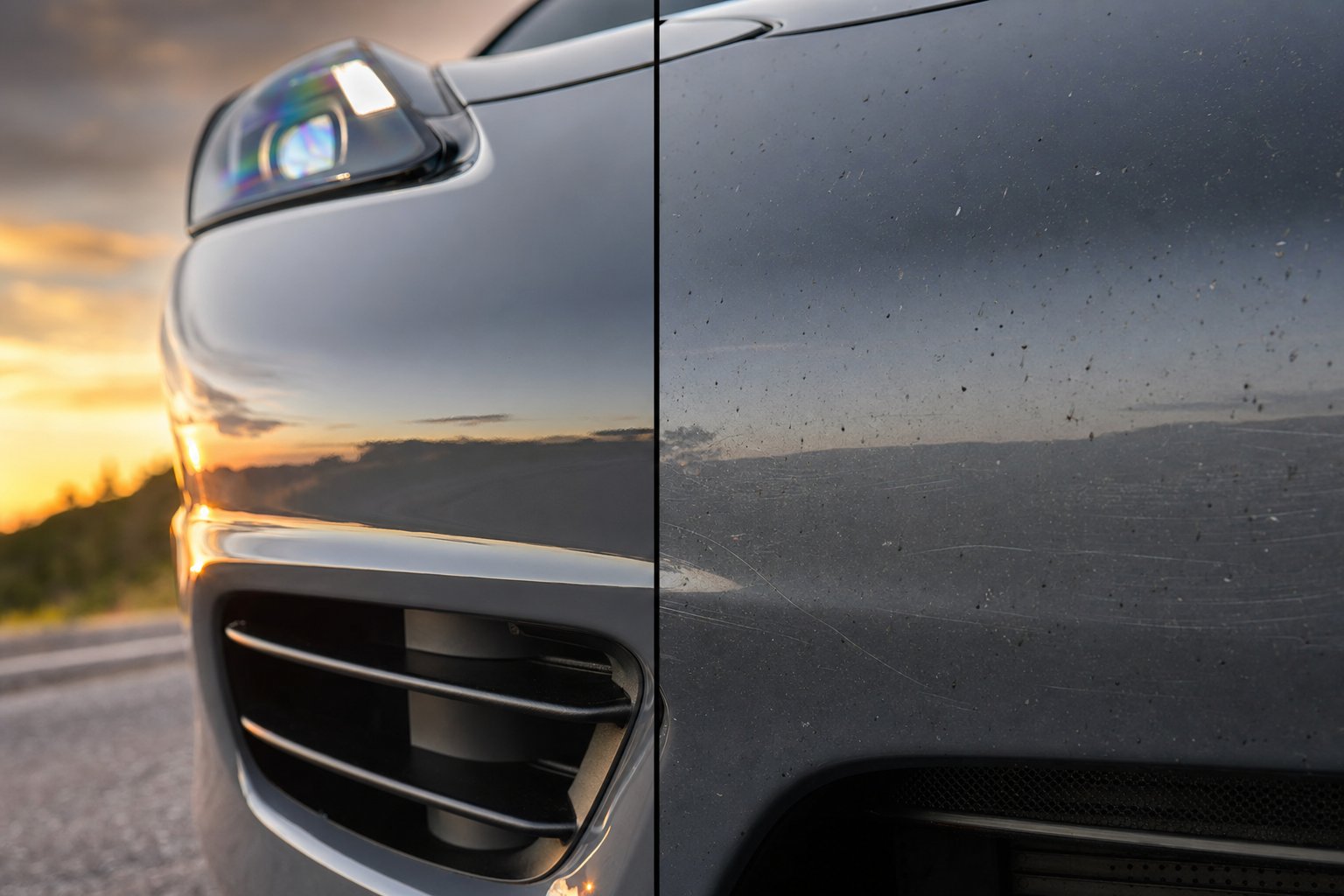
A ceramic coating doesn't stop bugs from hitting your car. What it does is create a slick, hydrophobic surface that gives bug residue almost nothing to bond to. On coated paint, most fresh bugs rinse off with a hose and no chemistry. Dried bugs release with a warm-water pre-soak and a wipe. The acidic fluids that would normally etch clear coat can't penetrate through the coating layer as easily, and you have a much larger time window before real damage sets in.
Undrdog HCC is our flagship hybrid ceramic — an all-surface product engineered for cars, boats, planes, and even bicycle frames — and it's particularly effective on the front-end bug zones because the hydrophobic layer sheets water fast enough to rinse contamination off without towel contact. Coat the hood, bumper, mirrors, and grille if nothing else. See our guide on maintaining a ceramic-coated car for maximum longevity for the wash routine that keeps that hydrophobicity intact through peak bug season.
What ceramic does not do
Ceramic does not make paint scratch-proof and it does not make bugs invisible. It changes the surface energy so contaminants don't bond. You still need to wash. You still need to remove bugs — you just get to do it faster and safer.
Prevention: The Least Time For the Least Damage
Some habits that reduce bug damage before it starts:
- Wash after every long summer drive. Even a quick foam pre-soak and rinse eliminates 90% of the risk. Full detail can wait.
- Carry bug remover in the car for road trips. A $12 spray bottle in the trunk means you're never scrubbing dried bugs the next morning.
- Refresh a ceramic detail spray monthly during summer. Quick Detail restores hydrophobicity between full washes and keeps the front end shedding water.
- Park in shade whenever possible. Cool paint = slower reaction = longer safe removal window.
- Add a partial-front PPF for high-mileage highway drivers. Not because ceramic can't handle bugs — because PPF also stops rock chips that neither ceramic nor bug remover can help with. See our ceramic coating vs PPF guide for the full comparison.
Regional Bug Season Notes
Bug damage risk varies dramatically by geography. If you're driving through:
- The Midwest and Great Plains (June–August). Peak lovebug and cicada season. Worst front-end loads of the year. Wash daily on road trips.
- Florida and the Gulf Coast (May–September). Lovebug swarms twice yearly plus year-round mosquito load. Coated paint and post-drive washing is basically mandatory.
- The Northeast (July–August). Moderate bug load, but high humidity accelerates residue drying and etching.
- The Desert Southwest (spring only). Fewer bugs but higher paint temperatures. Any bugs that hit will etch fast.
- Pacific Coast (mild all summer). Lightest bug load in the country. Standard weekly washing suffices.
- Hawaii and other island climates. Vog, salt air, and tropical rain are the bigger paint threats. See our guide on Hawaii vehicle protection.
Frequently Asked Questions About Bug Splatter Removal
Can bug splatter really damage car paint permanently?
Yes, if left on hot paint in sunlight for long enough. Bug fluids are acidic and etch clear coat as they dry, creating physical pits that only polishing can remove. Fresh bugs on cool paint have no meaningful damage risk if removed within a day or two.
How fast do I need to remove bugs from my car?
In peak summer heat with paint above 120°F, remove bugs within a day or two to avoid etching. In milder conditions, several days is usually fine. Coated paint gives you an extra window in both cases.
What is the safest way to remove dried bug splatter?
Pre-soak with warm water or a dedicated bug remover, wait 3–5 minutes, then wipe gently with a plush microfiber towel using straight-line motions. Never scrub, never scrape, and never use abrasive pads on paint.
Does WD-40 remove bug splatter safely?
WD-40 will remove bugs but also strips wax, sealant, and coating protection, and it can swell trim rubber. It's not a paint-safe solution. Use a dedicated bug remover or diluted all-purpose cleaner instead.
Can I use a bug sponge or bug scrubber?
Some are safe on paint, most are not. Assume anything with texture or scrubbing bristles will scratch clear coat. If bug residue won't come off with a soft microfiber and pre-soak, escalate to more dwell time or a stronger cleaner — not more scrubbing pressure.
Does ceramic coating prevent bug damage?
Ceramic coating dramatically reduces bug adhesion and slows the acidic reaction, but it doesn't prevent bugs from hitting the car. You still need to wash. Bug removal on coated paint is faster and safer, and etching becomes rare rather than common.
Should I wax my car before a road trip?
A fresh layer of wax, sealant, or ceramic detail spray before a long summer drive is one of the best low-effort protection moves. Bug residue struggles to bond to a freshly sealed surface, so cleanup at the end of the trip is dramatically easier.
Is bug splatter worse on darker paint colors?
Bug damage happens identically on any color, but darker paints show yellow bug residue and etching more visibly. Light colors mask surface stains but hide etching too, which means owners often don't notice damage until it's beyond removal.
Can a car wash remove dried bug splatter?
Automatic car washes often don't have enough dwell time or the right chemistry for dried bugs. Some upgraded packages include a bug pre-soak spray, which helps significantly. For heavy bug loads, hand cleaning with a proper bug remover is always more effective and safer for the paint.
What is the fastest bug remover for a bumper covered in bugs?
A dedicated bug remover applied to a rinsed surface, allowed to dwell 3–5 minutes, then wiped with a plush microfiber towel. Repeat once if needed. Total time for a heavy front end is usually under 20 minutes.


Leave a comment
This site is protected by hCaptcha and the hCaptcha Privacy Policy and Terms of Service apply.