

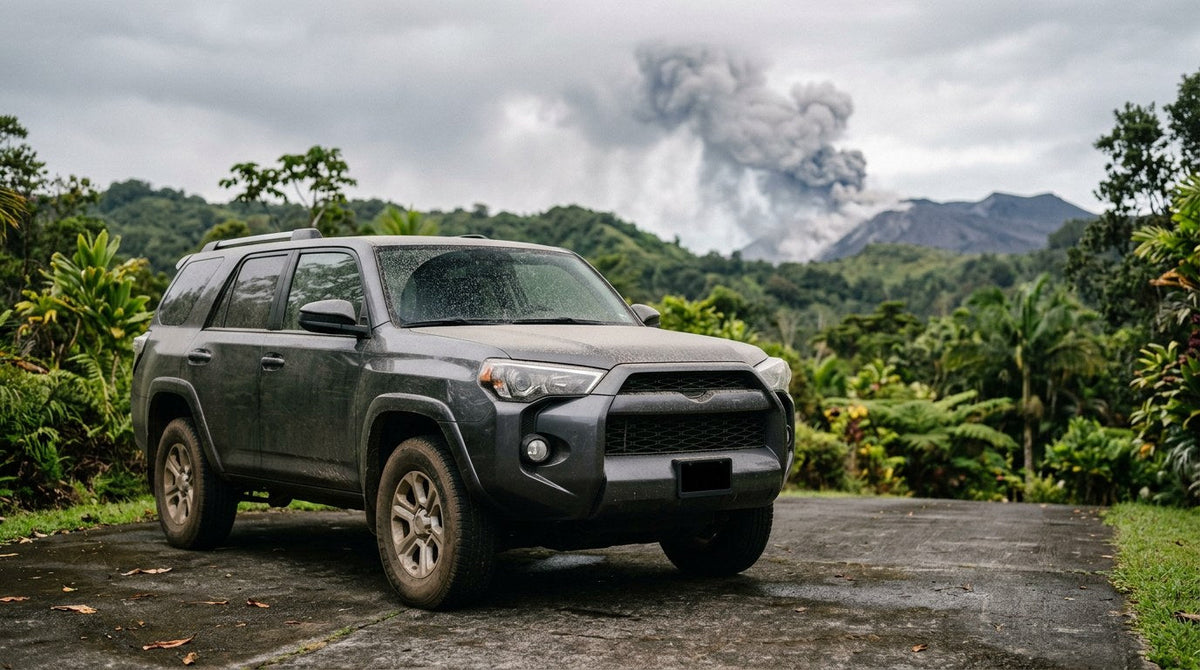
To clean volcanic ash off a car safely, never touch it dry: flood every surface with low-pressure water first so the ash floats off instead of dragging, then wash with a pH-neutral soap using a fresh mitt face for every panel, rinse again, and dry with clean towels — all before the next rain turns the residue into a paste. Volcanic ash is not soft like fireplace ash. It's tiny, jagged particles of rock and volcanic glass that sit around 5 on the Mohs hardness scale, hard enough to scratch clear coat if you wipe it, and it carries acidic coatings that etch paint when they get wet and sit. Here's the full method, what to skip, and how to make the next ashfall a ten-minute rinse instead of a paint-correction job.

Why Volcanic Ash Is Worse for Paint Than Wildfire Ash
If you've read our wildfire ash removal guide, most of the technique carries over. The material does not. Wildfire ash is a combustion residue — soft, alkaline, mostly calcium and potassium compounds. Volcanic ash is pulverized rock.
The USGS is direct about it: volcanic ash "consists of tiny jagged pieces of rock and glass. It is hard, abrasive, mildly corrosive, conducts electricity when wet, and does not dissolve in water" (USGS Volcano Hazards Program). The glass component is "relatively hard (5 on Moh's scale), and the more angular the glass shards the more abrasive the ash" (USGS, Components of Ash). Your clear coat is softer than that. Anything that drags a Mohs-5 shard across it — a towel, a duster, a wiper blade, a brush wash — is a scratch.
Then there's the chemistry riding on the particles. Fresh ash picks up acidic aerosols from volcanic gas (sulfur dioxide, hydrogen chloride, hydrogen fluoride) as it falls; the USGS calls these "ash coatings derived from aerosols." When dew or rain wets that ash on your hood, you get a weak acid solution sitting on paint, and acid etching is a chemical mark that washing won't remove. The International Volcanic Health Hazard Network adds that ash's "sharp, crystalline structure causes it to scratch and abrade surfaces when it is removed by wiping or brushing" (IVHHN).
| Volcanic ash | Wildfire ash | |
|---|---|---|
| What it is | Fragmented rock, minerals, volcanic glass | Combustion residue of wood, brush, structures |
| Hardness | Glass ≈ Mohs 5; angular and abrasive | Soft, but still gritty with embedded debris |
| Chemistry when wet | Acidic (sulfate/chloride/fluoride coatings) | Alkaline (high pH lye-like solution) |
| Dissolves in water? | No — must be physically floated off | Partially |
| Main paint risk | Scratching from any dry contact; acid etching after rain | Alkaline etching and staining after rain |
| Also damages | Windshields (wipers), air filters, brakes, bearings | Cabin filters, glass |
Why This Matters Right Now in Hawaiʻi
Kīlauea has been erupting episodically at its summit since late 2024, and as of the Hawaiian Volcano Observatory's September 11, 2026 update the volcano sits at alert level WATCH with "Episode 55 fountaining" expected imminently; HVO warned that "northerly winds later today could blow volcanic gases as well as fine ash and Pele's hair to the south of Kaluapele" and had already received "a report of trace Pele's hair falling in the Ka'ū district" (USGS Kīlauea Volcano Updates). Earlier episodes this year produced enough tephra that Hawaiʻi County Civil Defense issued precautionary advisories and the National Weather Service issued an Ashfall Warning for East, interior, and South Hawaiʻi Island (Hawaiʻi County Civil Defense).
If you're in Volcano, Pāhala, Nāʻālehu, Ocean View, or anywhere downwind of the summit, this is not a once-a-decade problem. It's a recurring one, which changes the strategy: cleanup technique matters, but so does making your paint easy to clean before the next episode.
What You Need
- A garden hose with a gentle shower nozzle, or a pressure washer with a wide (40°) tip held well back
- Two buckets with grit guards
- A pH-neutral car soap — we use Undrdog Soap because it's coating-safe and rinses clean without leaving film behind
- Several clean microfiber wash mitts or a pile of plush towels (you'll be swapping faces constantly)
- A separate mitt for the lower panels, wheels, and rocker areas
- Plush drying towels or a blower
- Optional but ideal: a foam cannon or pump sprayer for a pre-soak
- Optional: an N95 mask — fine ash is a respiratory irritant, and rinsing stirs it
Step-by-Step: How to Clean Volcanic Ash Off a Car
Step 1: Don't touch it. Don't drive it. Don't wipe the glass.
Every dry contact is a scratch. Resist the reflex to brush ash off the windshield with your hand or run the wipers — the USGS warns that "using wipers on dry ash may scratch the windscreen" (USGS, Vehicles). If you must drive before washing, flood the glass with washer fluid before the wipers move, and go slow. Better: don't drive until it's rinsed.
Step 2: Flood everything with low-pressure water
Start at the roof and work down. The goal is to lift the ash and float it off the paint on a film of water, not to blast it. A pressure washer is fine if you use a wide fan tip and stay two to three feet back — high pressure up close can drive sharp particles across the surface rather than off it. Spend far more time here than feels necessary. Flush the cowl, door jambs, mirror housings, grille, and wheel wells; ash packs into every gap and washes back out onto clean paint later if you miss it. Give the windshield and wiper channel extra attention.

Step 3: Pre-soak with foam if you have it
A foam cannon or pump sprayer lays down a layer of soap that encapsulates the remaining fine particles and gives them a slippery cushion to slide off in. Let it dwell three to five minutes (not in direct sun) and rinse again. On a heavy ashfall this step alone removes most of what the water missed and dramatically reduces how much grit your mitt has to deal with. Our foam cannon vs. pump sprayer comparison covers which tool is worth it for you.
Step 4: Two-bucket contact wash — one pass, one panel, fresh face
Fill one bucket with soap solution and one with clean rinse water, grit guards in both. Load the mitt, wash a single panel in straight lines with almost no pressure, then rinse the mitt thoroughly in the rinse bucket before it goes back in the soap. Flip to a clean face of the mitt every panel, and swap to a fresh mitt entirely after the hood, roof, and trunk are done. Save the lower third of the car, rockers, bumpers, and wheels for a separate mitt at the very end — that's where ash concentrates and where you'd otherwise pick up the most grit.

Ash doesn't dissolve, so soap isn't "breaking it down" the way it does road film — it's lubricating and suspending it. That's why pH-neutral matters here: you want lubricity and rinseability, not aggressive cleaners that strip whatever protection you've got on the paint and leave you more exposed for the next episode. If you're unsure whether your soap qualifies, our Undrdog Soap breakdown explains what to look for.
Step 5: Rinse, then rinse the hidden spots again
Final rinse from the top down, then go back to the cowl vents, the trim gaps around the windshield, the door seals, fuel filler door, and the seams around the tailgate. Open the doors and hose the jambs. Ash that stays in these areas gets pulled out by the next rain and streaks down freshly clean paint carrying acid with it.
Step 6: Dry with clean towels only
If any towel touched ash during the wash, it's not a drying towel anymore. Use a blower if you have one, or plush microfiber laid flat and pulled gently — no circular buffing. Check the towel face frequently. If you feel or see grit, stop and swap.
Step 7: Inspect in the shade, then decide on decon
Run a clean hand inside a plastic sandwich bag over the hood. If it feels gritty after washing, particles are bonded to the surface and need mechanical or chemical decontamination. Our four-step paint decontamination guide walks through iron remover, clay, and when to stop. Don't clay a car that still has loose ash on it — that's a guaranteed marring session.
What Not to Do
- No automatic brush washes. The brushes are loaded with the last hundred cars' grit and your car adds Mohs-5 glass to the mix. Touchless is acceptable if it's the only option; brush tunnels are not.
- No waterless wash on visible ash. Waterless and rinseless products are excellent for light dust; they are not enough lubrication for a layer of abrasive rock. Rinse first, always. (Once the bulk is off, a rinseless wash is fine for the final pass — see our rinseless vs. waterless comparison for where the line is.)
- No dusters, dry towels, or leaf blowers on the paint. Blowing dry ash across paint at speed sandblasts it, and you'll breathe what comes off.
- No harsh degreasers or all-purpose cleaners as your wash soap. They don't help with ash and they strip protection.
- Don't wait for rain to "do the work." Rain wets the acidic coatings, concentrates them as it evaporates, and leaves etch marks. It also doesn't rinse thoroughly — it just relocates ash into seams.
Don't Forget the Parts That Aren't Paint
The USGS notes that "volcanic ash can infiltrate nearly every opening and abrade or scratch most surfaces, especially between moving parts of vehicles," and that "ash particles easily clog air-filtration systems, which can lead to overheating and engine failure" (USGS, Vehicles). After a significant ashfall:
- Engine air filter: Check it. The USGS advises not to drive without one, and not to change it "until you notice a loss of power to the engine, as a dirty filter is more effective than a clean one" — but a filter caked in ash is a different story. Inspect and use judgment.
- Cabin air filter: Replace it if you drove through ashfall. You're breathing whatever it didn't catch.
- Brakes: For sustained heavy ash, the USGS recommends having a shop clean wheel brake assemblies "every 50–100 miles for very severe road conditions, or every 200–500 miles for heavy dust conditions."
- Glass: After the wash, clean the windshield with glass cleaner and a fresh towel, then top up washer fluid — you'll use more of it than usual for weeks.
- Wiper blades: Rinse the rubber edge under running water. Embedded grit in a blade will scratch the glass every time it sweeps.
The Real Fix: Make Ash Cleanup a Rinse, Not a Wash
Everything above is damage control. If you live downwind of Kīlauea, or anywhere ash is a recurring reality, the highest-leverage move is changing what the ash lands on. On bare or oxidized clear coat, ash particles settle into microscopic texture and the acidic coatings have direct access to the paint. On a properly cured ceramic film, the surface is dense, slick, and chemically resistant — ash sits on top instead of keying in, the acid has to get through the coating before it touches paint, and low-pressure water floats far more of it off before you ever pick up a mitt.
That's why our default recommendation for ash-prone vehicles is HCC – Hybrid Ceramic Coating. It's a high-solids coating that cures into a dense, crosslinked film with strong resistance to acids, alkalis, and solvents — exactly the chemistry sulfate- and chloride-coated ash throws at your paint — and it's formulated to accumulate less bonded contamination between washes, which is the whole game with ash. It's the same product on cars, boats, aircraft, and bicycles, so if you've got a truck, a skiff, and a mountain bike all sitting in the same ashfall, one bottle covers them. For the quickest DIY route, Undrdog Pro gets you protected in about an hour with a 7–10 minute flash time.
Between coatings, a quick spray of Quick Detail after each wash keeps the surface slick so the next dusting sheets off even easier. And if a previous episode already left you with etching or water-mineral marks, Water Spot Remover addresses mineral deposits before you polish or coat — see our water spot guide for what it will and won't fix.
One honest caveat: no coating makes dry wiping safe. Mohs-5 glass dragged across any surface leaves marks. What a coating changes is how much rinses off with water alone, how much time the acid has to work, and how easily the mitt glides. Technique still matters; the coating just makes good technique dramatically more effective. For the broader Hawaiʻi picture — UV, salt air, and vog on top of ash — see our Hawaiʻi vehicle protection guide.
Ready to make ash cleanup a ten-minute rinse?
HCC's dense, acid-resistant film keeps volcanic ash on top of the surface instead of in it, so water does most of the work before a mitt ever touches your paint. Cars, boats, planes, bikes — one coating.
Shop HCC →Frequently Asked Questions
Can volcanic ash damage car paint?
Yes, two ways. Mechanically, because it's jagged rock and glass around Mohs 5 that scratches clear coat when wiped or brushed. Chemically, because fresh ash carries acidic sulfate, chloride, and fluoride coatings that etch paint once rain or dew wets them and they sit. Rinsing promptly with water prevents most of both.
How soon do I need to wash volcanic ash off my car?
Before it gets wet, ideally. Dry ash sitting on paint is mostly a scratch risk if touched; the moment rain or heavy dew hits it, it becomes an acid-etching risk. Same day is the goal. If rain is coming and you can't wash, a thorough low-pressure rinse is far better than nothing.
Can I use a pressure washer on volcanic ash?
Yes, with a wide fan tip (40°) held two to three feet from the paint. Keep the pressure moderate and let the volume of water do the lifting. Never use a narrow tip or get close — you can drive abrasive particles across the surface.
Is it safe to take an ash-covered car through an automatic car wash?
A touchless wash is acceptable if it's your only option. A brush or cloth tunnel wash is not — the brushes drag your ash and everyone else's grit across your paint. Rinse as much off as possible first regardless.
Will a ceramic coating protect against volcanic ash?
It helps significantly but it isn't a force field. A cured ceramic film like HCC is chemically resistant to the acids on the ash and slick enough that far more particles rinse off with water alone. It will not make dry wiping safe, and it won't stop scratches from a brush wash. It turns a risky wash into an easy one; it doesn't eliminate the need to wash correctly.
How do I get volcanic ash off my windshield without scratching it?
Flood the glass with water before anything touches it — never run the wipers dry. After the wash, clean the glass with a dedicated glass cleaner and a fresh towel, rinse the wiper blade edges under running water, and top off washer fluid. If wipers were used on dry ash, inspect for fine arc-shaped scratches; light ones can sometimes be polished out with a glass polish.
Should I change my air filter after an ashfall?
Inspect it. The USGS advises against driving without a filter and notes a lightly dirty filter actually filters better than a brand-new one, but a filter caked in ash restricts airflow and can lead to overheating. Replace the cabin filter if you drove through ashfall so you aren't breathing fine particles.
What's the difference between cleaning volcanic ash and wildfire ash off a car?
Technique is nearly identical — rinse first, pH-neutral soap, two buckets, no dry contact. The chemistry is opposite: wildfire ash forms an alkaline solution when wet, volcanic ash forms an acidic one. Volcanic ash is also much harder and doesn't dissolve, so the pre-rinse and foam stages matter even more.
How do I know if ash left etching on my paint?
After a full wash, look at the hood and roof in shade at a low angle. Dull spots, ghost outlines of where ash sat, or a hazy patch that doesn't wash away are etch marks. Light etching typically responds to a fine polish; deeper etching may need compounding. Coat the paint afterward so the next episode doesn't repeat it.

Leave a comment
This site is protected by hCaptcha and the hCaptcha Privacy Policy and Terms of Service apply.