
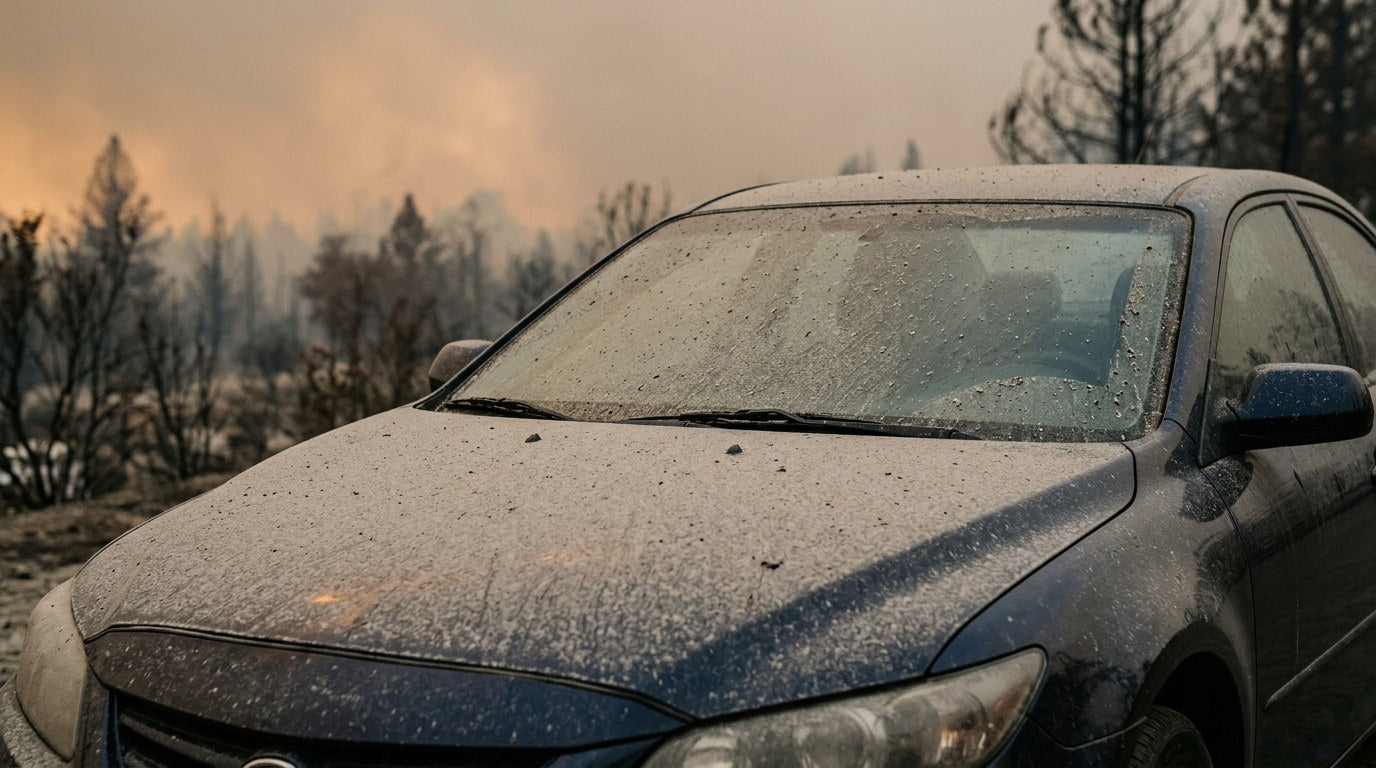
Wildfire ash is alkaline, abrasive, and chemically etches clear coat the moment it gets wet. The correct procedure is to flood the car with a high-volume, low-pressure water rinse from the top down before touching the paint, then wash with a pH-neutral car shampoo using the two-bucket method, decontaminate with an iron remover and clay, and dry completely. Do not dry-wipe ash, do not use a leaf blower on the vehicle, and never let ash sit through morning dew or fog.

Why Wildfire Ash Damages Car Paint
Wildfire ash is not the same as fireplace ash or road dust. It's a mixture of burned organic material (trees, grass) and burned synthetic material (structures, plastics, vehicles). The organic component leaves behind potassium and calcium salts that turn strongly alkaline when they contact water. The synthetic component adds petroleum residues, heavy metals, and microscopic silica particles that behave like fine abrasive.
Once ash gets wet — from rain, morning dew, fog, or an ill-timed rinse — those alkaline salts dissolve into a caustic slurry. Depending on what burned, the pH can climb well into the 12–14 range, which is corrosive enough to etch automotive clear coat. Alkaline etching leaves the same permanent water-spot rings and dull patches you see from bird droppings and hard-water spots, except across every horizontal surface of the vehicle.
The EPA's official Protect Yourself from Ash guidance warns that direct contact with wet ash can cause chemical burns on skin — the same chemistry is happening on your clear coat, only slower.
The Two Rules That Save Your Paint
Rule 1: Never Dry-Wipe Ash
The single most common mistake is grabbing a dry microfiber, a duster, or a shop rag and swiping the ash off your hood. Ash contains microscopic silica and glassy particles that act like fine sandpaper — dragging them across paint creates thousands of parallel micro-scratches that show up as haze under sunlight and require paint correction to remove. Multiple pro detailing sources explicitly warn to avoid wiping the exterior of your car prior to washing at all costs.
The corollary: never use a leaf blower on an ash-covered car. Blowers stir the particles into the air where they re-deposit onto your paint at high velocity, plus they push loose ash into panel gaps, mirror housings, and cowl vents where it becomes very hard to remove.
Rule 2: Never Let Ash Get Wet on Your Car
Dry ash on unpainted metal is a nuisance. Wet ash on painted metal is a chemistry problem. If overnight dew, morning fog, or a light rain lands on an ash-coated vehicle and sits for hours, the alkaline etching begins. That's why the EPA's 2026 Wildfire Smoke guide for public health officials emphasizes wet-cleaning ash promptly but under controlled conditions rather than letting it sit or handling it dry.
If a fire event is active in your area and your car is going to see ash exposure, keep it garaged when possible. If garaging isn't an option, a fitted breathable car cover is the second-best line of defense — it doesn't stop microscopic ash entirely, but it keeps the bulk off your paint and off the horizontal surfaces where wet etching does the most damage.
The Safe Wildfire-Ash Wash Workflow

Step 1: Wait for Safe Conditions
Do not attempt to wash the car while active ashfall is happening — you'll just re-deposit fresh ash on wet paint. Wait until local officials confirm the ashfall has stopped and outdoor air quality has improved enough that spending 30+ minutes outside won't harm you. EPA guidance recommends checking the AQI before doing any outdoor cleanup work.
If you must do interim cleaning during an extended fire event, prioritize horizontal surfaces (roof, hood, trunk) where water pooling would trigger the worst etching. Cover the whole vehicle again after each interim wash if fire conditions continue.
Step 2: PPE and Setup
The CDC's Wildfire Smoke guidance and EPA's Protect Yourself from Ash factsheet both call for well-fitting NIOSH-approved N95 or P100 respirators, gloves, long sleeves, long pants, and eye protection during any ash cleanup. This isn't optional — you're going to be aerosolizing fine particulates as you spray, and standing in that plume with just a dust mask is not enough.
Move the car into shade if possible and let hot panels cool before rinsing. Rinsing a hot panel with cold water can flash the ash slurry into the paint and increase etching risk. Set up two clean buckets, one for a pH-neutral soap solution and one for rinsing your mitt.
Step 3: High-Volume Pre-Rinse (Most Important Step)
Start at the roof and work down. Use a garden hose with a high-volume nozzle or a pressure washer held far enough back to float ash off rather than blast it into the paint. The goal is to dilute the ash and float it off with sheer water volume — not to blast at it. Do not aim high-pressure water directly at panel gaps, badges, or trim, and stay off the actual paint surface with your hands.
Spend more time than feels reasonable on this step. Ten to fifteen minutes of continuous rinsing is not excessive. The more ash you remove with water alone before any physical contact, the fewer abrasive particles get dragged across your clear coat during the wash. Pro detailer guidance from Torque Detail emphasizes flushing wash buckets and refilling with fresh water after every few panels for the same reason.
Step 4: Foam Cannon or Pre-Soak

Apply a thick layer of pH-neutral car soap via foam cannon and let it dwell 3–5 minutes. The foam softens any bonded ash and gives you lubrication for the physical wash step. Because ash is alkaline, you want a neutral shampoo — never an alkaline degreaser or all-purpose cleaner, which fights nothing in the ash chemistry and can accelerate clear-coat damage.
For post-fire washing specifically, Undrdog Soap is a pH-neutral formulation that lubricates well through a foam cannon and won't strip existing ceramic coating or sealant while you work.
Step 5: Two-Bucket Wash With a Plush Mitt
Wash top to bottom in straight lines using a plush microfiber or chenille mitt. Rinse the mitt in your rinse bucket after every panel. Flush both buckets completely and refill with fresh water after every 2–3 panels — post-fire wash water gets contaminated with abrasive ash within a few minutes, and reusing it drags those particles back onto your paint.
Use minimal pressure. The soap and foam are doing the chemical lift; your mitt is just guiding the residue off the surface. Grinding at stubborn patches with pressure is the fastest way to add scratches. If a section isn't coming clean, re-foam it and let it dwell longer rather than pressing harder.
Step 6: Iron and Fallout Decontamination
Wildfire smoke deposits microscopic ferrous particles onto paint that a soap wash won't fully remove. After the primary wash, spray the car panel-by-panel with an iron and fallout remover, let it dwell until the reagent turns purple (indicating iron reaction), then agitate lightly and rinse.
The Purps is our iron remover — the pH-neutral formulation dissolves embedded ferrous particles safely, and the color change tells you exactly where and how much iron is still lifting out of the surface. For a car that's seen serious smoke exposure, expect a heavy purple reaction across horizontal panels.
Step 7: Clay if the Paint Still Feels Rough
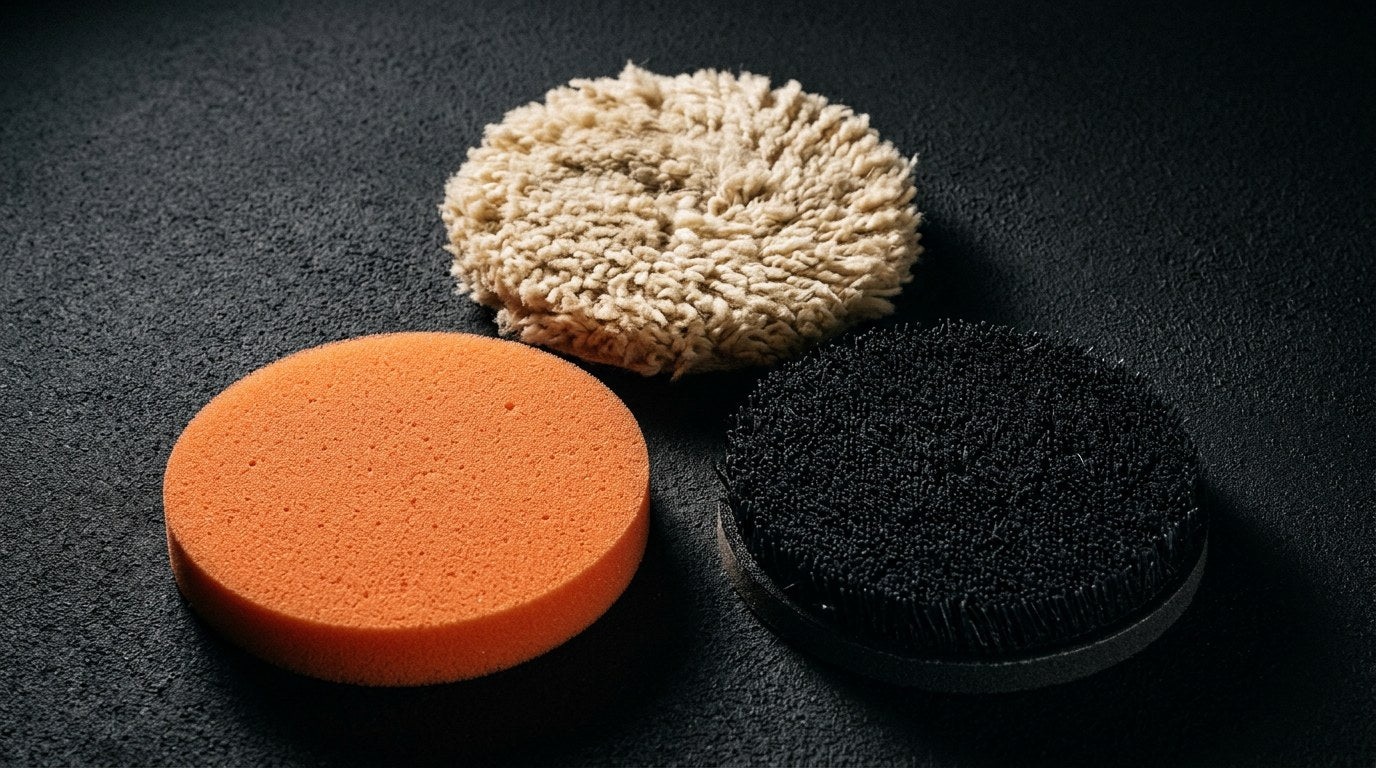
Run your bare hand across the paint (with a plastic bag as a glide layer) after rinse and decon. If it still feels gritty or textured, you've got bonded ash particles that need mechanical removal. Use a mild clay bar or clay mitt with generous lubrication (a rinseless wash solution or dedicated clay lube). Work small sections with light pressure — pressing down grinds contamination into the paint you're trying to protect.
Step 8: Complete Dry — Never Air Dry
Post-fire ash wash requires 100% complete drying. Any water left standing in door jambs, panel gaps, or on painted surfaces still contains dissolved alkaline residue, and evaporation concentrates it into water spots. Use clean plush microfiber drying towels or a forced-air dryer. Blow out mirror housings, door jambs, license plate recesses, and the cowl area under the wipers. If you have to walk away, park in the sun to accelerate any lingering moisture rather than the shade.
What Ash Actually Does to Clear Coat
| Exposure | Damage Mechanism | Recovery Difficulty |
|---|---|---|
| Dry ash under 24 hours | Surface deposit only, no etching yet | Easy — proper wash removes it |
| Dry ash dry-wiped or blown with leaf blower | Physical scratches from silica particles | Moderate — polishing may correct |
| Wet ash 6–24 hours (dew or fog) | Alkaline etching, light water spots | Moderate — chemical spot remover may work |
| Wet ash 2–7 days | Deep alkaline etching, permanent ring marks | Difficult — usually requires paint correction |
| Wet ash multiple wet-dry cycles | Etched craters, clear coat failure | Severe — may require repaint |
| Ash + high heat + wet | Accelerated etching, cloudy discoloration | Severe — clear coat compromised |
After the Wash: Protection and Prevention
A clean, corrected surface is the perfect window to apply protection that will make the next ash event dramatically easier to clean. A properly cured ceramic coating creates a slick, hydrophobic barrier that prevents ash from bonding to paint, gives you longer safe-contact time between exposure and wash, and reduces alkaline etching risk during the wet phase.
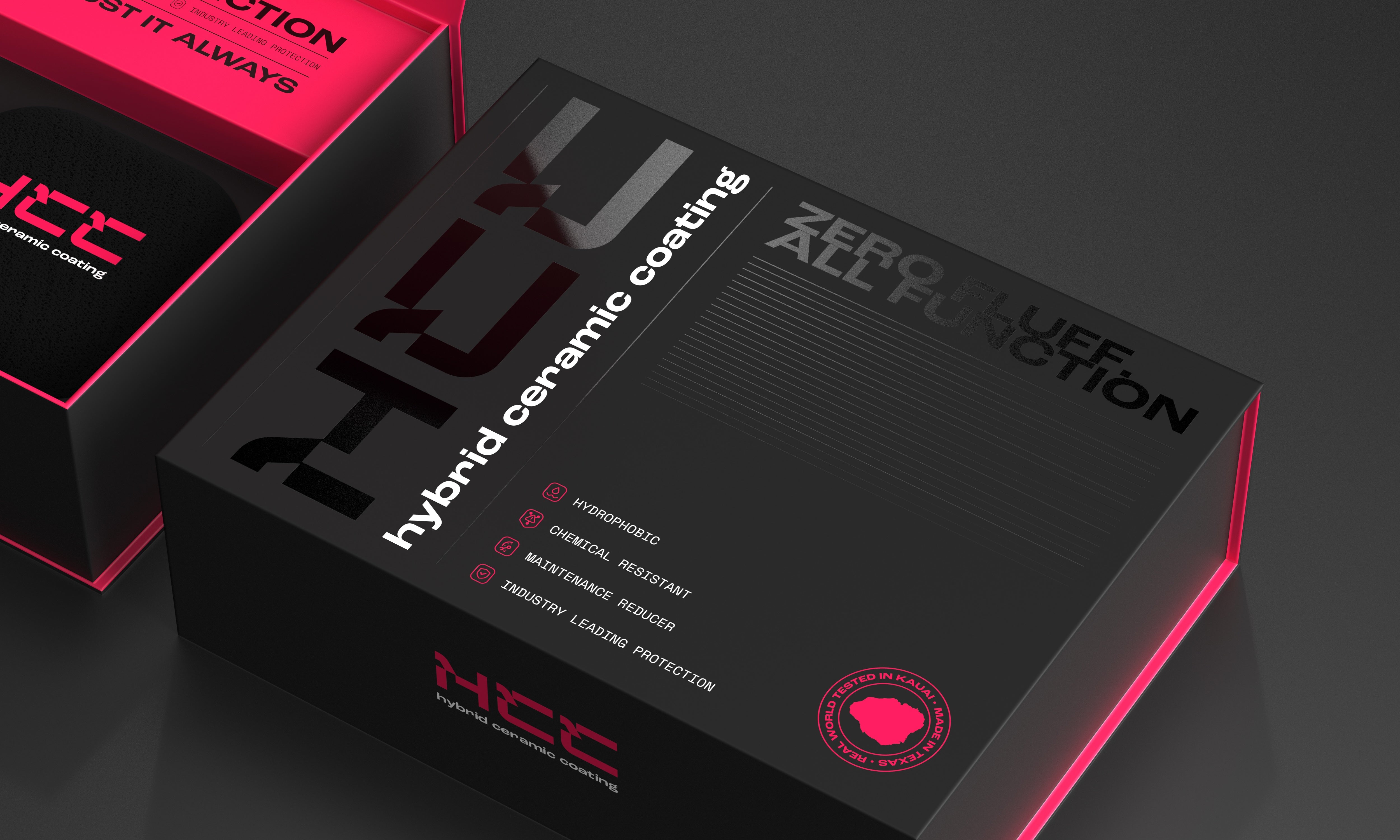
For the fall wildfire season into winter, our flagship HCC Hybrid Ceramic Coating is the DIY choice for full protection across cars, boats, planes, and bicycles. It cures in hours, layers over existing coatings, and produces the slick surface that keeps ash from getting a real grip. For maximum durability under sustained ash and salt exposure, Undrdog Pro Plus steps up the ceramic content.
Between full washes during an active fire event, a quick maintenance rinse plus a slick spray booster can dramatically reduce risk. Undrdog Quick Detail can be applied wet after a rinse to add a fast hydrophobic top layer that helps water and ash slurry sheet off before etching starts. It's not a replacement for a real wash — it's a stopgap while conditions remain hazardous.
What About the Interior?
Even with windows up, fine ash particles infiltrate through the fresh-air intake and cabin filter during driving. The EPA recommends setting the air conditioner to recirculate mode during high-smoke driving to minimize infiltration.
For interior cleanup, use a HEPA-filtered vacuum rather than a standard shop vac (which blows fine particles right back into the cabin). Vacuum carpets, seats, and headliner. Wipe hard surfaces with a slightly damp microfiber — dry wiping stirs fine particles into the air. Replace your cabin air filter if the vehicle spent significant time driving through active smoke; particulate loading shortens filter life dramatically.
Wipe the dashboard, door cards, and console with a mild interior cleaner. Skip aggressive degreasers or high-VOC products that combine badly with lingering smoke residues.
Common Mistakes That Ruin Paint During Ash Cleanup
Using a leaf blower on the car. Redistributes ash back onto paint and pressurizes fine particles into gaps and seams. Never do this — it's called out explicitly in EPA guidance for good reason.
Dish soap or all-purpose cleaner. Both are alkaline. Alkaline soap on alkaline ash accelerates clear-coat damage instead of neutralizing it. Only pH-neutral automotive shampoo.
Automatic touchless car wash during a fire event. Better than nothing, but the "touchless" high-alkaline cleaners used by many automatic bays are worse for ash chemistry than a proper hand wash with neutral soap. If touchless is your only option, follow it up with a proper hand wash within 24 hours.
Wiping the paint dry before rinsing. Just don't. Water first, always.
Skipping the drying step. Air-dried water carries dissolved alkaline residue that concentrates into permanent water spots as it evaporates. Every wash needs a full dry.
Reusing wash mitts across vehicles or across days. Ash particles embed in mitt fibers and grind into the next panel you touch. Wash mitts thoroughly after every session, or use fresh mitts if you're washing multiple ash-covered vehicles.
Make the next ash event dramatically easier.
A properly cured ceramic coating creates a slick hydrophobic surface that keeps ash from bonding to clear coat, gives you more safe-contact time before etching starts, and turns post-fire washes into a quick rinse job. HCC Hybrid Ceramic Coating is our flagship all-surface ceramic — one bottle for cars, boats, planes, and bicycles.
Shop HCC Hybrid Ceramic Coating →Frequently Asked Questions
Can I wash my car during active wildfire ashfall?
Wait until ashfall has stopped and outdoor air quality is safe. Washing during active fall re-deposits fresh ash on wet paint and defeats the purpose. If you must do interim maintenance during a multi-day event, prioritize horizontal surfaces where water pooling causes the worst etching, then re-cover the car until the event ends.
Is a touchless automatic car wash safe for wildfire ash?
Better than dry-wiping, worse than a proper hand wash. Many touchless systems use high-alkaline cleaners that combine poorly with alkaline ash. A touchless wash removes the bulk of loose ash without physical contact, but you should follow it up with a proper hand wash using pH-neutral soap within 24 hours to prevent residual alkaline etching.
How long can wildfire ash sit on my car before it damages the paint?
Dry ash under 24 hours is usually surface-only and washes off cleanly with the right method. Once the ash gets wet — through dew, fog, or rain — etching begins within hours and worsens over days. Multiple wet-dry cycles compound the damage. The safest window is to remove ash within a day of exposure, and always before it gets wet.
What pH should the car soap be for washing off wildfire ash?
Neutral, right around pH 7. Ash is alkaline (often pH 11–14 when wet). Neutral shampoo prevents further chemistry with the ash while lubricating the paint for safe wash contact. Alkaline shampoos, degreasers, or dish soap can accelerate clear-coat damage instead of removing ash cleanly.
Do I need an iron remover after washing off ash?
Yes, if the vehicle saw significant smoke exposure. Wildfire smoke deposits microscopic ferrous particles that a soap wash won't remove. An iron remover like The Purps dissolves those particles chemically without the abrasion of clay, and the color-change reaction shows you exactly where iron is bonded to your paint.
Can I use a pressure washer on ash?
Yes, held back at reasonable distance to float ash off with volume rather than blast it into the paint at close range. Do not aim high-pressure water directly at panel gaps, trim, badges, or headlight seams — that drives ash into places you can't easily clean and can force water past seals. Use a 25-degree or wider tip at 3–4 feet.
What if ash has already etched my clear coat?
Light etching (visible only in direct sun as haze or faint water-spot rings) may respond to a dedicated water spot remover or light polishing pass with a foam pad. Moderate etching usually requires paint correction with a cutting compound. Severe etching where clear coat has failed may require repaint. A paint thickness gauge and a test spot will tell you which category you're in before you start.
Should I wax my car before ash exposure?
A wax or sealant provides some sacrificial protection but breaks down under alkaline attack within a few weeks. A properly cured ceramic coating is dramatically more effective — it doesn't stop ash from landing on your paint, but it creates a slick surface that keeps ash from bonding and gives you more time to wash before etching starts. Coat before fire season, not during.
Do I need to wash the underside of my car after ash exposure?
If the vehicle drove through recently rained-on ash or debris flows, yes. Ash-laden runoff carries alkaline residue and fine particulate onto the undercarriage, suspension components, and brake hardware. A thorough underside rinse with a hose or pressure washer prevents corrosion and keeps the alkaline chemistry away from bare metal surfaces.
Is smoke damage covered by car insurance?
Comprehensive coverage typically covers wildfire smoke and ash damage to vehicles, including paint correction or repaint when clear coat etching is severe. Document the exposure with photos before you clean, get a written assessment from a detailer or body shop if damage is visible, and file promptly. Coverage details vary by policy — check with your carrier before the fire event, not after.
Where This Fits in Your Fall Maintenance Cycle
Wildfire ash is one of several fall paint-hazard categories that follow summer UV and precede winter road salt. If your vehicle is entering the season with existing summer damage, our hurricane season car care guide covers the parallel workflow for storm exposure. Our 4-step paint decontamination guide walks through the wash/iron/clay/protect cycle we referenced above. And for setting up ceramic protection ahead of the next event, our streak-free ceramic application guide covers the DIY procedure end to end.

Leave a comment
This site is protected by hCaptcha and the hCaptcha Privacy Policy and Terms of Service apply.