
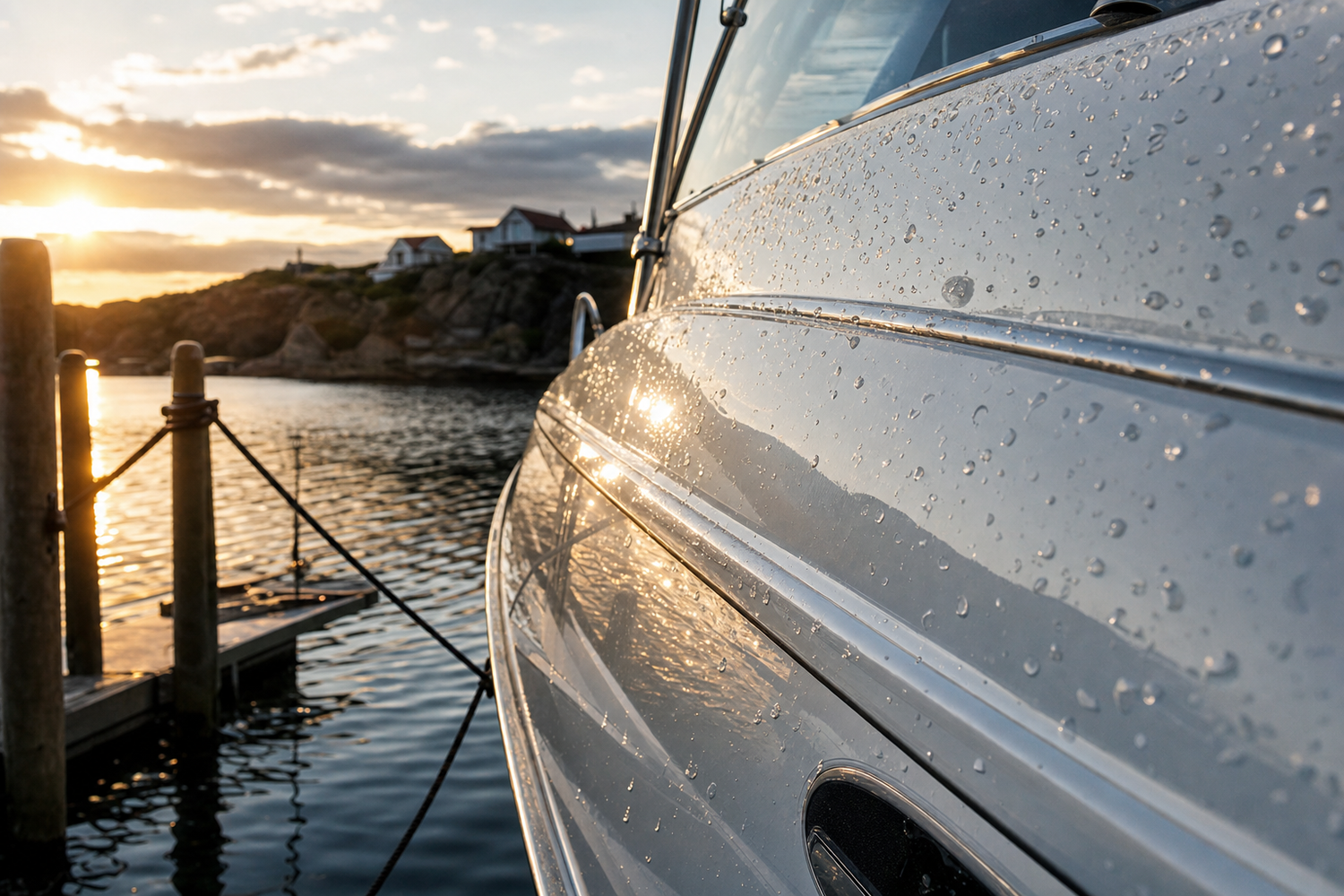
Undrdog Marine and Marine Plus share the same PTFE, silicon, and paraffin base chemistry — the difference is concentration. Marine Plus runs a higher silicon ratio for more durability, gloss, and chemical resistance, but with a shorter working window that's built for experienced installers. Marine is the more forgiving formula for weekend boat owners doing their own maintenance. Here's which one fits your boat and skill level.

Same Chemistry, Different Ratio
Both Undrdog Marine and Marine Plus are built on a base of PTFE (polytetrafluoroethylene), silicon, and paraffin. The difference isn't a different formula — it's the ratio. Marine Plus carries a higher concentration of silicon, which is the component doing most of the work associated with "ceramic" performance in ceramic coatings. That higher silicon ratio is what pushes Marine Plus ahead on durability, chemical resistance, hydrophobicity, gloss, and paint saturation compared to standard Marine. It also means a shorter flash time during application, which is part of why Marine Plus is positioned for experienced installers rather than first-timers. The same regular-versus-plus split shows up on the automotive side too — see Undrdog Pro vs Pro Plus.
Marine vs Marine Plus: Side-by-Side
| Factor | Undrdog Marine | Marine Plus |
|---|---|---|
| Base chemistry | PTFE, silicon, paraffin | PTFE, silicon, paraffin (higher silicon ratio) |
| Best for | Weekend boat owners, DIY maintenance | Seasoned installers, detail shops |
| Flash/working time | More forgiving | Shorter — needs experience to avoid high spots |
| Durability | Solid, real protection | Up to ~3 years with proper maintenance |
| Typical use case | Owner-applied touch-ups and full jobs | Hull and topsides on professionally coated boats |
Who Each One Is Actually For
Undrdog Marine is the better fit if you're a weekend boat owner or enthusiast doing your own maintenance without professional-level experience applying coatings. It's more forgiving during application and still delivers real gloss and UV resistance without demanding the tight working window Marine Plus requires.
Marine Plus is explicitly built for seasoned coating installers and detail shops. The shorter flash time means less room for error — if you're not experienced with cross-hatch application and buffing within a tight window, you're more likely to end up with high spots or uneven coverage. It's also the product to reach for if you're coating a boat professionally for a client and durability (up to roughly 3 years with proper maintenance) is the priority over ease of application.

Why Some Owners Actually Use Both
It's not unusual for a boat to get Marine Plus on the hull and topsides — where maximum durability and gloss matter most and a professional installer is handling the job — while standard Marine gets used for touch-ups, secondary surfaces, or areas where an owner wants to do their own maintenance between professional coating cycles. Since both share the same base chemistry, there's no compatibility conflict between using Marine Plus for the main coating job and Marine for accessible upkeep in between full recoats.
What They Both Cover
Both products protect vinyl, plastics, metal, and glass — useful given how many different materials show up on a single boat between the hull, hardware, windows, and trim. Neither is advised for fabric. On deck surfaces, standard grated non-skid decking won't become slippery when coated, but roll-on sand non-skid will, so that's worth checking before treating deck areas specifically. Both can also go over vinyl wraps without issue. If your gelcoat is already chalky before you even get to the coating decision, our guide on why boat gelcoat turns chalky and how to restore the shine covers the restoration step that should happen first.

Application Basics That Apply to Both
Surface prep is identical either way: wipe down with denatured alcohol or a wax and grease remover using fresh microfiber towels before applying either product. Apply in a cross-hatch pattern, one panel at a time, then buff residue away with clean microfibers — the three-towel method is worth using for consistent results. After installation, keep the vessel dry for at least 24 hours, and hold off on washing with strong detergents for about 5 days. If rain hits within the first 24 hours, dry the surface with soft microfibers as soon as it stops to avoid water spots.
Frequently Asked Questions
Can a beginner apply Marine Plus if they're careful?
It's possible but not recommended as a first coating project — the shorter flash time leaves less margin for error than standard Marine, and a rushed or uneven application on a boat this size is a lot of wasted product and time to redo.
Do I need to strip old coating before switching from Marine to Marine Plus?
Proper decontamination and surface prep before any coating application matters regardless of which product you're upgrading to — work with your installer or your own prep routine to ensure the surface is clean before applying either product.
Which one lasts longer?
Marine Plus is built for greater durability, with proper maintenance supporting performance for up to roughly 3 years. Standard Marine is a solid option too, just formulated for a different balance of ease-of-use versus maximum longevity.
Can I use these on an aluminum boat?
Both are formulated for compatibility with metal surfaces commonly found on boats, but always spot-test on unfamiliar aluminum finishes first, since anodized and painted aluminum can react differently.
Will either product make the non-skid deck slippery?
Standard grated non-skid decking won't become slippery when coated, but roll-on sand non-skid will — check your specific deck material before coating that area.
How soon can I take the boat out after coating?
Keep it dry for at least 24 hours and avoid strong detergents for about 5 days while the coating cures. Light use is generally fine once the initial dry period has passed.
Is HCC a better option than either Marine product?
Not necessarily better — HCC is the all-surface flagship for owners who want one coating across a car, boat, and other surfaces, while Marine and Marine Plus are purpose-built marine formulas. Choose based on whether you need cross-surface versatility or a dedicated marine product.
Neither product is strictly "better" in isolation — it depends on your experience level and what you're trying to protect. If you're weighing Undrdog Marine against Marine Plus, start with how comfortable you are applying a coating yourself, then work backward from there.


Leave a comment
This site is protected by hCaptcha and the hCaptcha Privacy Policy and Terms of Service apply.