

To wash a painted boat hull safely, identify the exact paint system, follow its current care instructions, and use the specified cleaner with clean, non-abrasive wash materials. Rinse thoroughly with fresh water and inspect the dry finish before attempting stain removal, polishing, or another protective treatment.
This guide covers routine cleaning of painted topsides above the waterline. It is not a procedure for underwater hull cleaning, antifouling paint, oxidized gelcoat restoration, or repainting. The useful question is not simply “Is this a boat wash?” It is “Does this process fit the finish actually on my boat?”
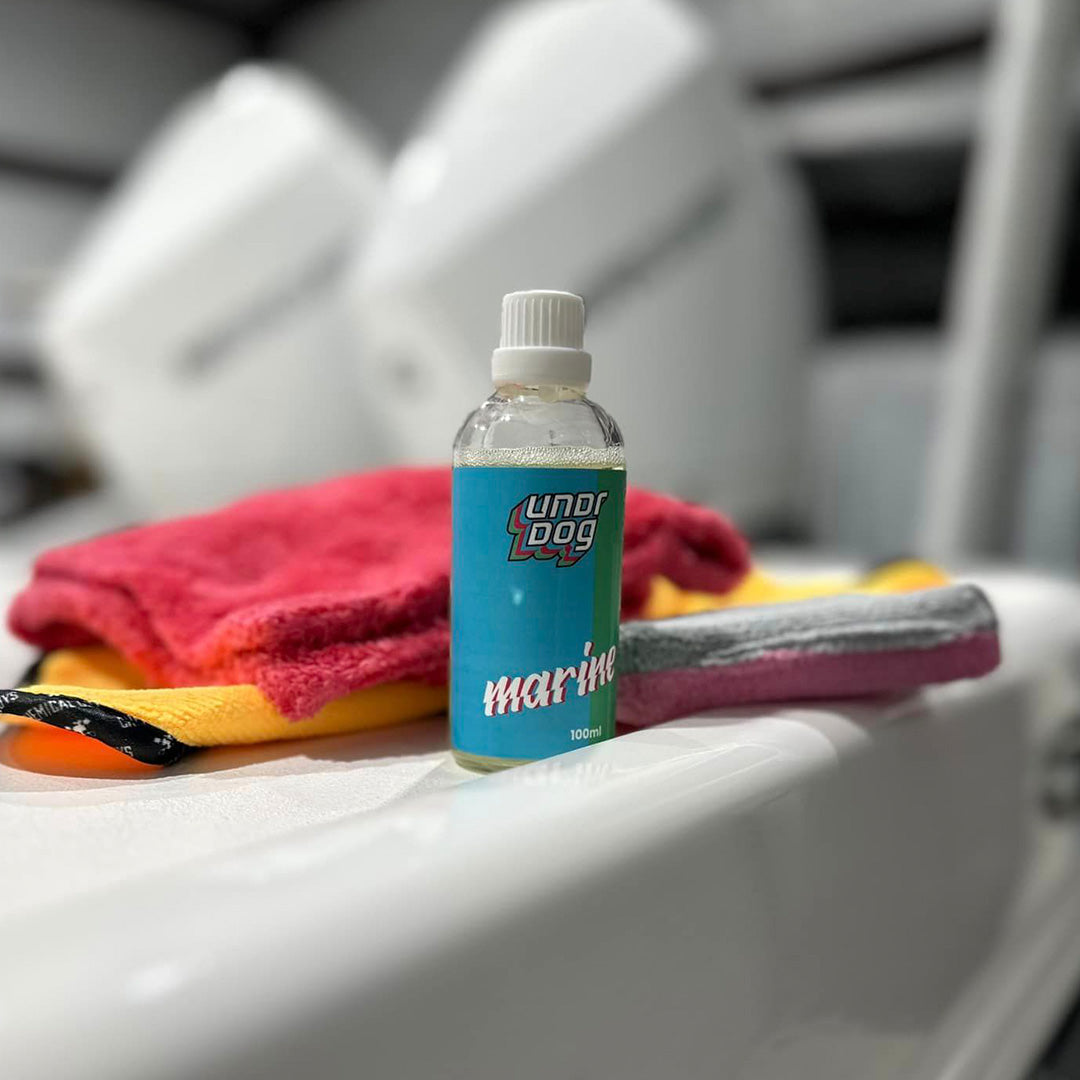
The hero photograph is owned Undrdog marine-care imagery. It does not identify the boat's paint system or demonstrate approval of a product for that finish.
Identify the boat paint before choosing a cleaner
Start with the boat's records, not its color or gloss. Ask for the coating manufacturer's name, exact product line, application date, and any repair history. A yard invoice or paint specification is more useful than a previous owner's recollection that the boat has “a two-part finish.” Record any separate instructions for stripes, graphics, clear finishes, and recently repaired areas.
That detail changes the maintenance decision. Awlgrip's paint-care instructions distinguish its traditional G/H Line topcoat from Awlcraft 2000 and Awlgrip HDT; specifically, they prohibit polishing compounds on G/H Line topcoat. A glossy boat is therefore not automatically a candidate for a gelcoat compound or automotive finishing-polish routine.
If the finish is unknown, make identification the first job. Photograph the boat, collect whatever paperwork exists, and ask the painter, yard, or manufacturer for a maintenance recommendation. Do not scratch, sand, solvent-wipe, or aggressively polish an inconspicuous spot merely to find out what the finish is. An unidentified surface does not become a suitable test panel because the damage would be hard to see.
For a recently painted boat, ask the applicator when washing and additional treatments are allowed. Do not substitute an internet coating-cure timeline for the paint system's own instructions. “Dry enough to touch” and “ready for this maintenance process” are different questions, and the person responsible for the paint application should answer the latter.
What painted-hull care does differently from gelcoat care
Use the table below to choose the next action, not to diagnose the finish from appearance. When a boat has several exterior materials, divide the work by surface rather than using one chemical and one brush everywhere.
| Surface or condition | Start here | Do not assume |
|---|---|---|
| Identified painted topsides | Exact paint maker's routine wash directions | A gelcoat compound or wax is suitable |
| Traditional Awlgrip G/H Line topcoat | Its named wash and non-abrasive care process | Machine polishing is ordinary maintenance; the maker prohibits polishing compounds |
| Awlcraft 2000 or Awlgrip HDT | Instructions specifically covering that finish | Every solvent or process listed for traditional Awlgrip also applies |
| Unknown finish or local repaint | Identification and applicator advice | The surrounding hull's instructions cover the repaired patch |
| Antifouling bottom paint or submerged growth | Separate boatyard and coating-specific service plan | This topside wash guide covers the job |
The named paint distinctions above come from Awlgrip's maintenance guidance, not a comparative test performed by Undrdog. They illustrate why the product line matters; they do not establish a maintenance recipe for every other marine paint.
Also separate cleaning from correction. The objective of a wash is to remove ordinary surface soil using a permitted process. It is not to remove finish until every scratch, patch of haze, or persistent stain disappears. Agree on that boundary before starting, especially when a customer expects a wash to restore a weathered hull.
Set up a controlled painted-boat wash
Choose a position where you can reach the intended section without leaning over an edge or improvising a platform. If the hull cannot be accessed safely from the available dock or work area, arrange suitable yard access or professional service. Do not let a long-handled tool turn an unreachable area into an uncontrolled scrubbing job.
Before opening products, confirm the facility's rules for washing, runoff, and waste disposal. Keep the job within those rules and the product labels. A cleaner's suitability for paint is not permission to release it into the water, and a product marketed for marine use is not an exemption from disposal requirements.
Lay out the approved cleaner, its measuring equipment, fresh rinse water, clean wash materials, and separate drying cloths. Keep anything used for metal polish, teak treatment, greasy machinery, or bottom work away from the topside wash kit. Inspect cloths and mitts before use; a clean-looking bucket is not a reason to skip checking the materials that will touch the paint.
For the finishes covered by its guide, Awlgrip specifies Awlwash 73234 and water with soft, non-abrasive cloths, sponges, or washing mitts, followed by thorough fresh-water rinsing (manufacturer instructions). Use the current directions for the actual wash product and finish rather than inventing a universal dilution or replacing a named product solely because another bottle says “pH neutral.”

Wash, rinse, and inspect one manageable section at a time
Remove loose contamination without dry scrubbing
Where the paint and boat instructions permit, begin with a gentle fresh-water rinse to move loose contamination before contact washing. Keep water directed at the intended exterior surface, not into openings, fittings, or equipment. This is not a pressure-washer specification: do not improvise nozzle settings or distances for an unidentified finish or damaged edge.
Choose a small enough working area that you can control the wash and rinse without rushing. If heat, wind, awkward access, or an interruption makes that difficult, change the setup or pause. There is no benefit in covering an entire hull with cleaner if you cannot manage what happens before it dries.
Use the permitted wash process, not extra force
Apply the approved wash according to its directions using clean, non-abrasive materials. Keep the process deliberate and the contact light. If grit appears in a mitt or cloth, stop and replace or properly clean it before continuing. Do not use a stubborn mark as a reason to bear down on the same small patch.
Awlgrip specifically warns against abrasives and scratch pads on the finishes covered by its care page (Awlgrip cleaning restrictions). A household scrubbing sponge, aggressive pad, or compound does not become an appropriate wash tool because the remaining mark is frustrating.
Rinse completely, then judge the result
Rinse each cleaned section thoroughly with fresh water. Awlgrip explains that detergent residue attracts dirt and that solvent residue can attack the topcoat, which is why its instructions emphasize complete rinsing after cleaning (paint-care guidance). Do not treat an absence of visible foam as proof that every runoff path has been checked.
Dry using the finish's approved method and clean materials, then inspect under useful light. Record marks that remain rather than immediately reaching for another bottle. Note the location, appearance, and whether it changed during the wash. A brief record makes the next discussion with the owner, painter, or detailer much more specific.
Handle stains and nearby materials as separate jobs
For persistent soot, salt staining, metal runoff, or other deposits, return to the paint maker's instructions. Awlgrip lists particular treatments and distinguishes solvent allowances between its topcoat lines; it also requires testing an inconspicuous area when solvents are used (manufacturer stain-removal directions). That is not permission to transfer a solvent list to unknown paint or mix a stronger cleaning recipe.
For an owner doing routine washing, the practical stopping point is simple: if removal would require an unfamiliar chemical, abrasive, or repair process, document the mark and get finish-specific advice. Follow the relevant safety data and label precautions for any subsequently approved treatment. Do not infer suitable protective equipment from how mild a product smells.
Pay attention to work happening above the paint. Awlgrip warns against contact with teak cleaners and explains that metal-polish residue can travel onto the finish with rain or dew and cause staining or dulling (adjacent-material cautions). Coordinate the order of work so a finished hull is not immediately exposed to another task's residue.
For a separate hardware-cleaning job, our boat stainless-steel and rust-stain guide explains identification and escalation boundaries. Keep the fitting's treatment separate from the painted surface around it, and do not assume that a product appropriate for stainless steel is appropriate for the hull beneath it.
If the finish is lifting, blistering, peeling, or unexpectedly transferring color during the approved wash, stop. Photograph the condition and contact the paint applicator or a qualified yard. Additional rubbing or a protective coating is not a substitute for assessing an unstable finish.
Protect the clean finish from trapped moisture and chafe
The wash is not finished if wet gear is immediately returned against the paint. Awlgrip cautions that wet cushions, lines, covers, and similar equipment can trap moisture and lead to blistering or delamination; it also warns against tightly bound plastic and covers that chafe its finishes (post-cleaning care restrictions). Inspect the contact arrangement, not just the visible shine.
Check where fenders, lines, covers, and stored gear meet the topsides. Do not move safety-critical equipment casually; coordinate necessary adjustments with the person responsible for the boat. The aim is to identify damp or abrasive contact and arrange an appropriate solution, not to leave the vessel unprotected while improving a cosmetic detail.
If the boat is going into storage, use our exterior storage handoff checklist for organizing the inspection and responsibilities. The exact paint system's restrictions still govern cover contact and wrapping; a general storage checklist does not override them.
Leave the owner or next detailer a short maintenance note: finish identification, wash product and dilution used, areas inspected, unresolved marks, and any follow-up assigned to the yard. This makes regular care repeatable without suggesting that every boat needs the same fixed wash interval or protection package.
How Undrdog does it: match the product to the finish
Undrdog Soap is a pH-neutral car-and-boat wash offered for coating maintenance. Its public safety instructions require complete residue removal and warn against allowing a washed surface to dry in direct sunlight. Those directions matter more than assuming “sun-friendly” means you can leave a soaped hull unattended.
For this painted-hull task, use Soap only where the exact finish's care requirements permit it. Awlgrip's cited instructions name its own wash product; this article does not establish an approval to substitute Undrdog Soap for that recommendation. Where compatibility has not been established, follow the paint maker's prescribed system rather than forcing a brand preference into the wash.

When a separate protective-coating project is justified on a confirmed compatible surface, HCC Hybrid Ceramic Coating is Undrdog's all-surface flagship for cars, boats, planes, and bicycles. Its multi-year positioning depends on preparation, exposure, use, and maintenance. That broad positioning does not override a paint manufacturer's restrictions or establish compatibility with every topside system.
Before proposing HCC on a painted hull, resolve the paint maker's requirements, application history, existing treatments, and suitability of the complete preparation process. Awlgrip's care page explicitly restricts certain added coatings and refers to warranty consequences, so do not infer permission from the absence of a named product (Awlgrip finish restrictions). This guide does not assert HCC approval for Awlgrip finishes.
For an approved project, read HCC's current application and safety instructions before scheduling work. Its public safety section includes flammability, skin and eye hazards, and aquatic-environment warnings; keep chemical handling and containment separate from an ordinary wash. A clean, sound hull maintained under its paint maker's instructions is already a worthwhile result. Adding a coating is a separate decision, not a mandatory last step.
Frequently asked questions
Can I wash a painted boat the same way as gelcoat?
Do not transfer the entire process automatically. Identify the paint and use its current care directions, especially for cleaners, compounds, solvents, and protective treatments. Gelcoat restoration advice is not a default maintenance procedure for painted topsides.
How do I know which paint is on my hull?
Check the paint specification, yard invoices, repair records, and applicator's documentation. Ask for the exact product line rather than relying on color or gloss. If identification remains uncertain, get guidance before using chemical or abrasive methods to investigate.
Can I compound traditional Awlgrip topcoat?
Awlgrip's maintenance instructions prohibit polishing compounds on its G/H Line topcoat. Do not substitute a gelcoat or automotive polishing recipe. Consult the paint manufacturer or qualified applicator about a finish that remains dull after its approved cleaning process.
Is a pH-neutral wash automatically safe for marine paint?
No. A pH description alone does not establish approval for the exact paint system, its condition, or adjacent materials. Use the cleaner specified or permitted by the paint maker and follow the actual product's dilution, rinsing, and safety instructions.
What should I do when stains remain after washing?
Record the location and appearance, then consult the paint system's stain-removal guidance. Do not immediately increase pressure or switch to a solvent or abrasive. Unidentified marks, damaged paint, or an unfamiliar treatment are reasons to seek finish-specific help.
Can metal polish affect the paint below a fitting?
Yes, that is a concern specifically addressed in Awlgrip's care instructions: residue from metal polishing can run onto the painted surface and cause damage. Keep hardware treatment separate, protect nearby finishes, and follow the relevant residue-removal directions.
Should I ceramic-coat the hull after every wash?
No. Routine washing does not automatically call for another coating. First confirm the finish is sound, identify existing treatments, and resolve paint-maker approval and preparation requirements. HCC's broad surface positioning is not permission to override a particular marine paint's restrictions.
Does this guide cover antifouling paint below the waterline?
No. This guide is limited to routine care of painted topsides above the waterline. Underwater growth, bottom paint, hull scraping, and antifouling service require a separate coating-specific and facility-appropriate plan.
Plan protection around the actual finish
Review HCC for a separately approved coating project, and confirm paint compatibility and preparation requirements before buying or applying it.
Explore HCC Hybrid Ceramic Coating

Leave a comment
This site is protected by hCaptcha and the hCaptcha Privacy Policy and Terms of Service apply.